
Aperture of Time: A participatory performance
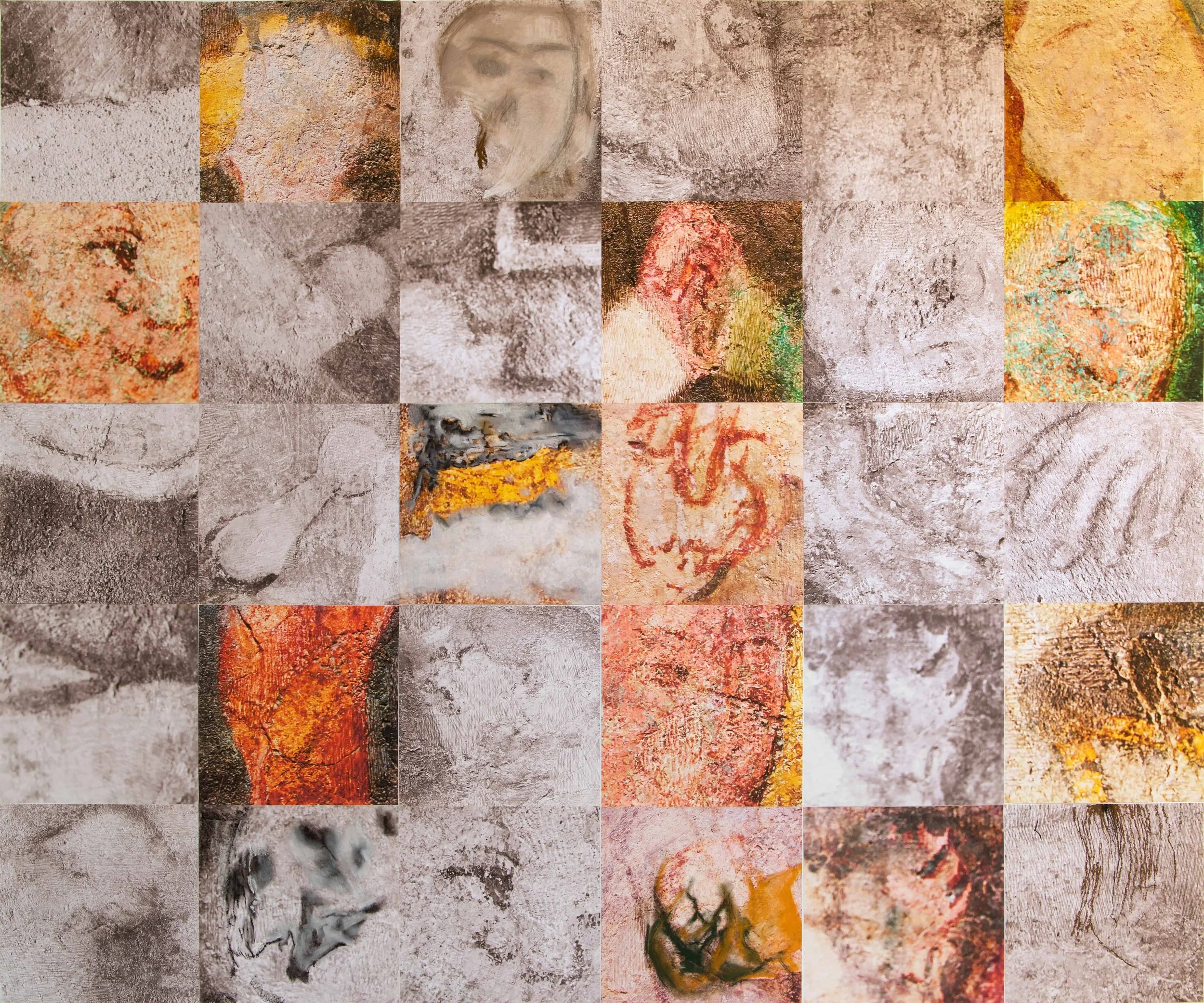
Working Title
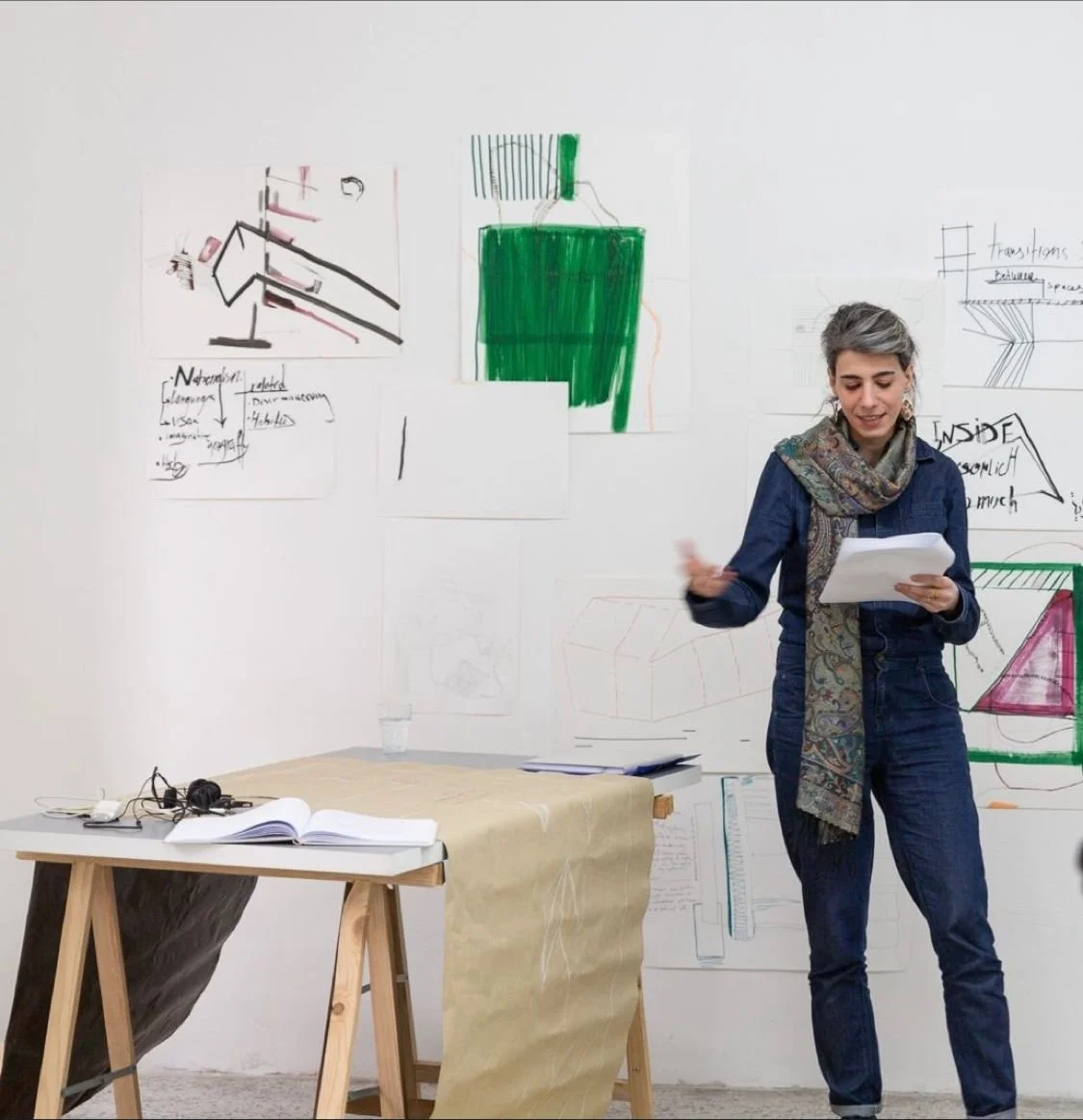
Questions of Cosmopolitanism and Boundaries of Space in the Academy of Fine Arts Vienna
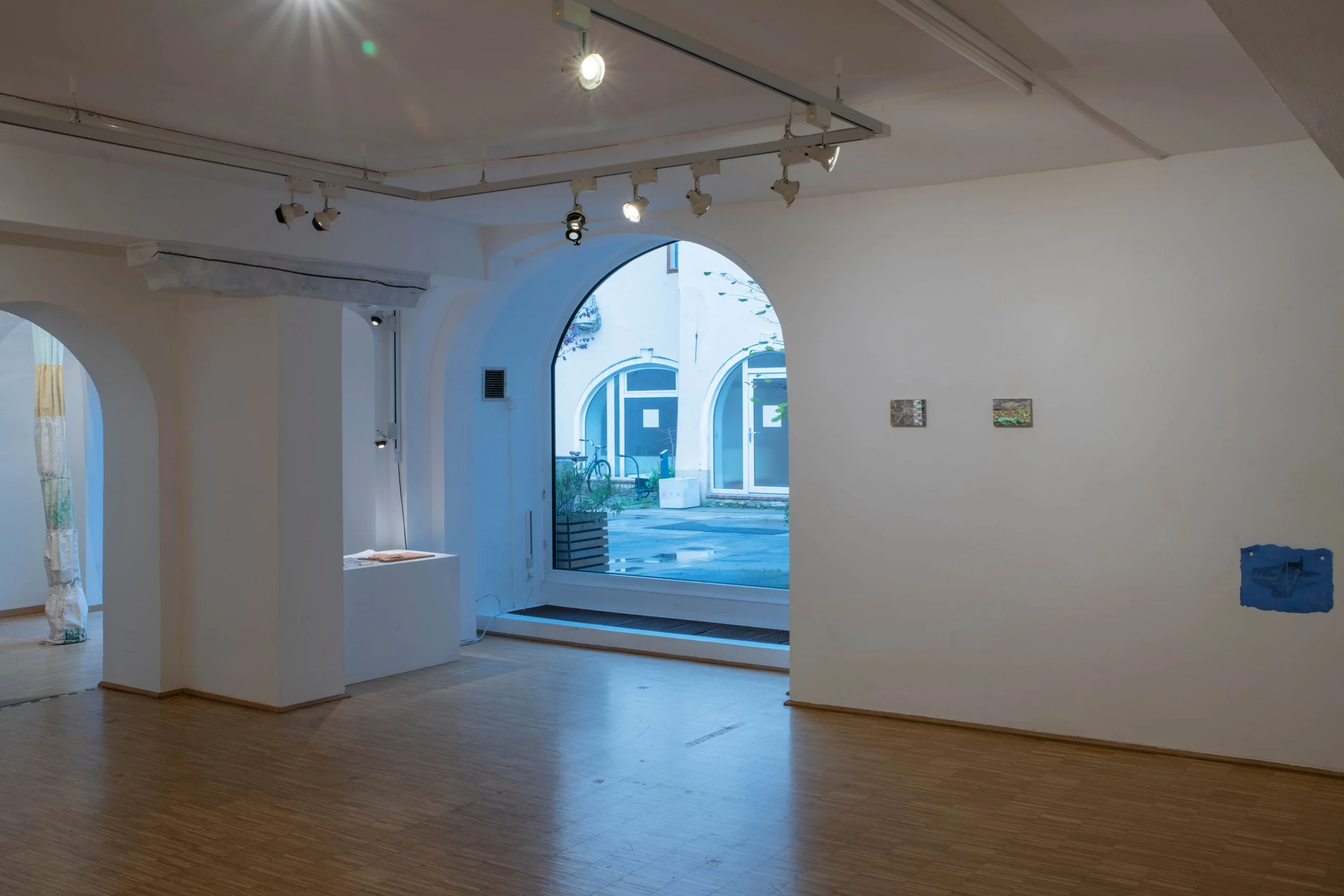
On Belief: Cultural Heritage
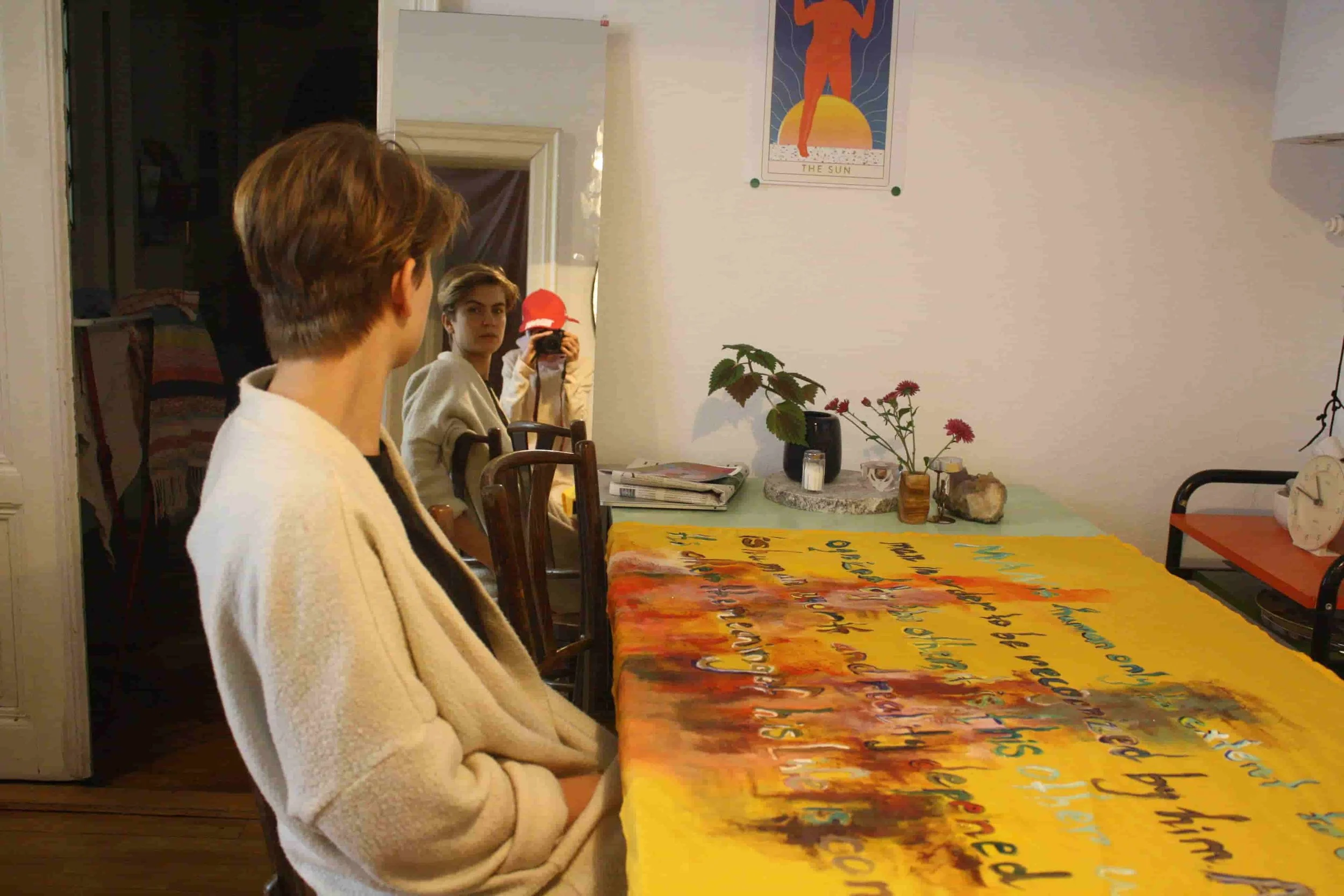
In Conversation, 2017

Ferdinand II., Verfremdung I., Verfremdung II.

Vorarlberg Residency Sketchbook
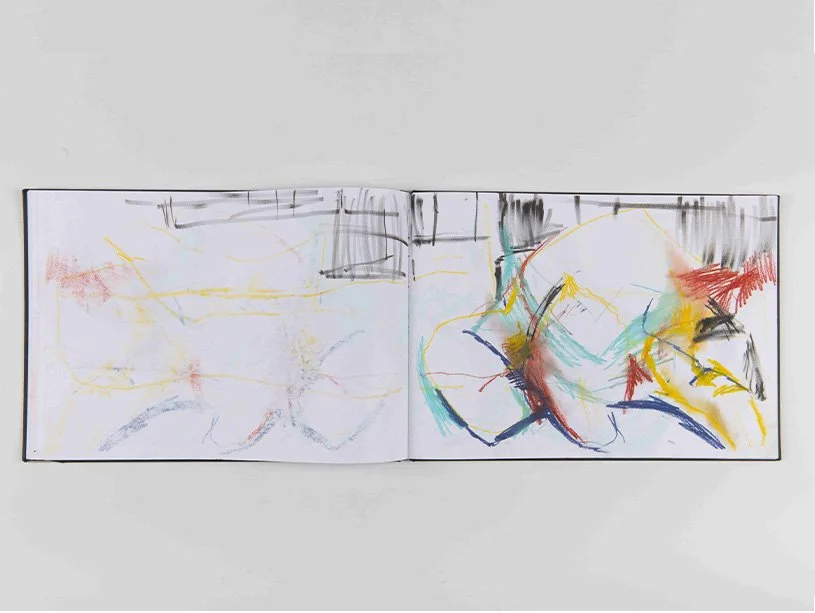
bodily experience in public and semi public spaces sketchbook
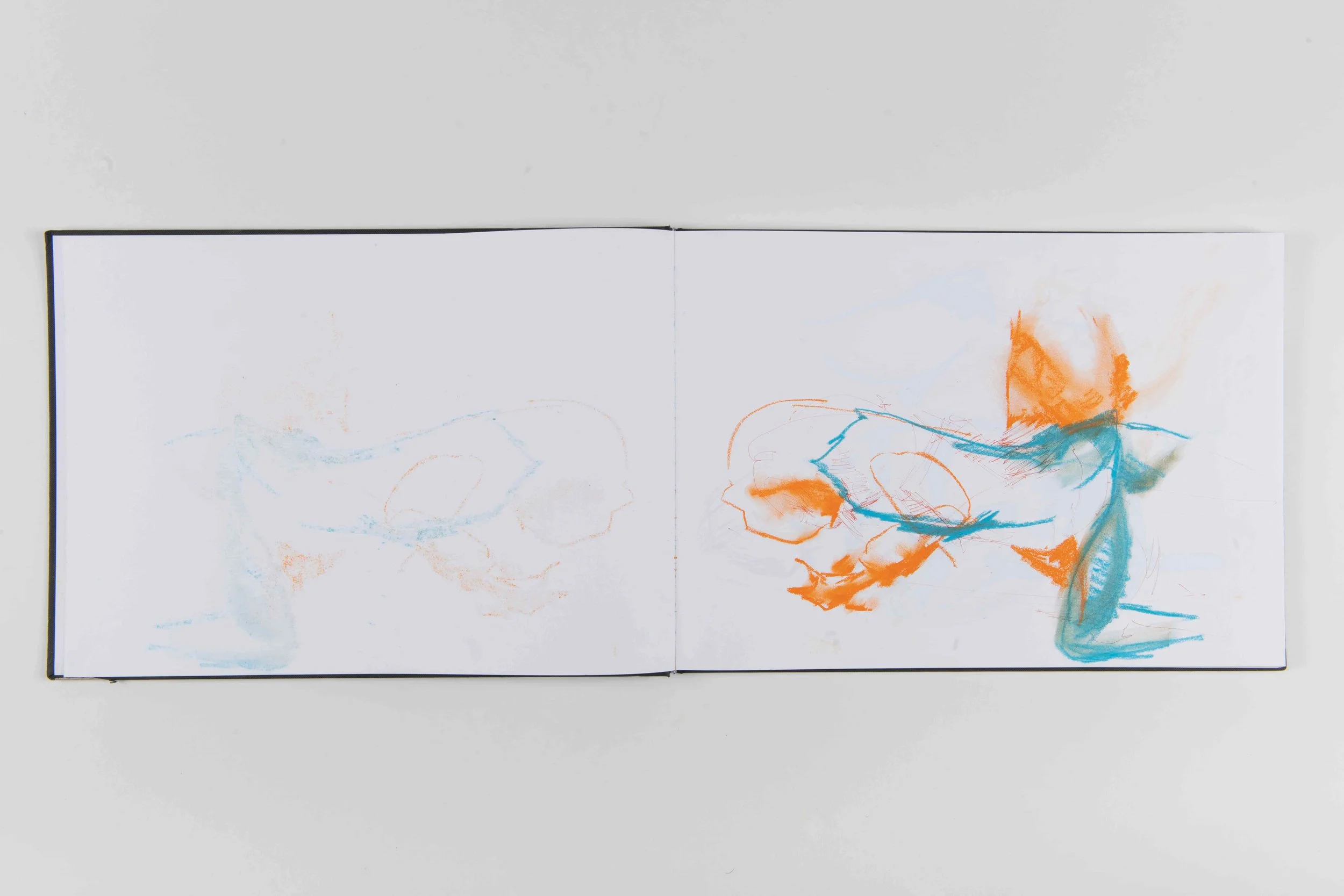
On Perception
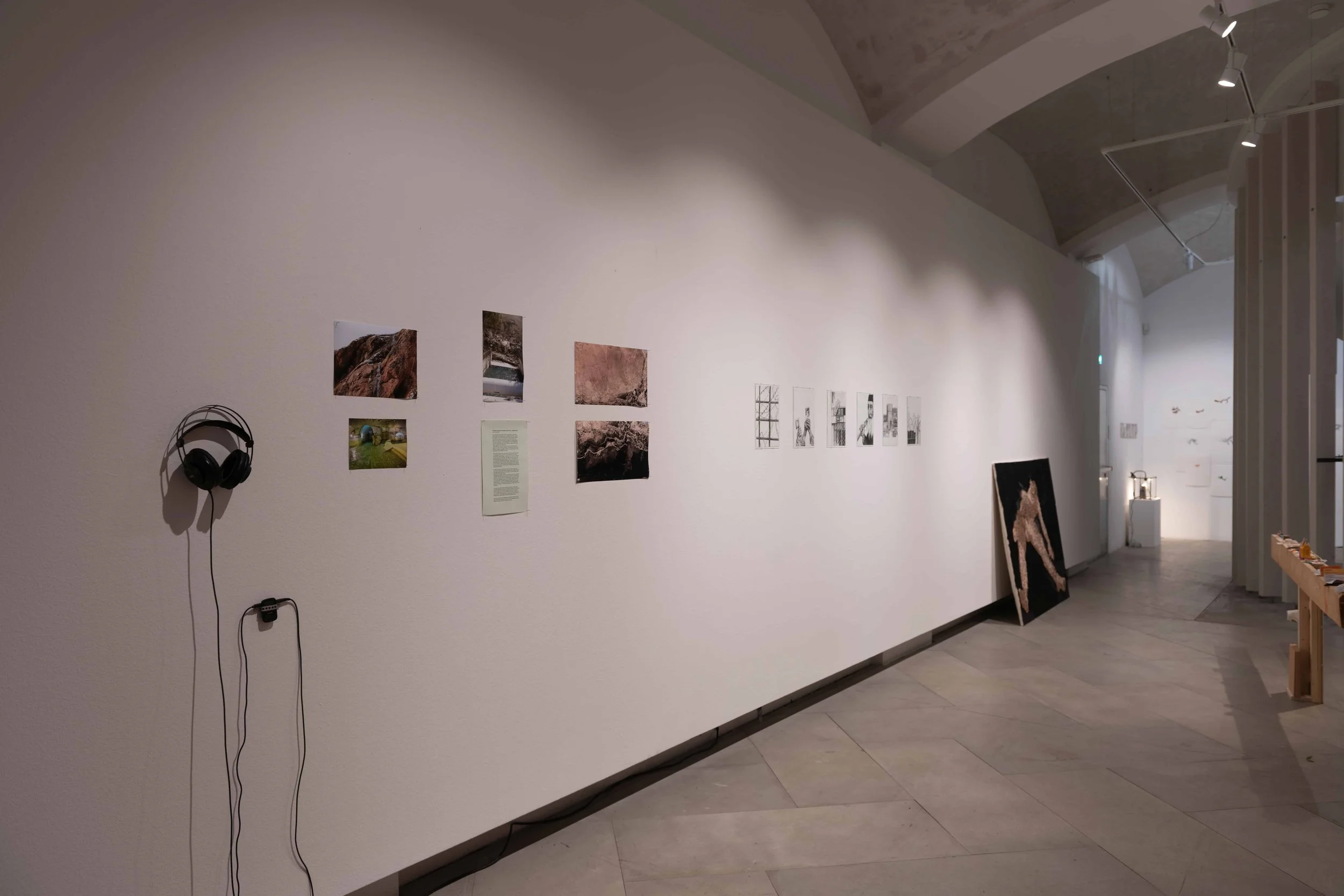
Work In Progress

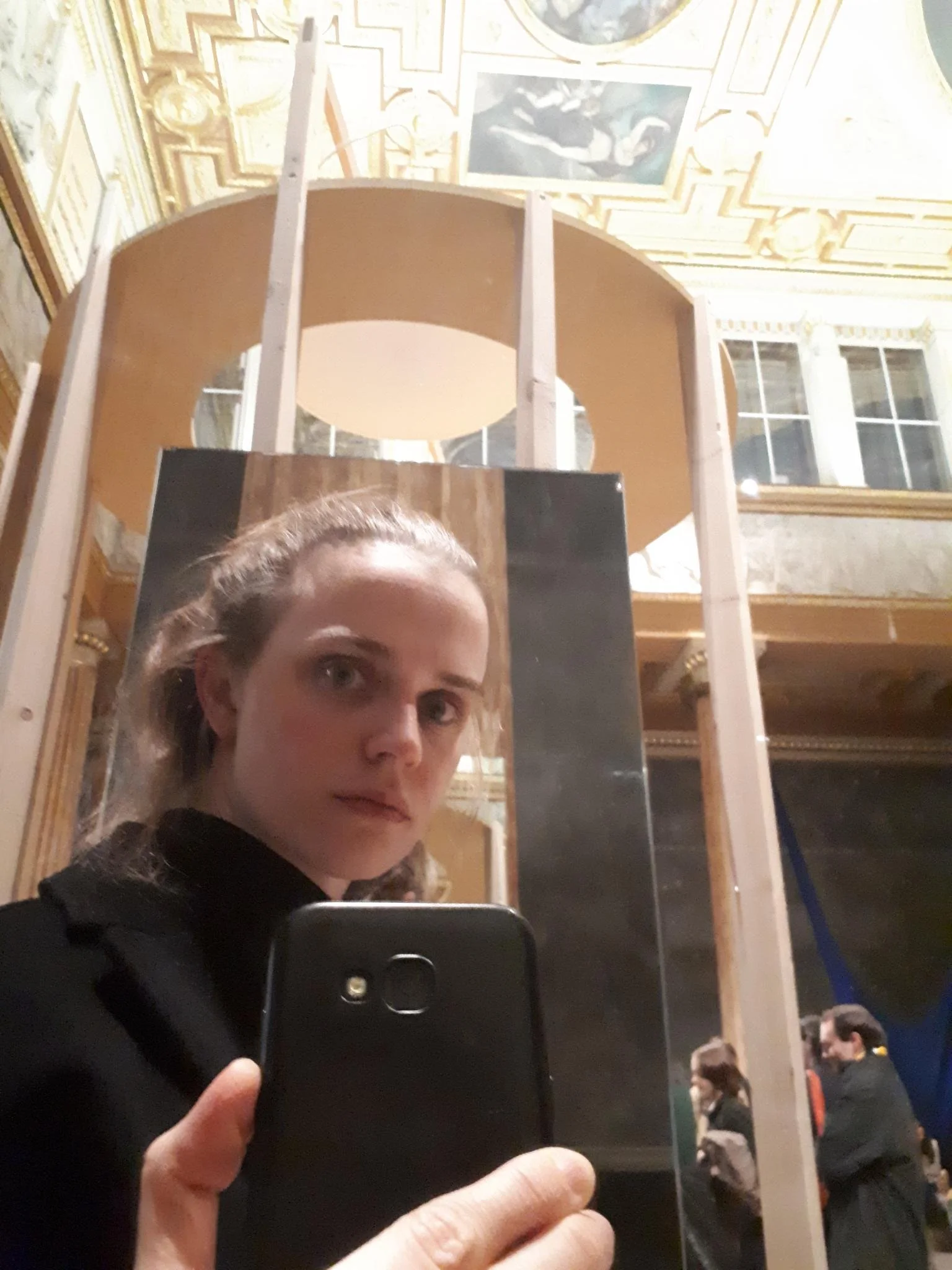



About the artwork
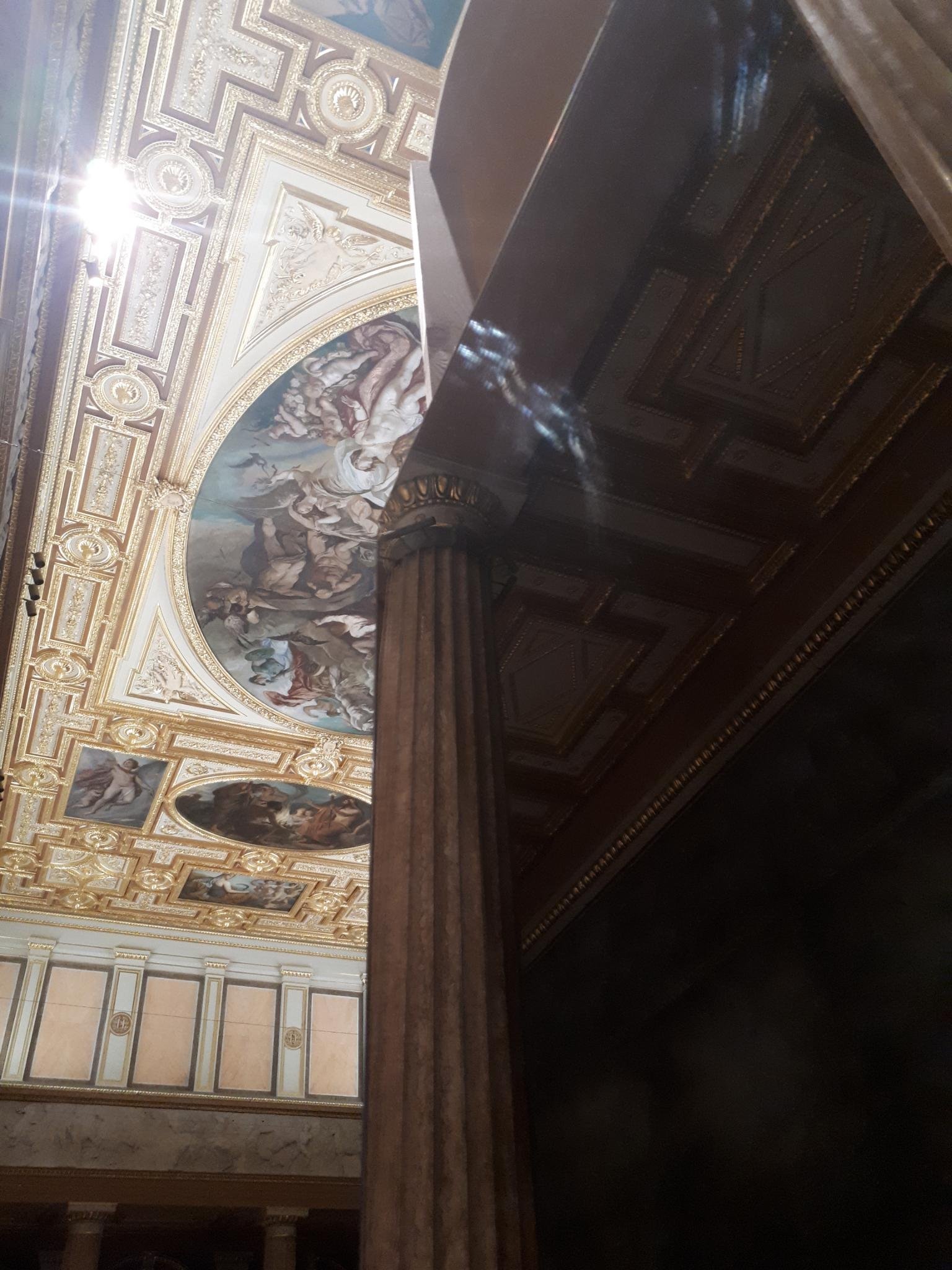
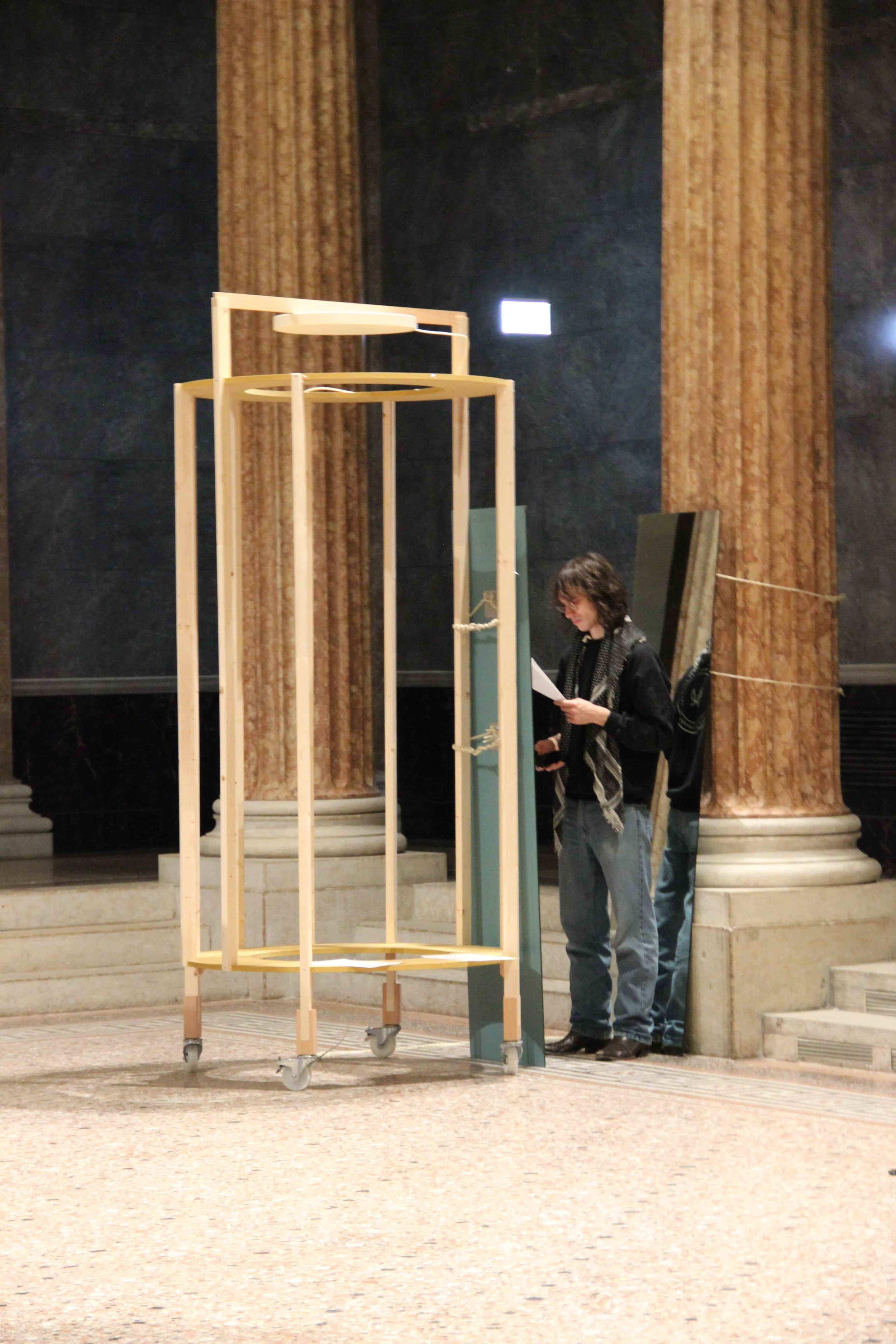
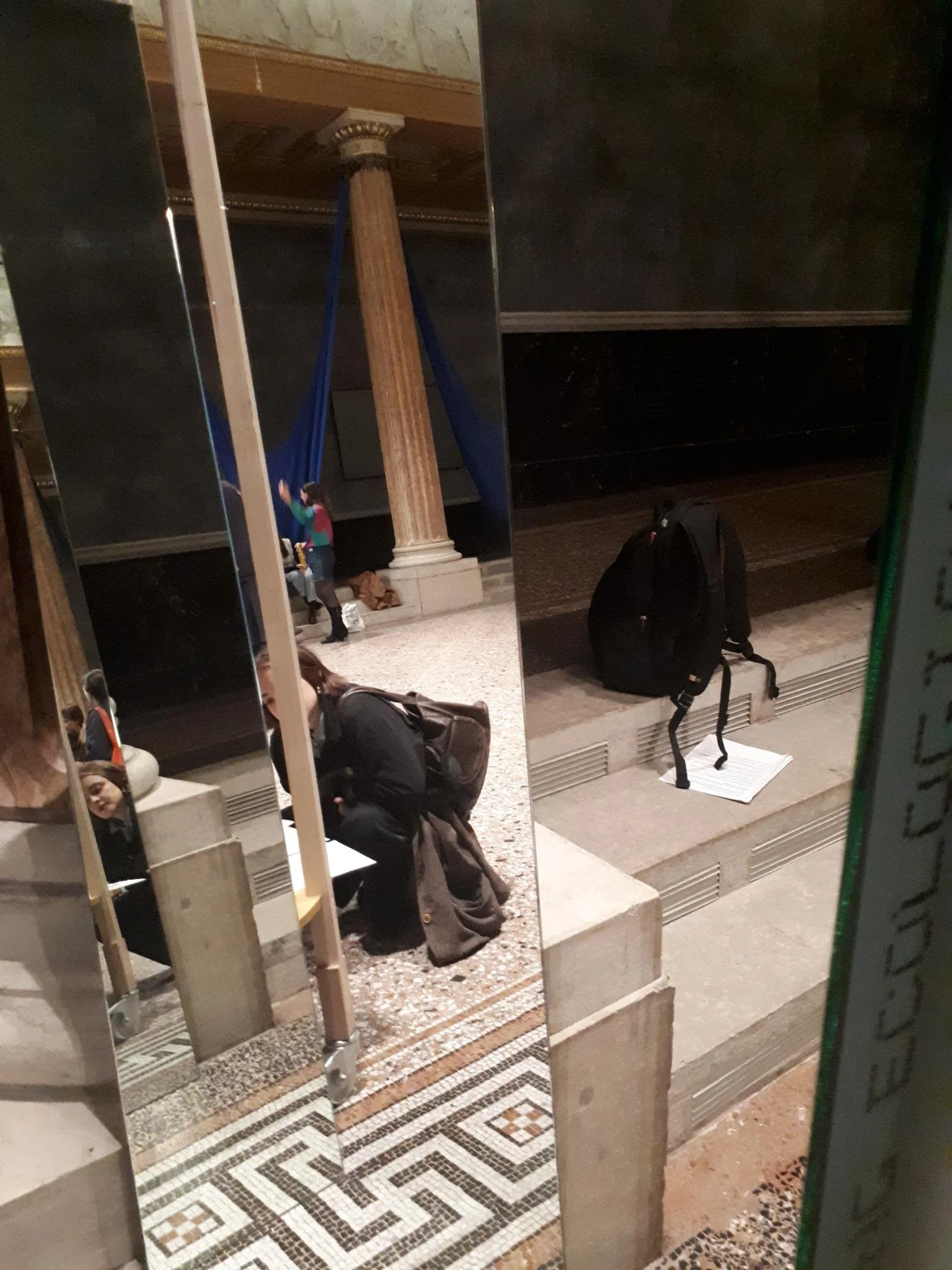
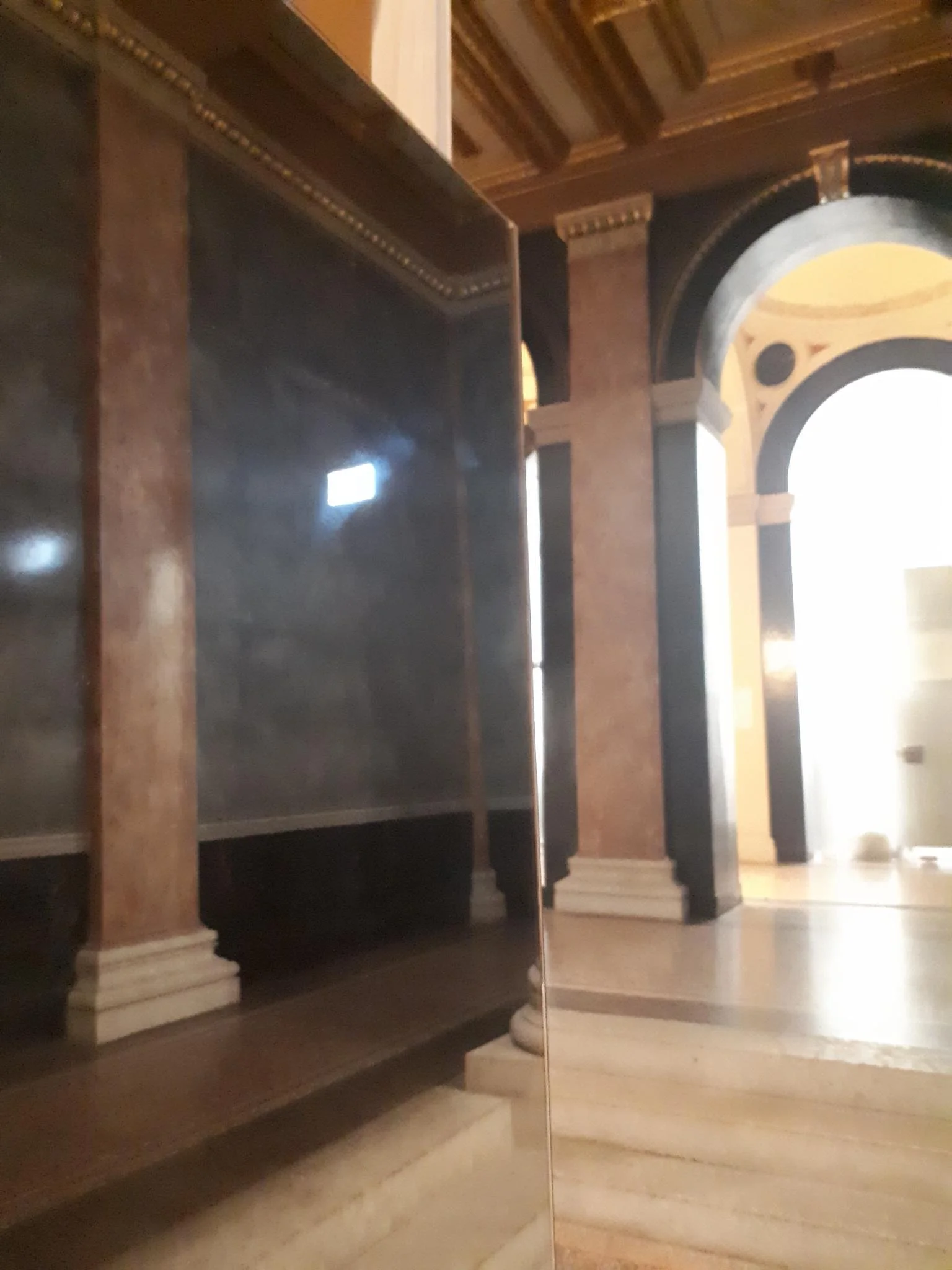
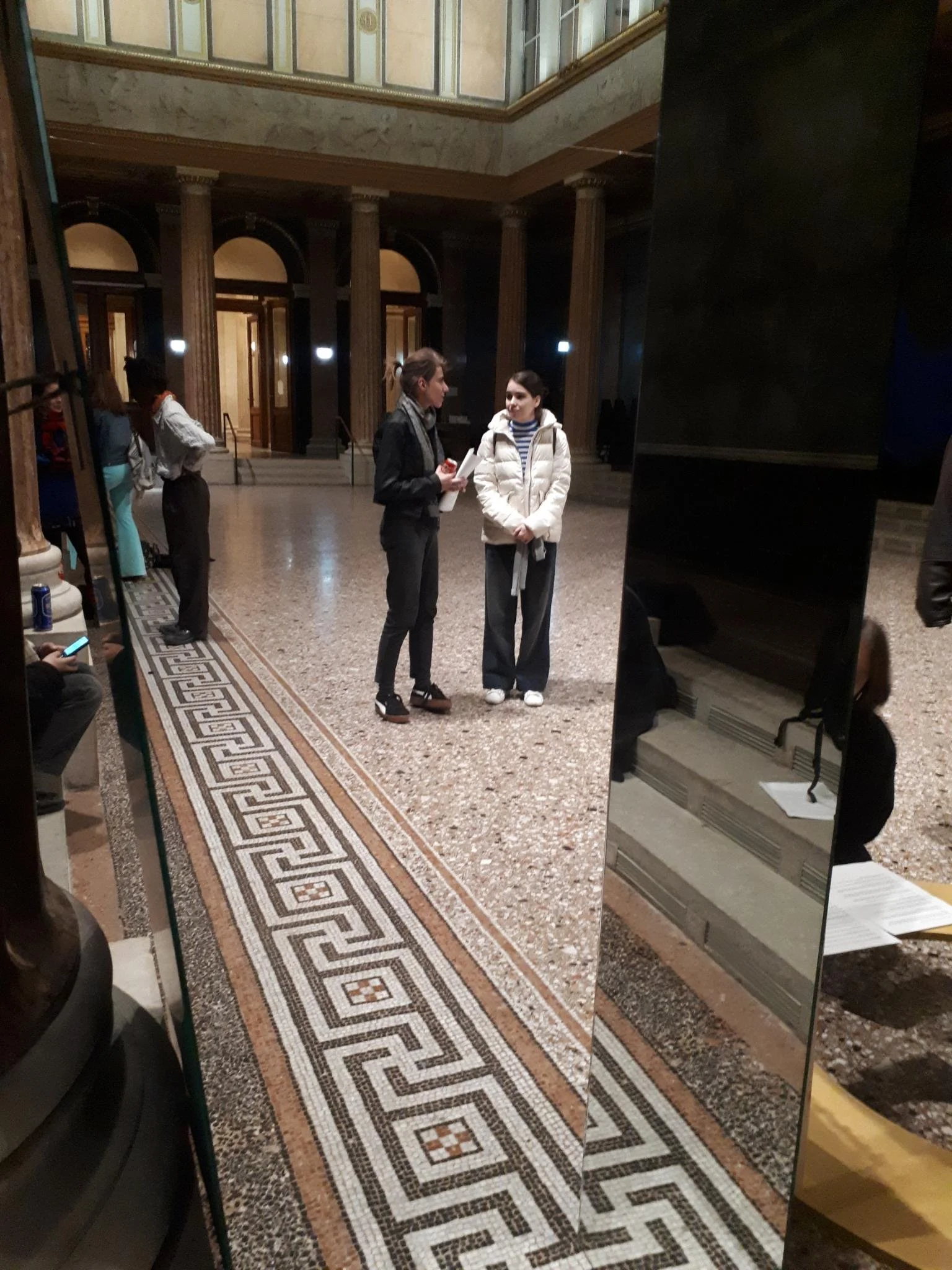
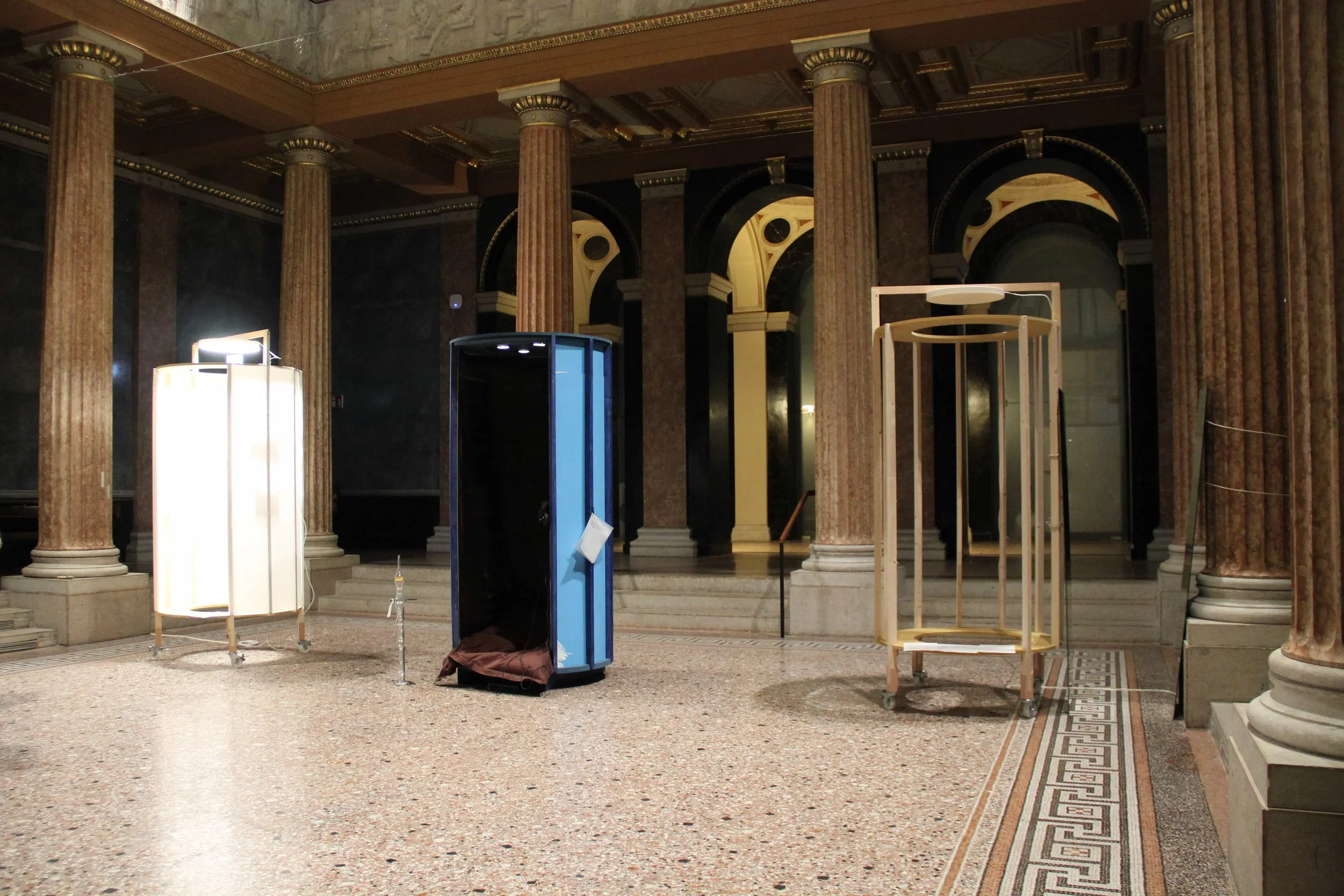
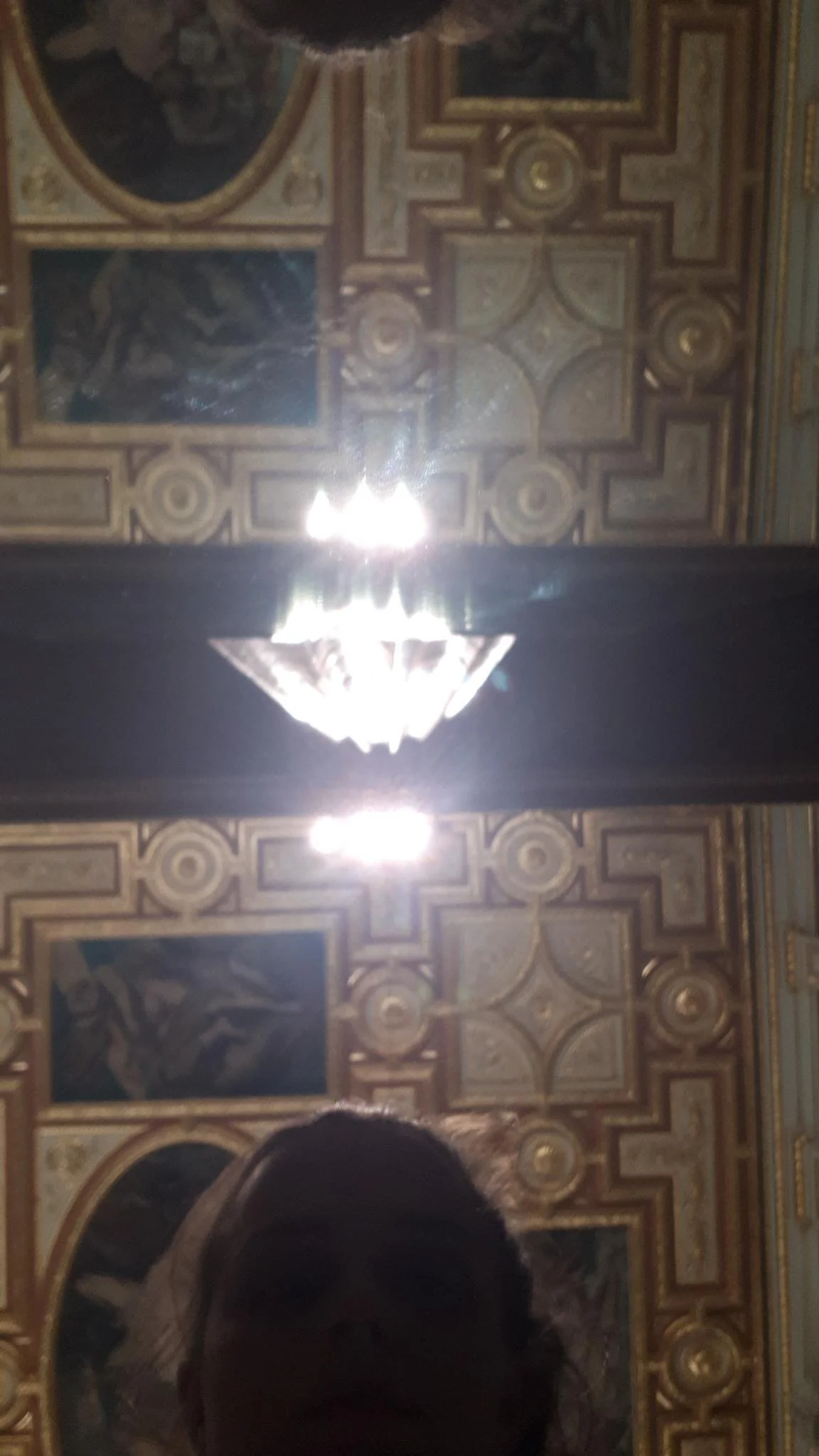
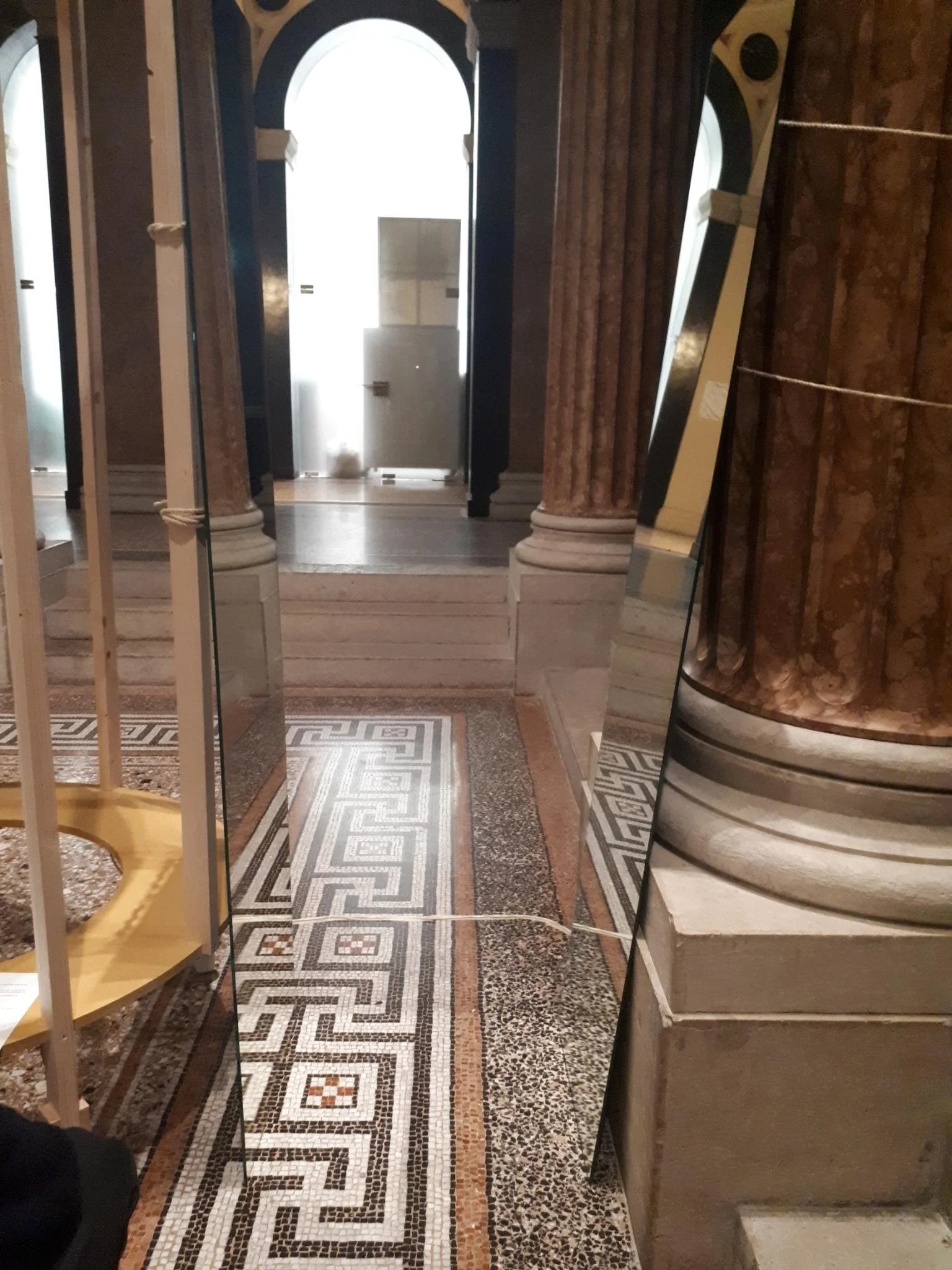
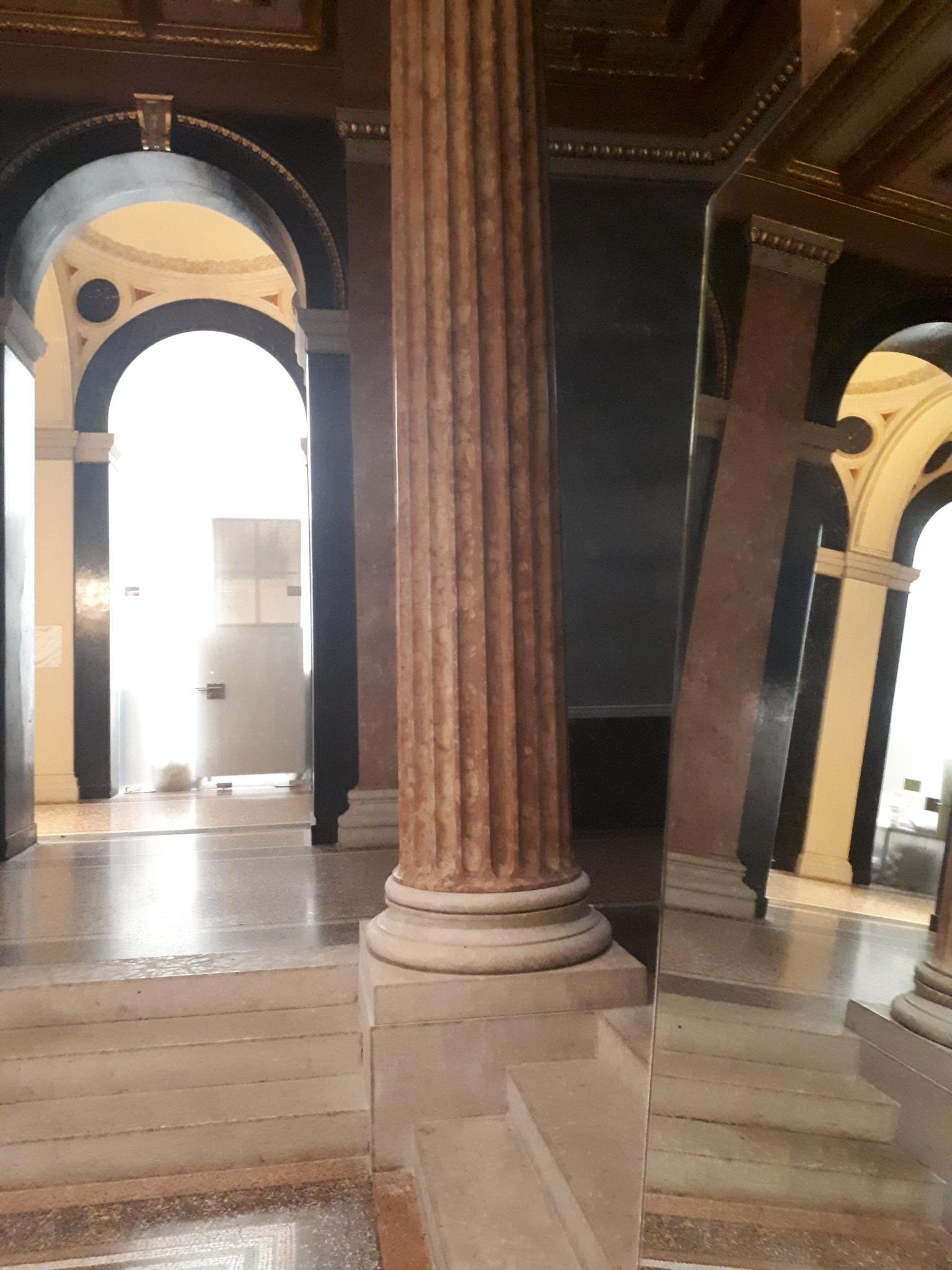
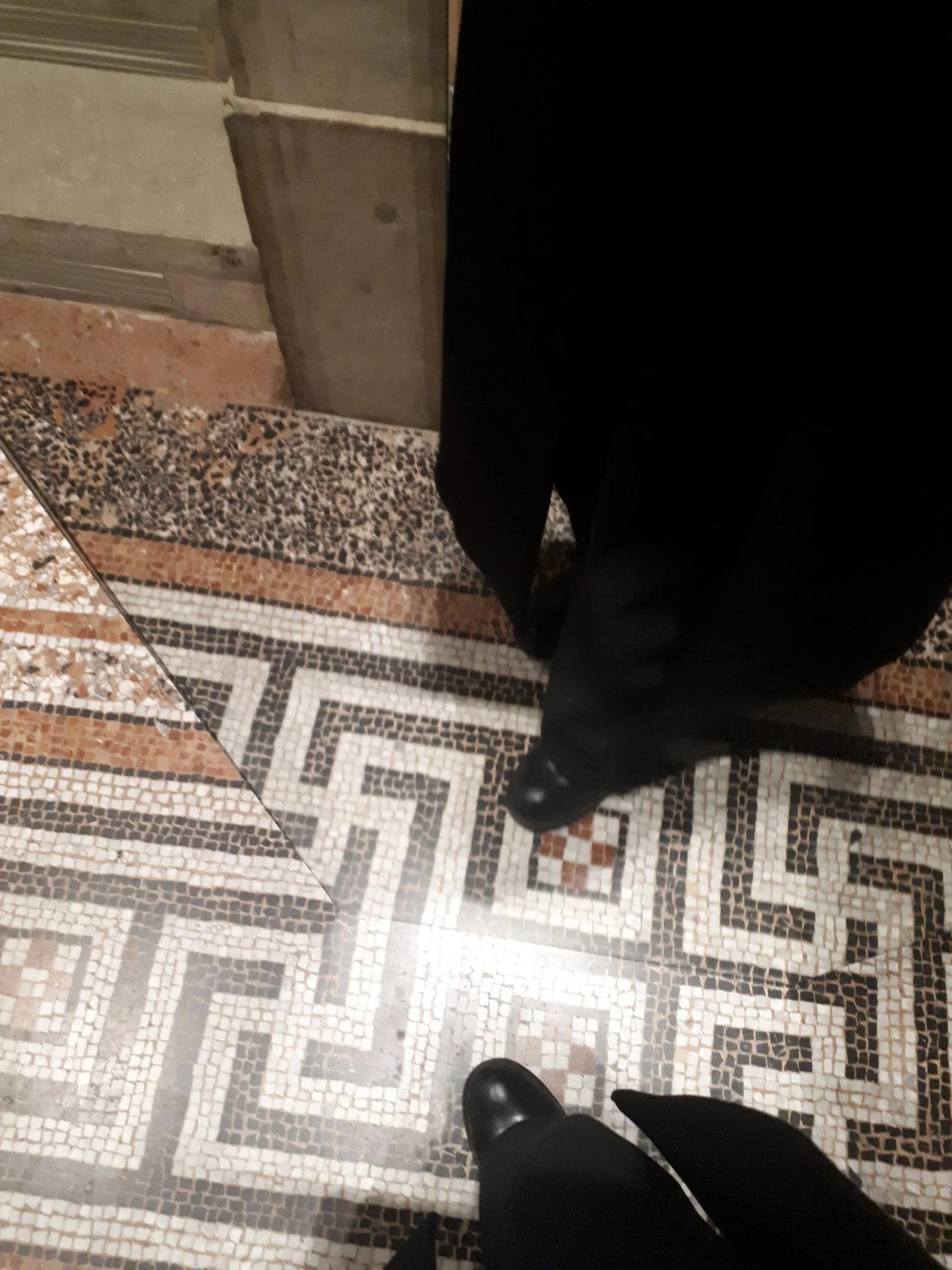
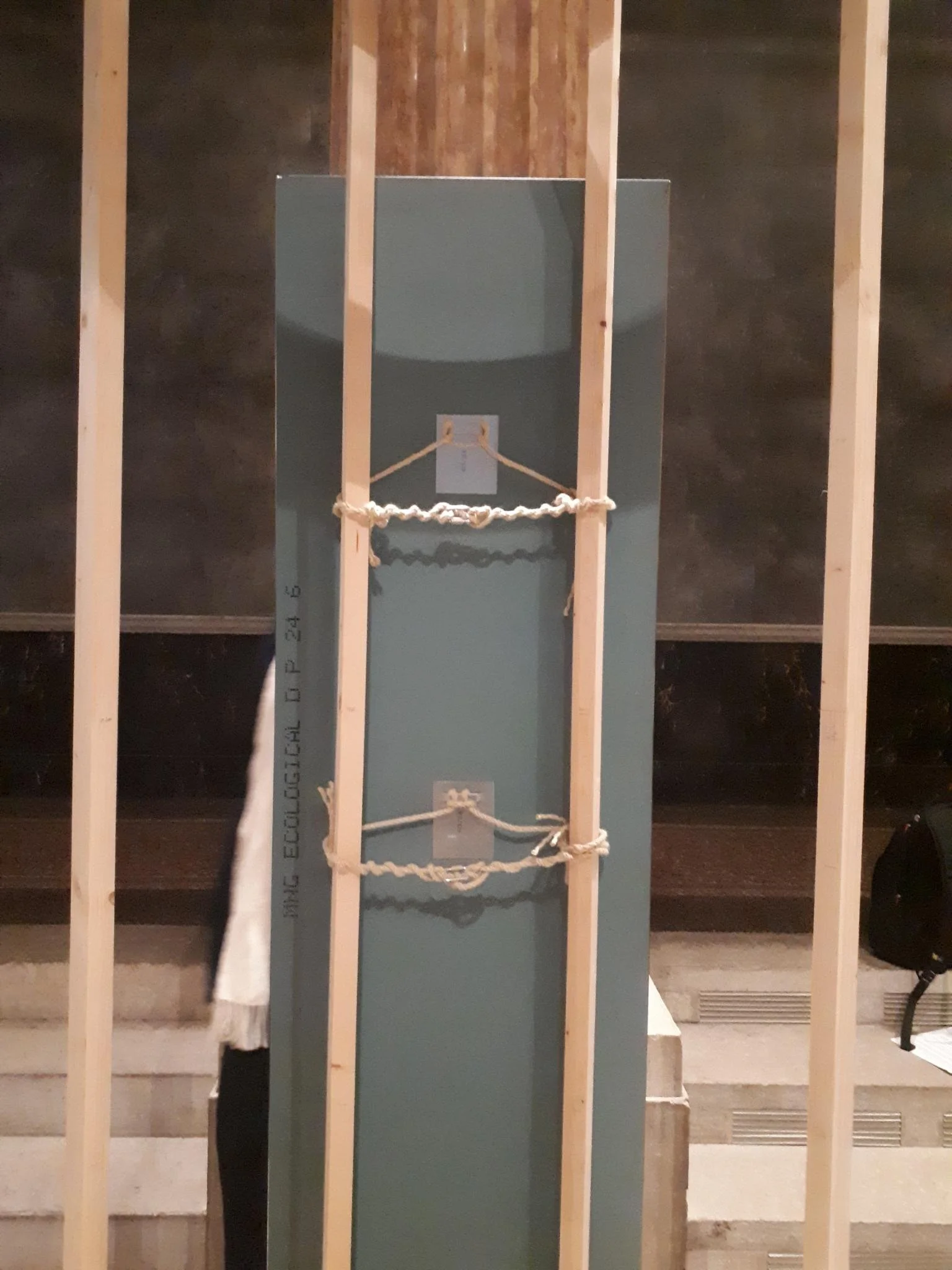
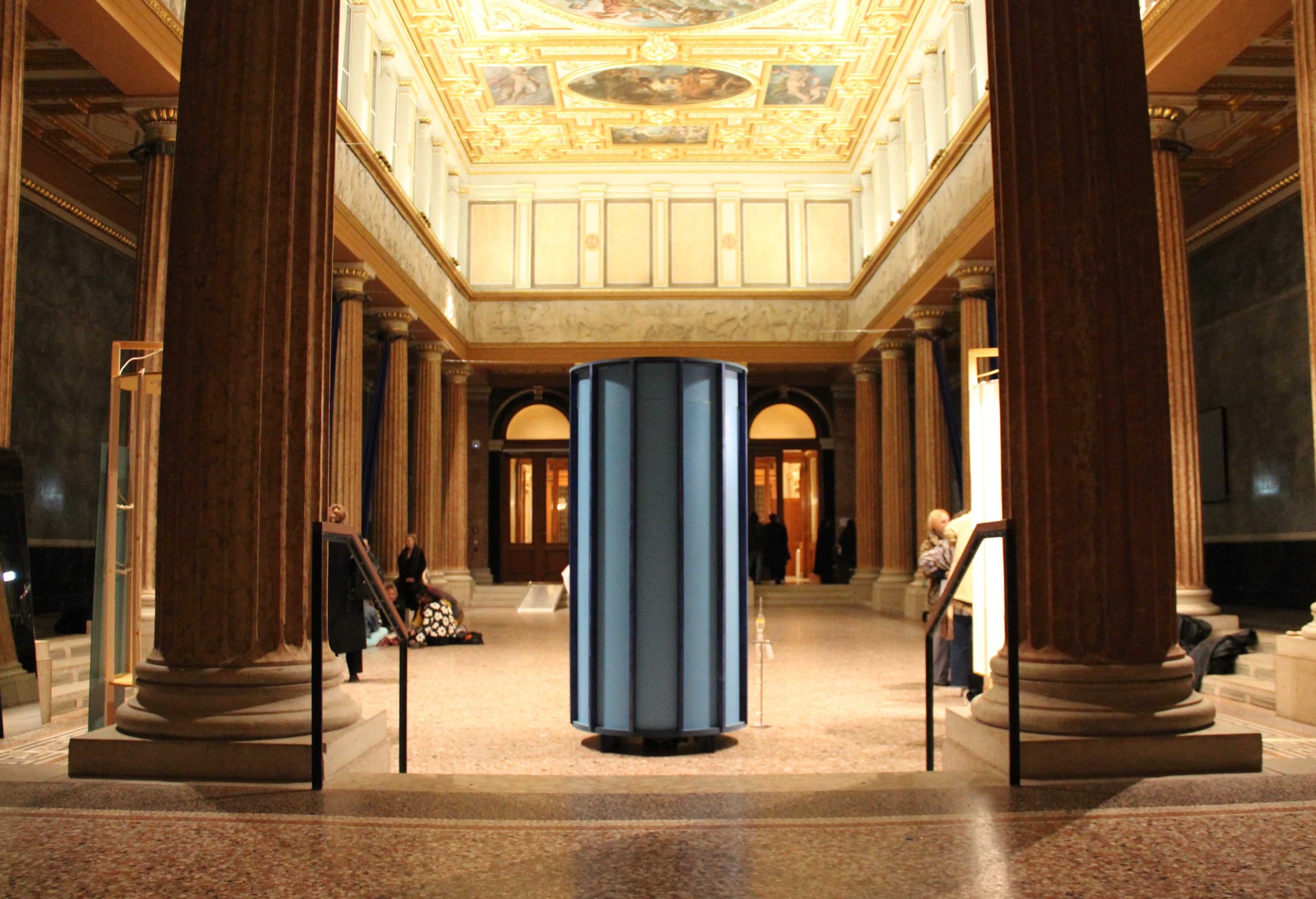
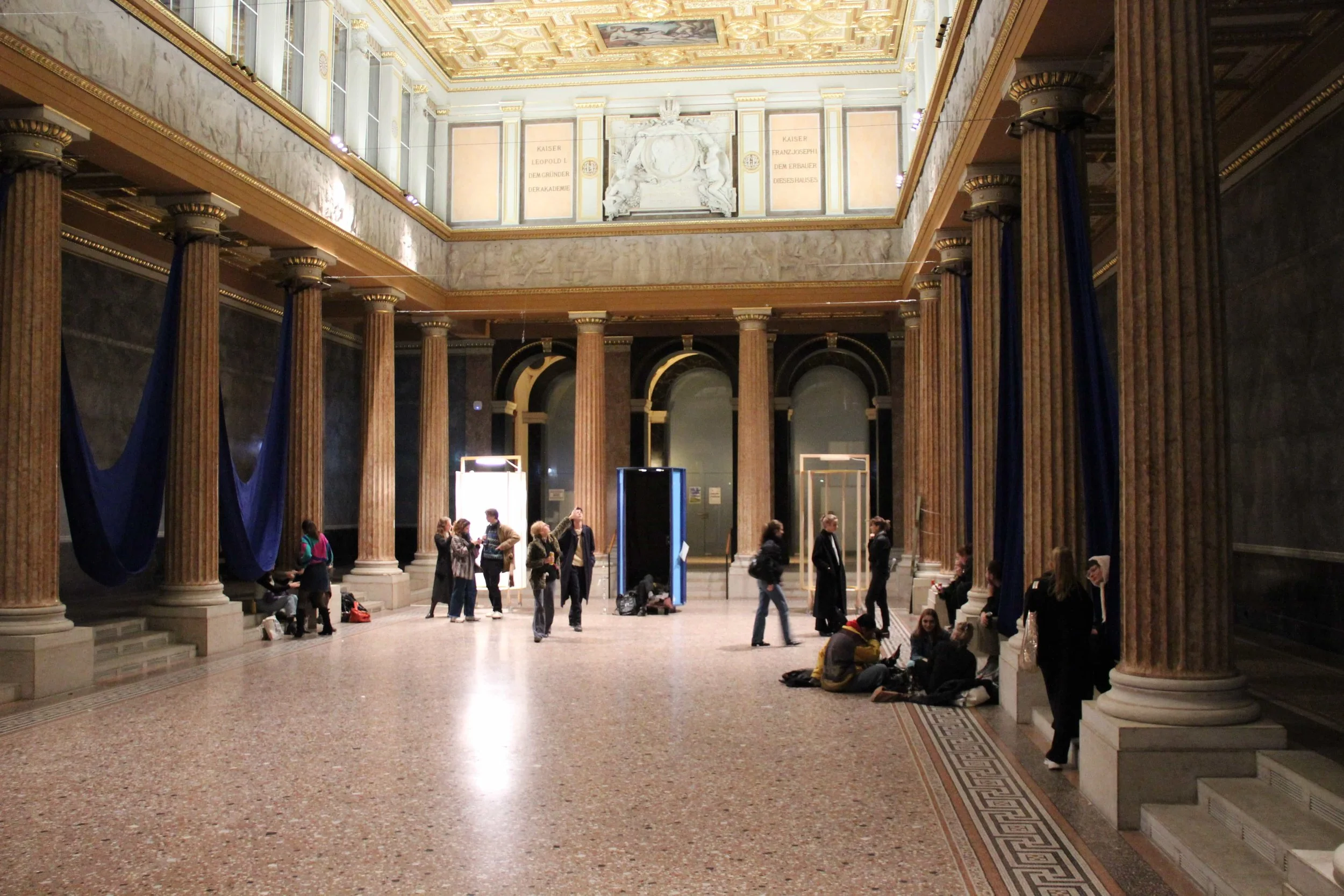
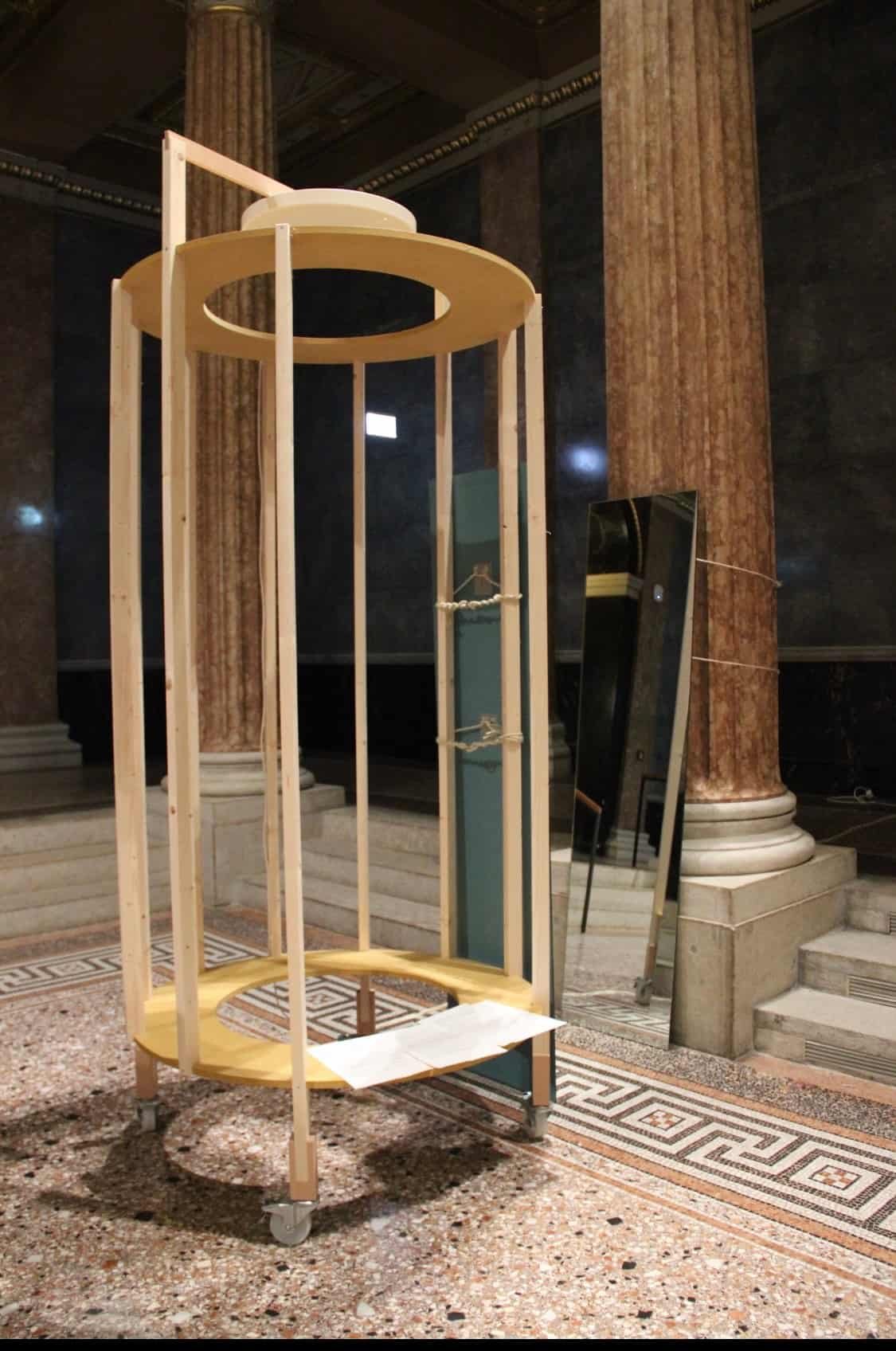
Aperture of Time is a participatory, site-responsive performance that explores the relationship between identity, history, images, and memory through mirrors, smartphone images, bodily movement, and the spatial, social, and historical conditions of a given site - here, the Aula at the Academy of Fine Arts Vienna, Schillerplatz.
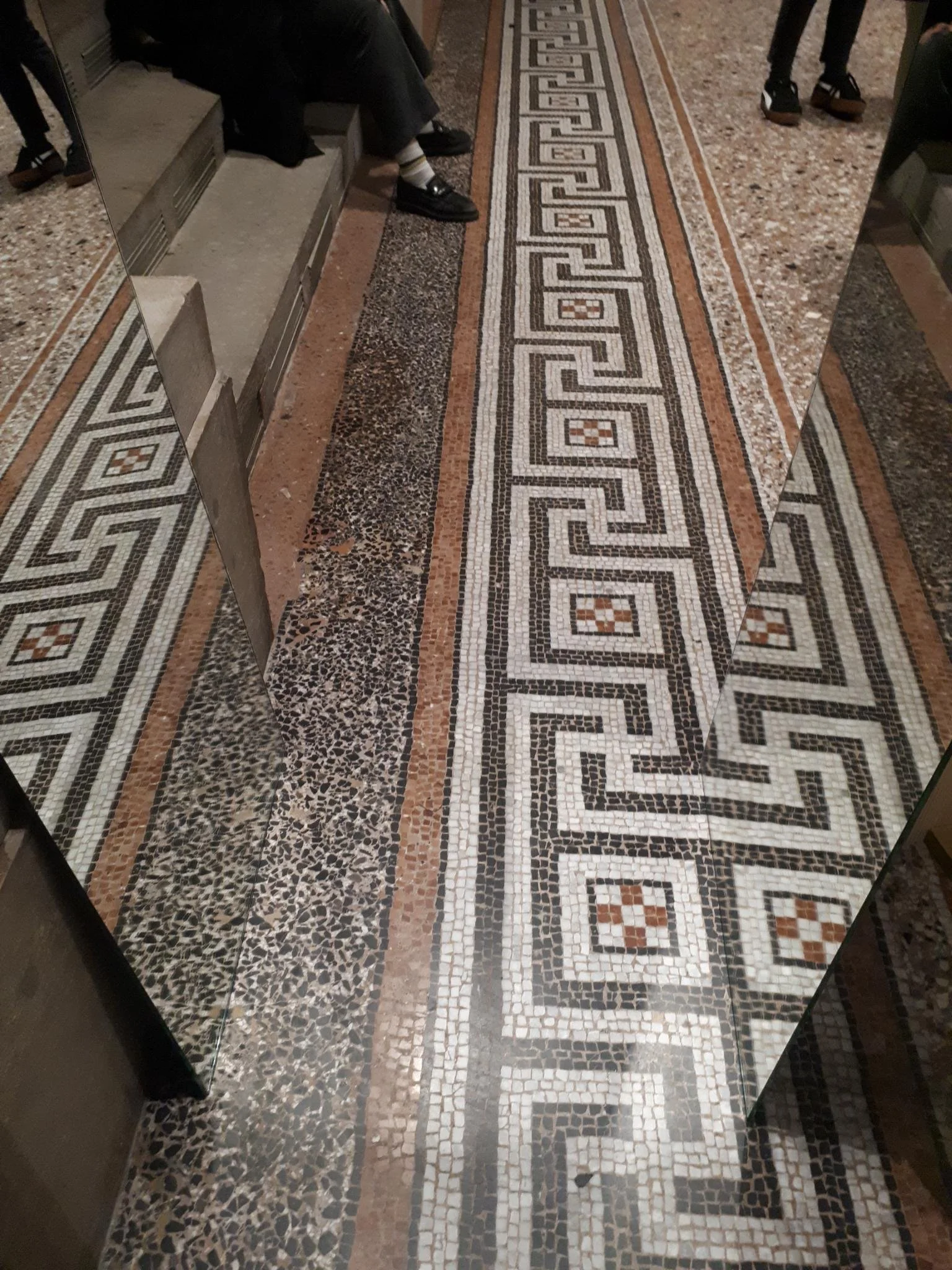
Presented in the Aula as part of the group exhibition Ich sehe, ich sehe, ich sehe, organized by the Drawing Class, the work unfolded between two mirrors - one in the Aula and one in the Demoraum - in dialogue with Steffie Alte's work, the surrounding architecture, and the presence of visitors. While this installation was shaped by the specific conditions of the Aula, the work can be reinstalled in other contexts. Its performance scope remains conceptually consistent while adapting to the architecture, history, and social conditions of each site.
From this emerges what I call Meta-Camera Obscura. The work begins with the historical concept of the camera obscura while consciously departing from its classical form. Rather than reproducing a fixed observer, a stable perspective, or a closed visual field, Aperture of Time reworks this model as a contemporary, open, and participatory image-space. The image is co-formed through visitors, mirrors, smartphone cameras, bodily movement, and the site itself rather than being generated from a single authorial point of view. The gaze is therefore mobile, embodied, and continually reconfigured through angle, distance, gesture, memory, and the presence of others.
This shifting structure allows visitors to enter a space in which reflection is not only optical but also historical and relational. Perception unfolds through movement and encounter, so that identity appears not as fixed but as layered, unstable, and shaped through spatial and social relations. In this way, the work connects personal and collective memory, image production, and embodied presence, opening a temporal loop between past, present, and possible futures.
Performance scope
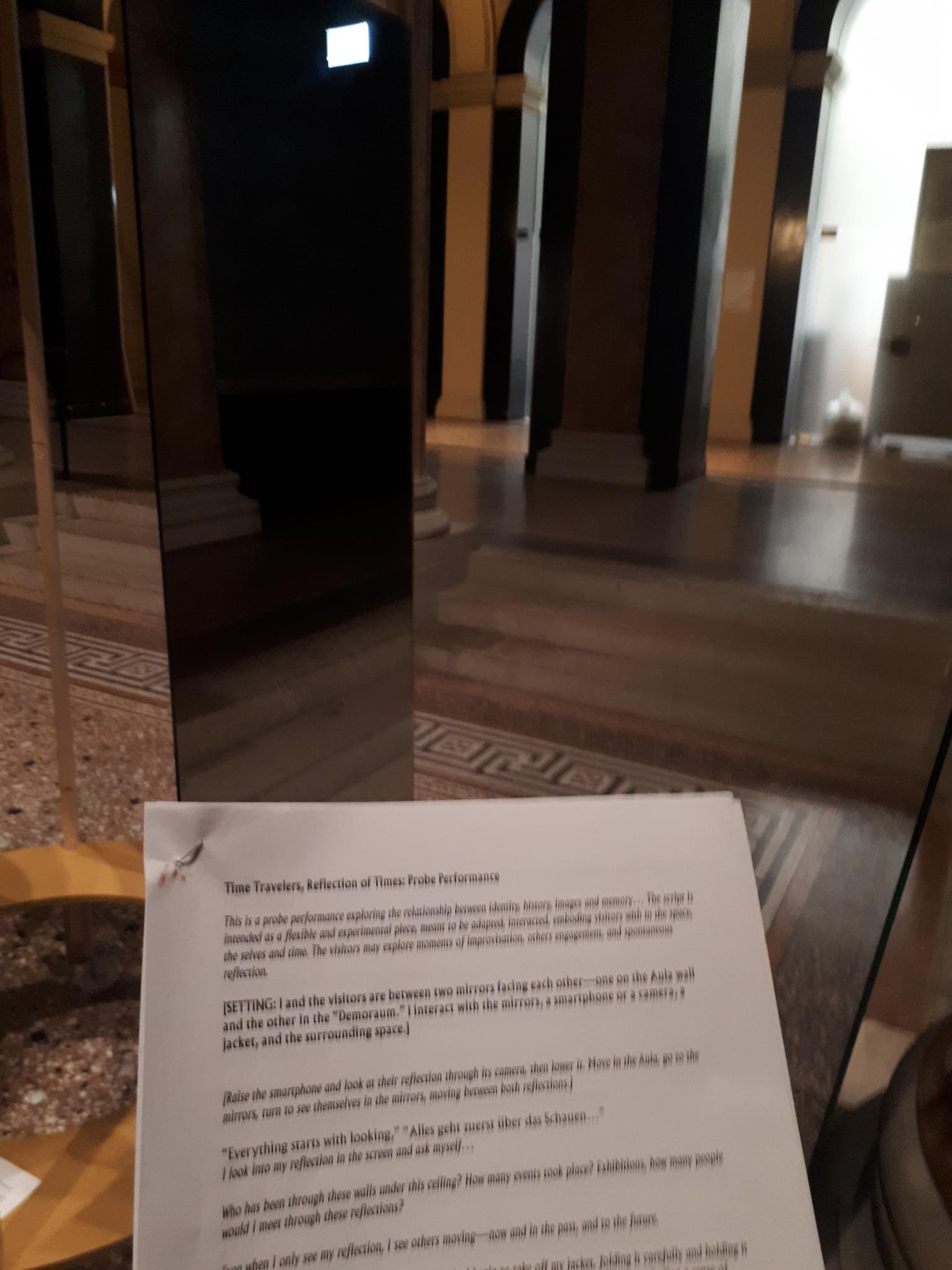
This is a probe performance exploring the relationship between identity, history, images, and memory. The script is intended as a flexible and experimental piece: it can be adapted and interacted with, bringing visitors into the space, the selves, and time. Visitors may explore moments of improvisation, engagement with others, and spontaneous reflection.
[SETTING: The visitors and I are between two mirrors facing each other - one on the Aula wall and the other in the Demoraum. I interact with the mirrors, a smartphone or camera, a jacket, and the surrounding space.]
[Raise the smartphone and look at the reflection through its camera, then lower it. Move through the Aula, approach the mirrors, turn, and see the self moving between both reflections.]
"Everything starts with looking." "Alles geht zuerst über das Schauen..."
I look into my reflection on the screen and ask myself:
Who has passed through these walls and beneath this ceiling? How many events have taken place here? How many exhibitions, and how many people, might I meet through these reflections?
Even when I see only my own reflection, I see others moving - now, in the past, and toward the future.
[Pause and look thoughtfully into the mirror. Slowly take off the jacket, fold it carefully, and hold it up, as if examining how this simple action transforms the reflection. Place the jacket down, sensing exposure and a change in self-image.]
I heard, in a meeting in this room, about the occupation of the Aula in late October 2009 - a protest against the Bologna system and restrictions on higher education. In seminars, I heard about discrimination here during the National Socialist period. More recently, I was present during the Climate Action Month in October 2022 and witnessed the occupation during the "Uni brennt" protests concerning climate change.
[With the jacket draped, move slowly and observe the transformed reflection in the mirror. Then put the jacket back on and take a picture, as if reassuming a familiar identity, noticing how every small shift affects the person and the many reflections of the self and the spaces reflected back.]
When I enter the Aula, I see the covered statues and the name of an empire. I see my sceptical look as I read that name while entering the room. I see the iconographic painting on the ceiling.
I wrote myself a note to research these myths, but I could not find them online. I lost time in another time loop of daily life and could not find them before the opening that evening.
[Gesture upward in the mirror, then walk around and look toward the ceiling, inviting the visitors to look as well.]
But I can describe them, just as you can glance upward or observe the figure within your own gaze in the mirror - perhaps also in the other work in this room.
"Narcissus does not love himself but succumbs to the seductive power of an image. To question oneself so deeply can make one's whole worldview tremble."
In this reflection, I see myself and the other within me, with an interest in who I am, who the people around me are, and the hybrid identities within.
[Shift slightly, seeming to reach toward the mirror before pausing and addressing the visitors directly.]
One can travel through one's own perception in this room - into the past and toward the future.
[Gaze at the mirrors.]
There are many gazes here... This exhibition holds the Mendoza gaze, the admiring gaze, the sceptical gaze, and the gaze influenced by social and historical forces. All of them are here, reflected in these mirrors.
What moment of one's identity exists in this loop? Toward what moment in the future does one aspire?
[Take a photograph of the reflection in the mirror, then look down at it contemplatively.]
While we exist, do these images and reflections disappear, or do they remain with us in memory? I thought I would capture it - capture this time loop in a photograph.
[Look toward the visitors with an inviting gesture, encouraging them to join.]
Feel free to enter a time loop, past and future: press the button and share it with the visitors here. Send it to me; it will reappear, and this moment will be captured again and again through many narratives.
[Pause and gaze into the mirror as if seeing countless versions of the self.]
One identity is so complex that a loop of multiple, endless selves emerges. It is not only one reflection, one image, or one identification; it is a loss in time, not only of oneself but also through others.
[Turn slightly away from the mirror, thinking aloud toward the visitors.]
The mirror is not only a place of meditation, and photographs are not only about the self. It is as if these reflections say something beyond the ego - something about one's surroundings and one's times.
In these mirrors, I am not pointing only to stories from one era. The work concerns history - personal and public history. The gaze is shaped by social struggles, not merely by myths: by the weight of the past, hopes for the future, and expectations projected onto us.
[Slowly put the jacket back on, assuming a stance that feels both familiar and changed, as if embodying a new understanding.]
Perhaps the question is the ritual - the gazes, the selves, the time.
[Look deeply into the mirror once more, then briefly close the eyes.]
I see myself and the Aula reflected through mutable times. I see my reflection in others, and I capture a moment in time - the impossible becomes possible.
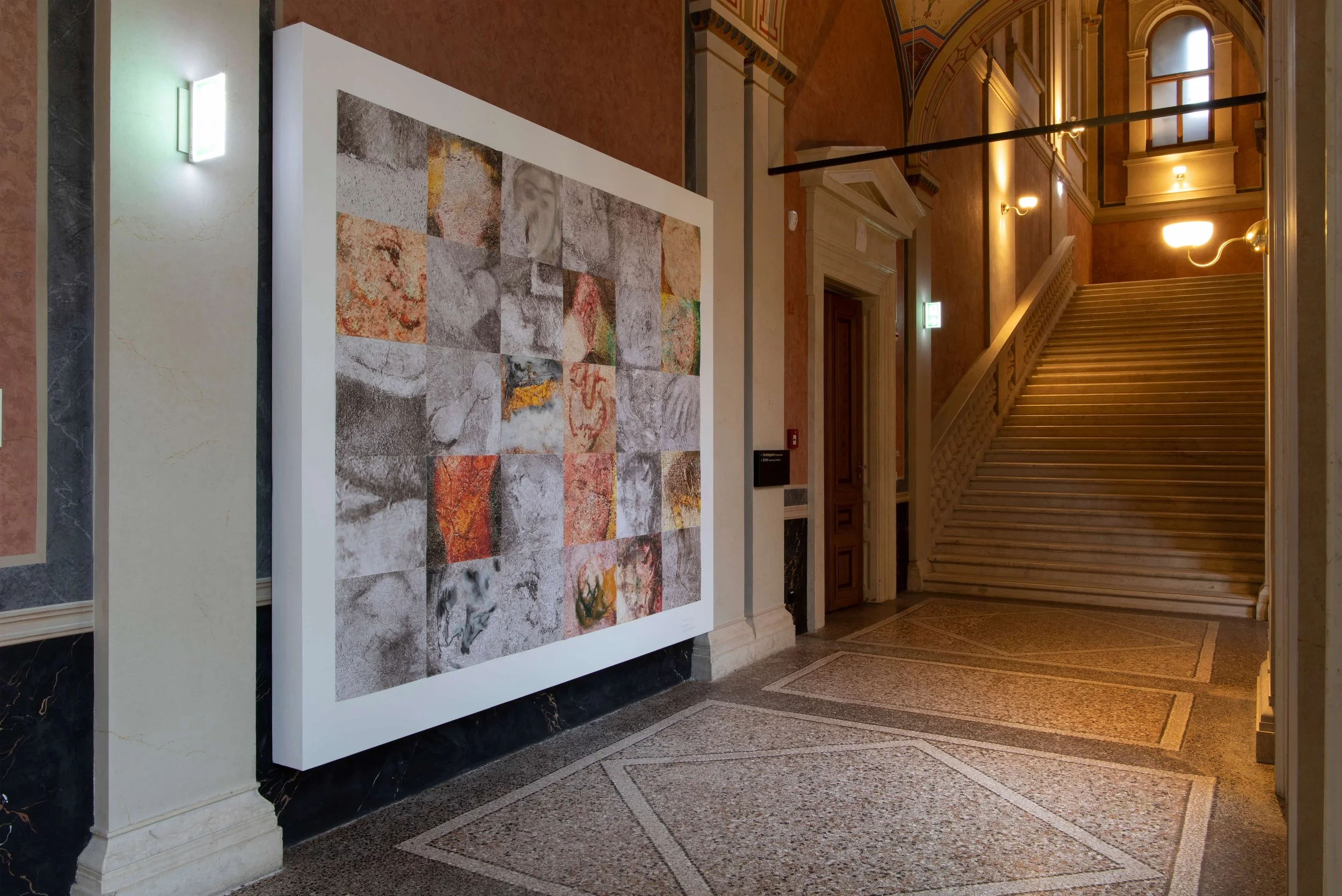
About the artwork
Working Title, 2023. In this work, I reflect on the way the Wien Museum affirms the position of the Minnesang poet, while the artist who made the wall painting and the artist's social position remain anonymous in the museum's present-day account of the fourteenth century.
Working with the historical and social relationship between the present and the Middle Ages, I used my smartphone to make colour and black-and-white photographs of details from the wall painting in the Neidhartfestsaal. I then drew on the photographs with chalk pastel. The individual images can be arranged in continually changing configurations.
My aim is to deconstruct the performative narrative - the "play" - through which the museum presents the painting and its social history.
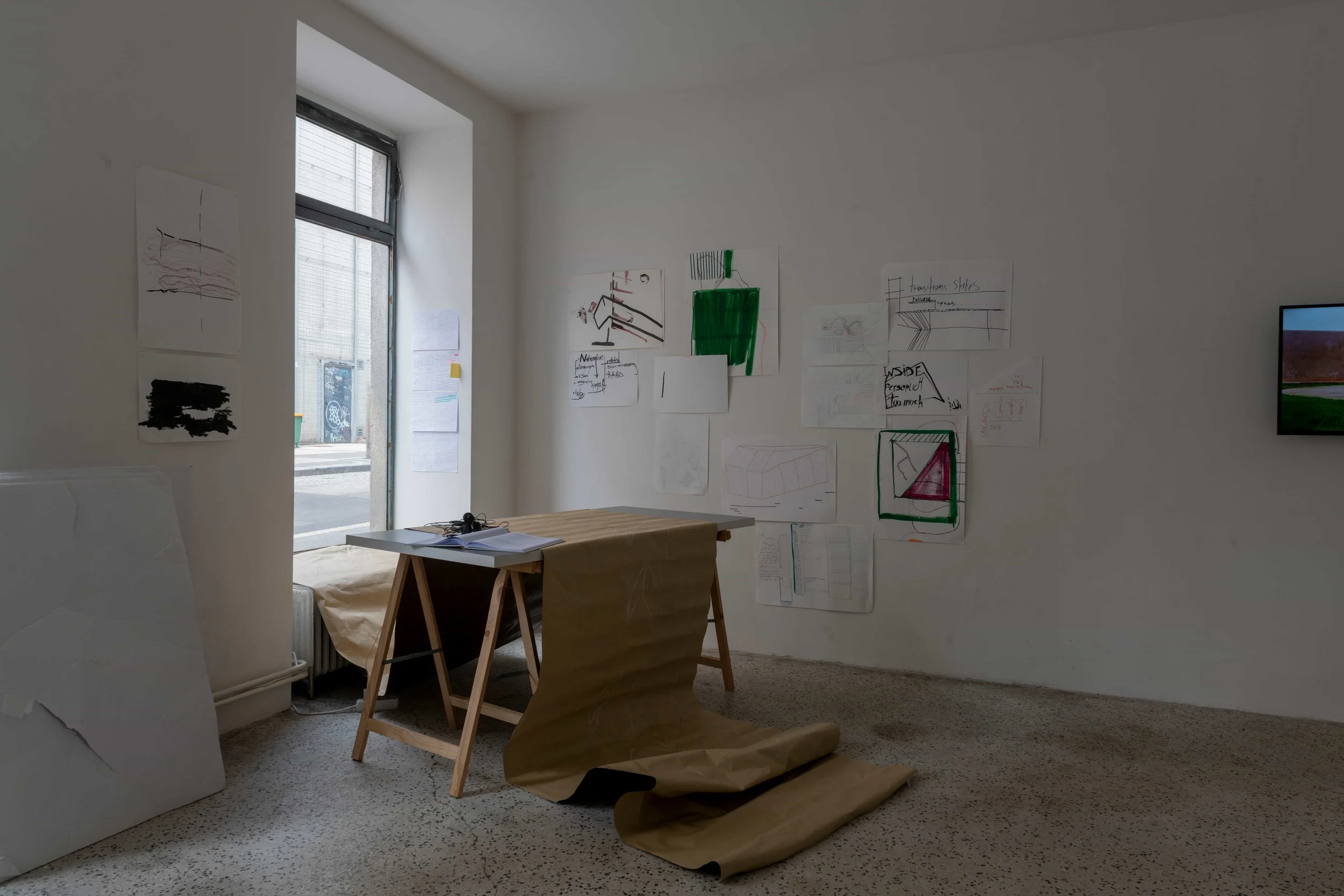
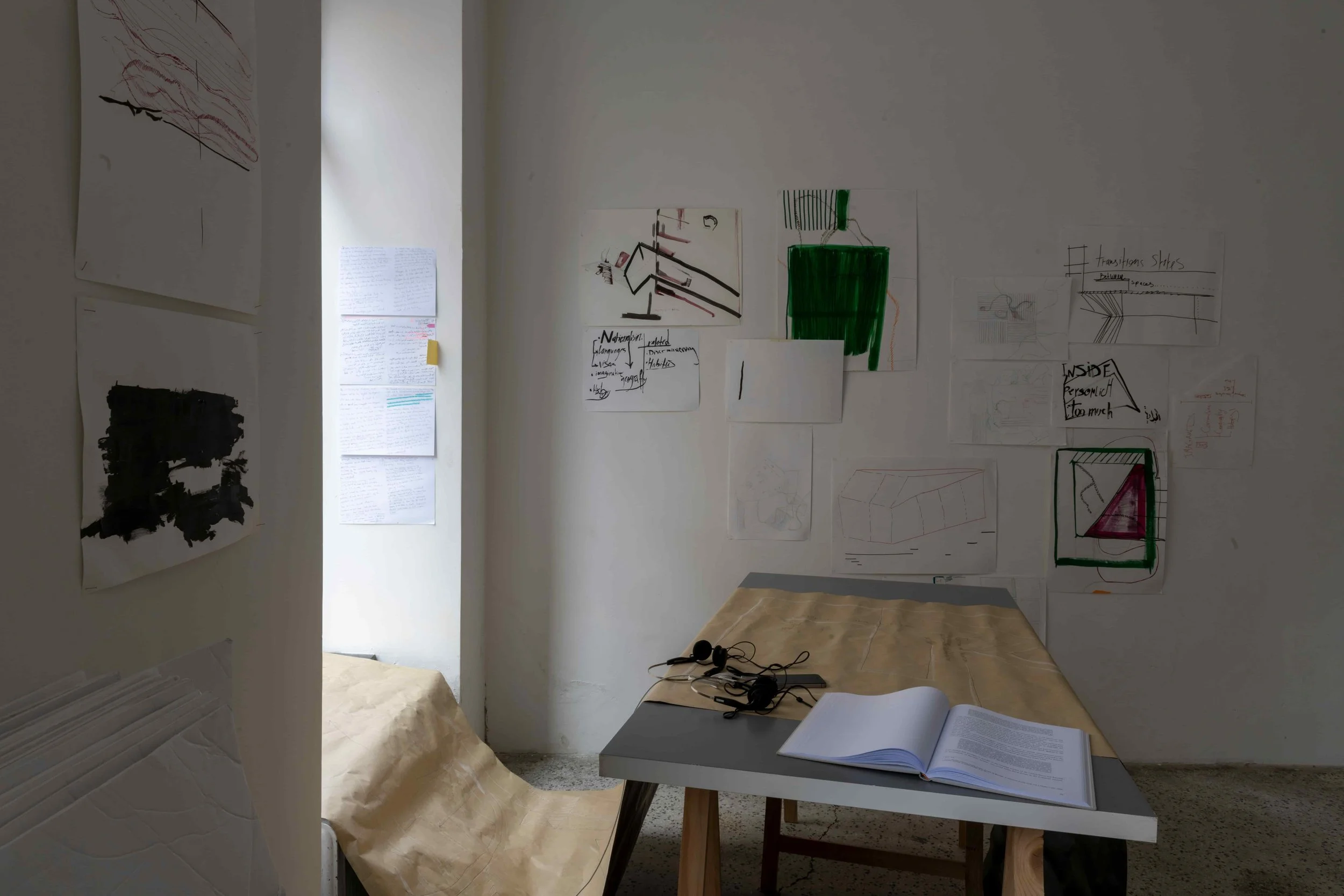
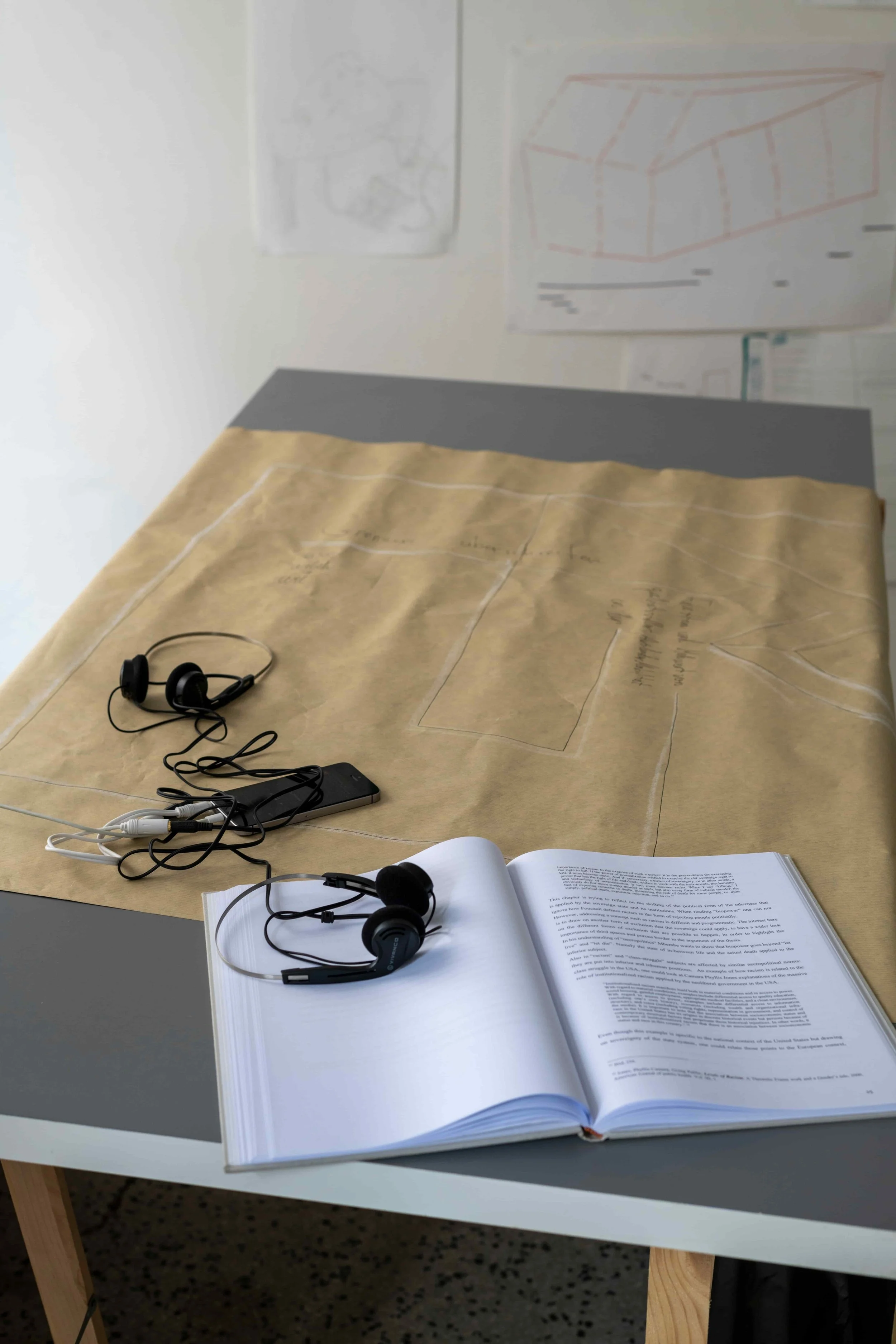

About the artwork
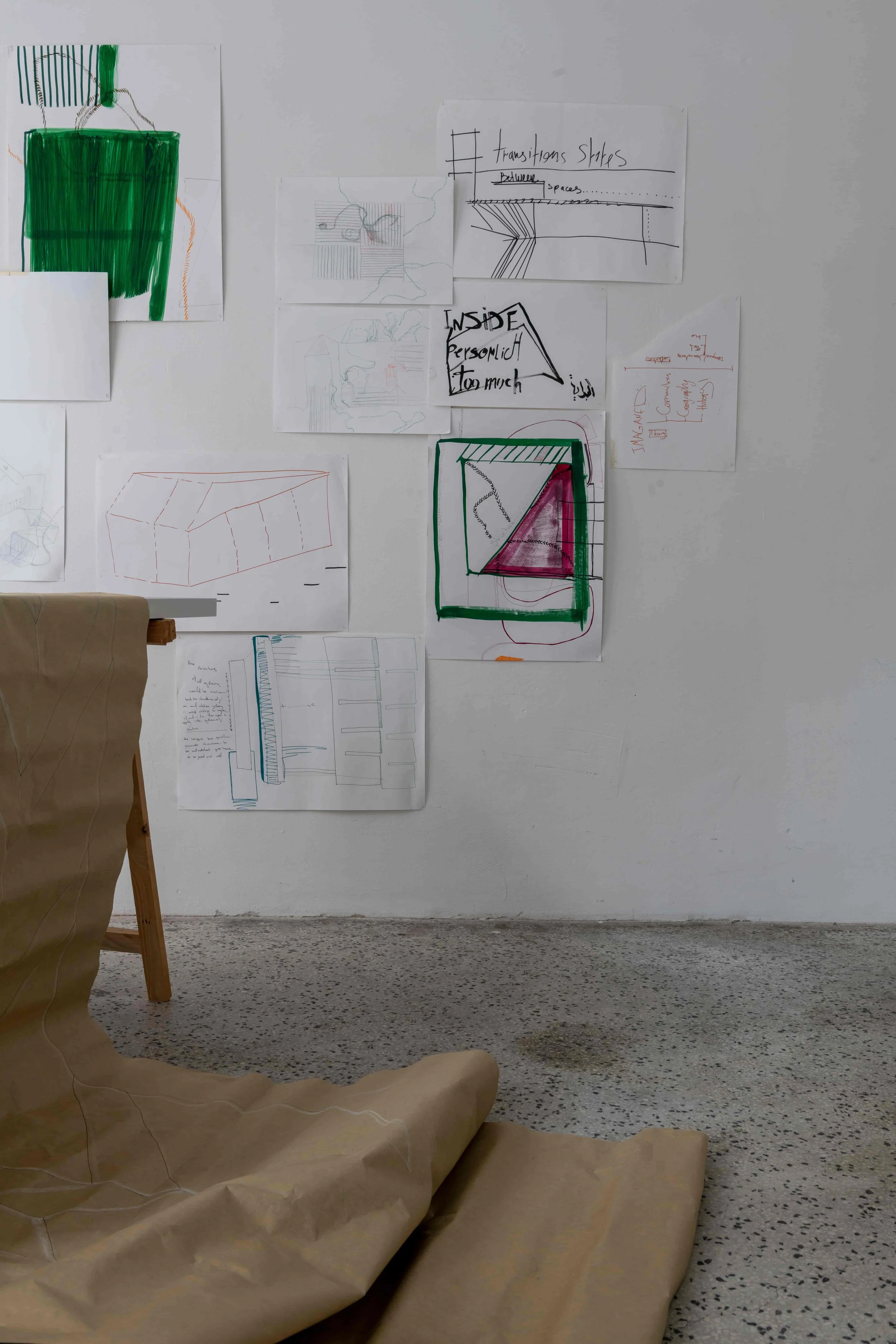
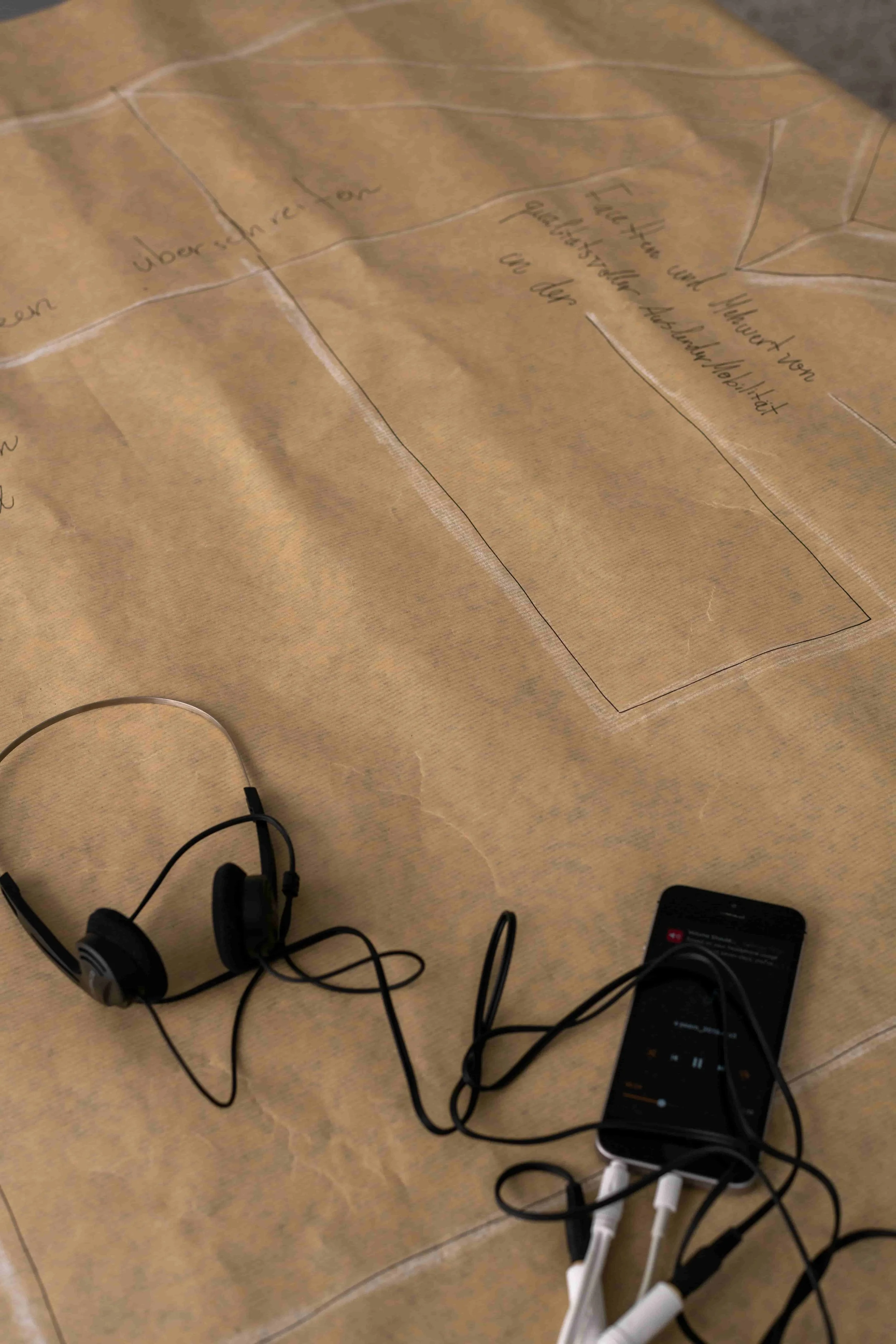
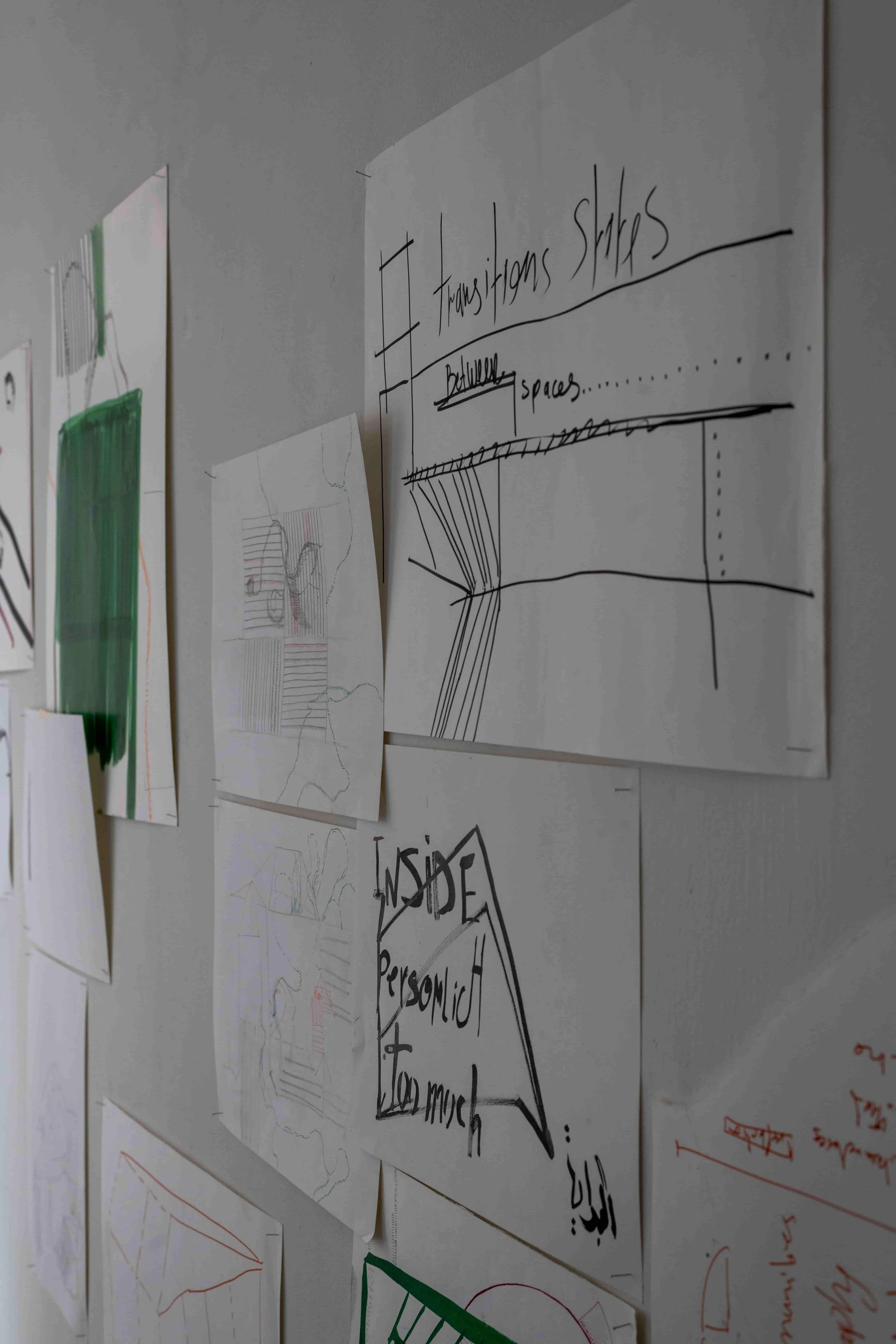
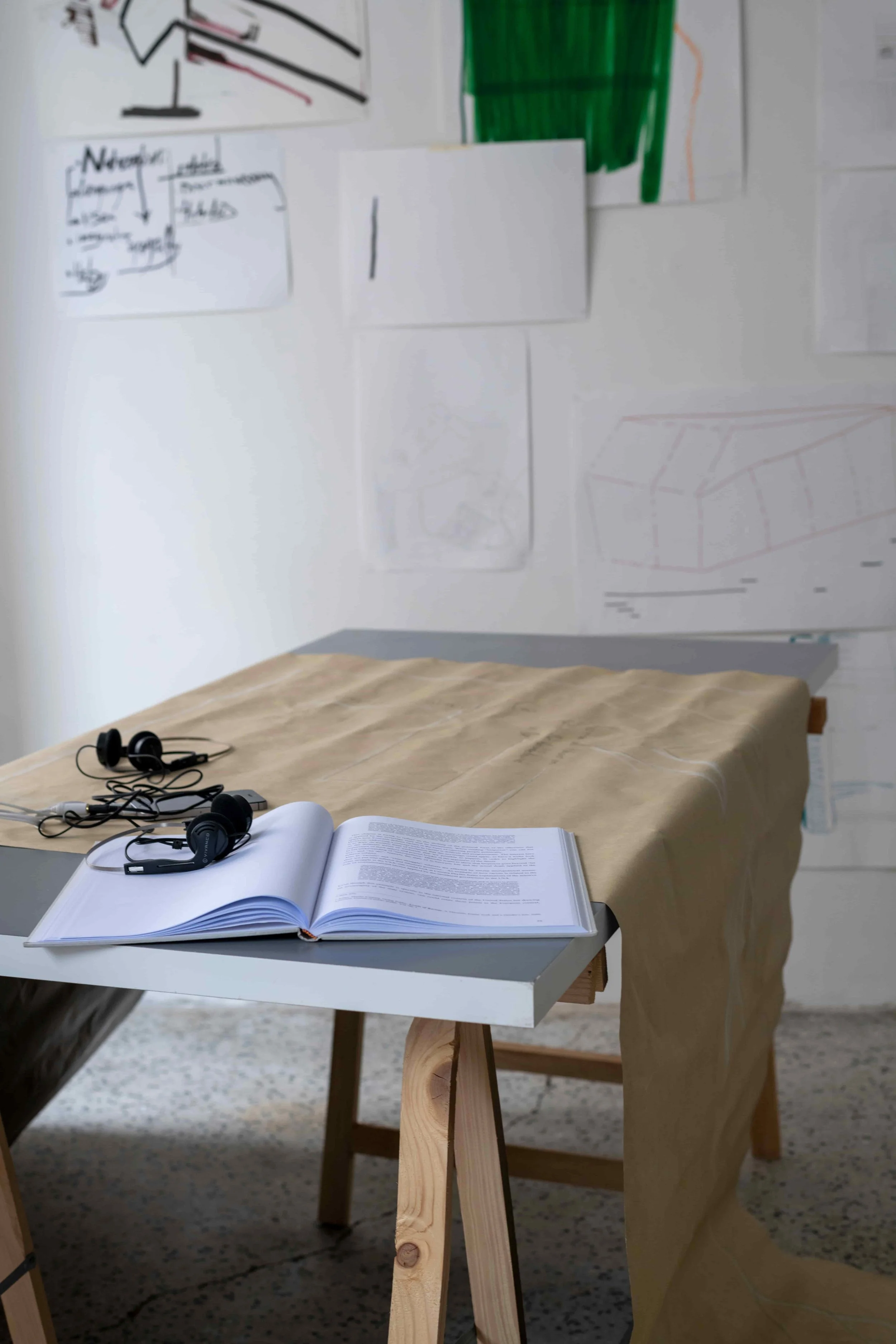
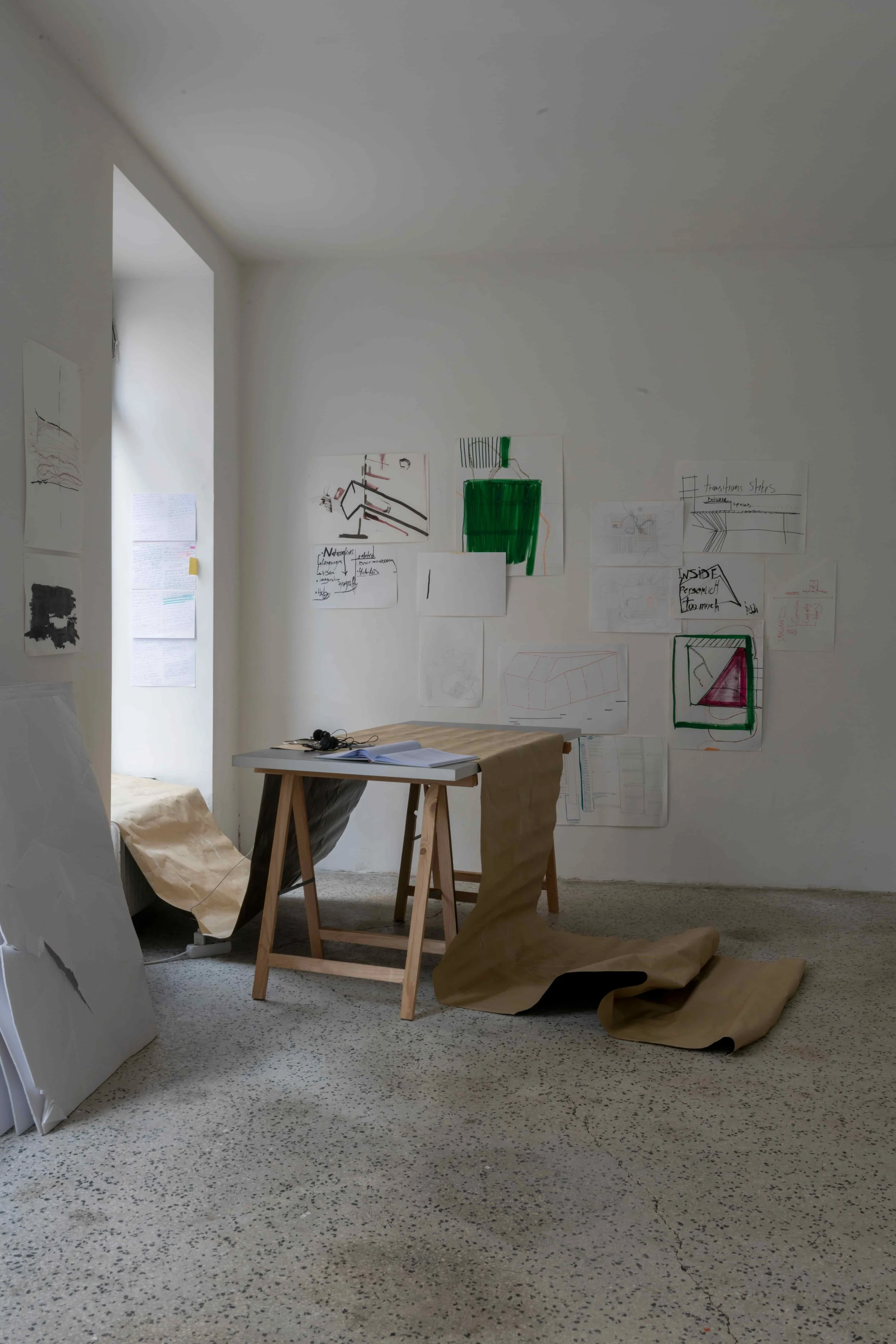
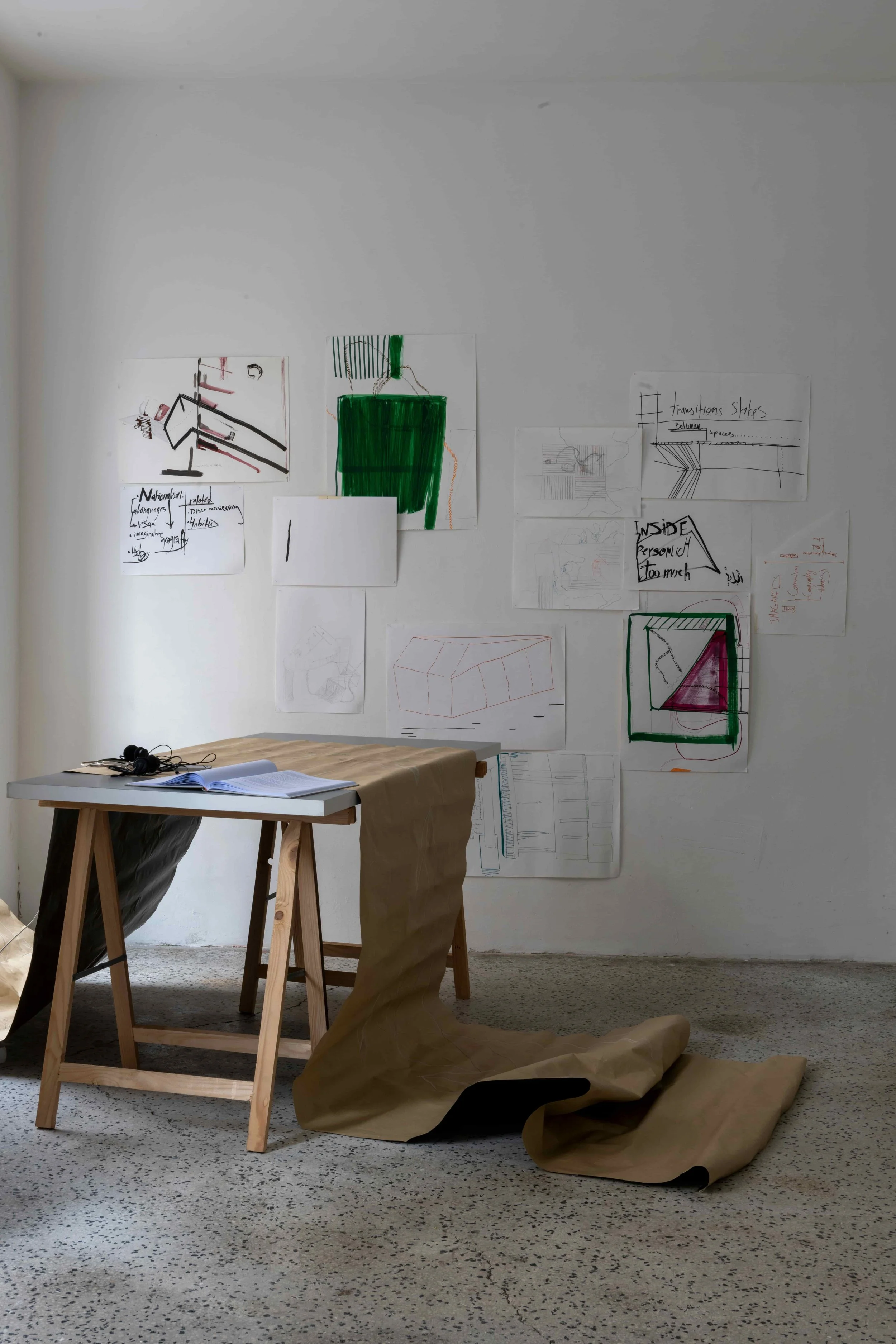
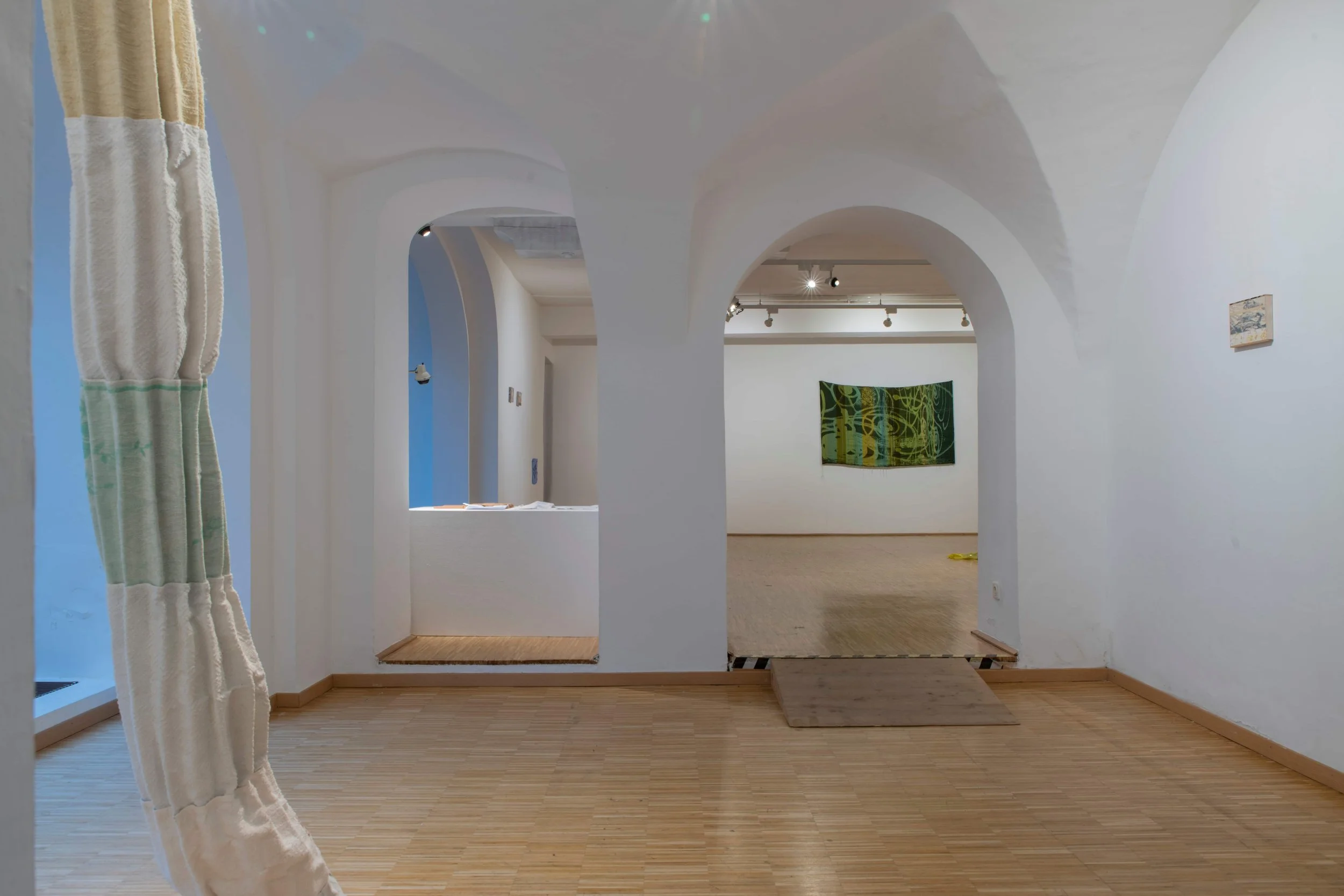
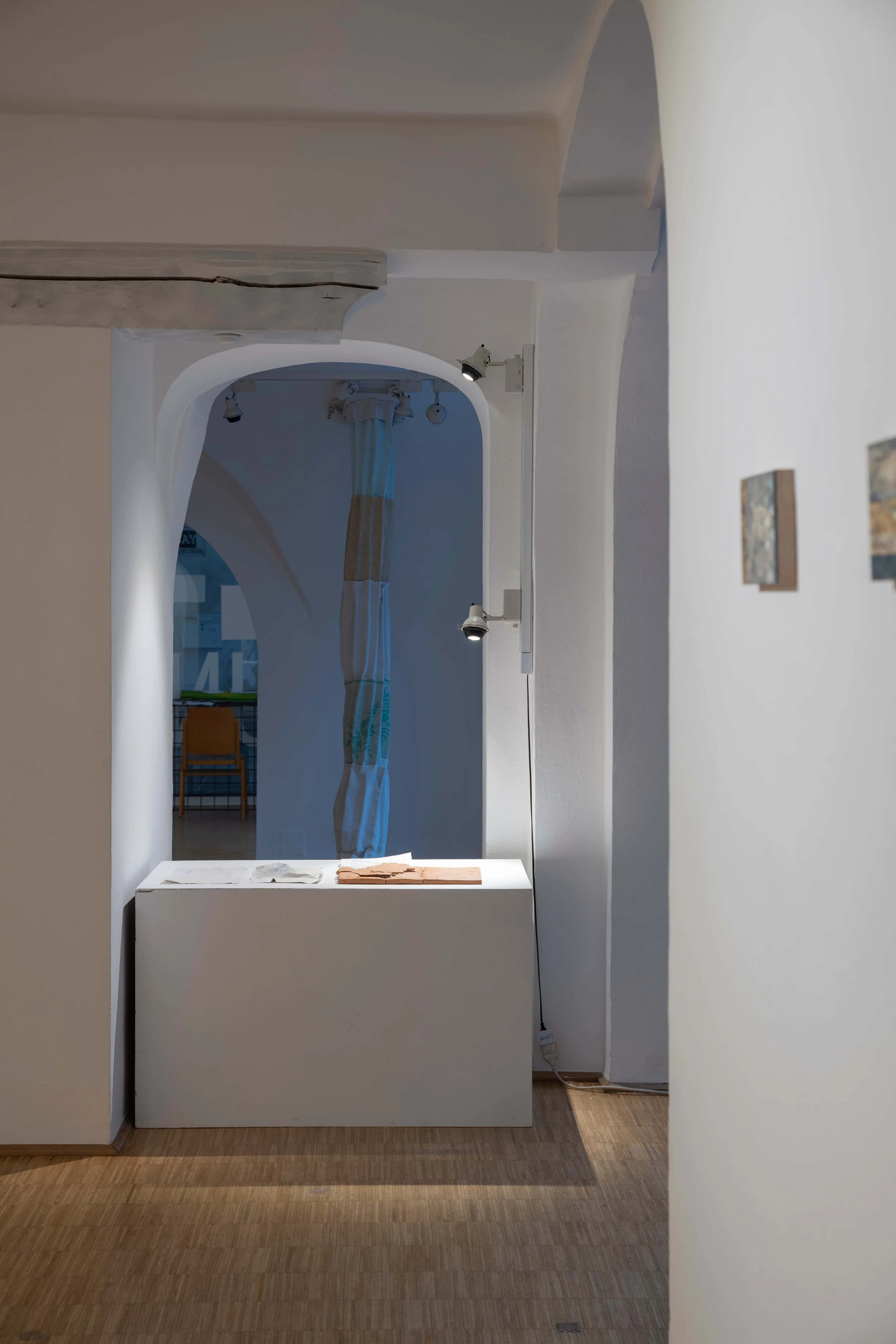
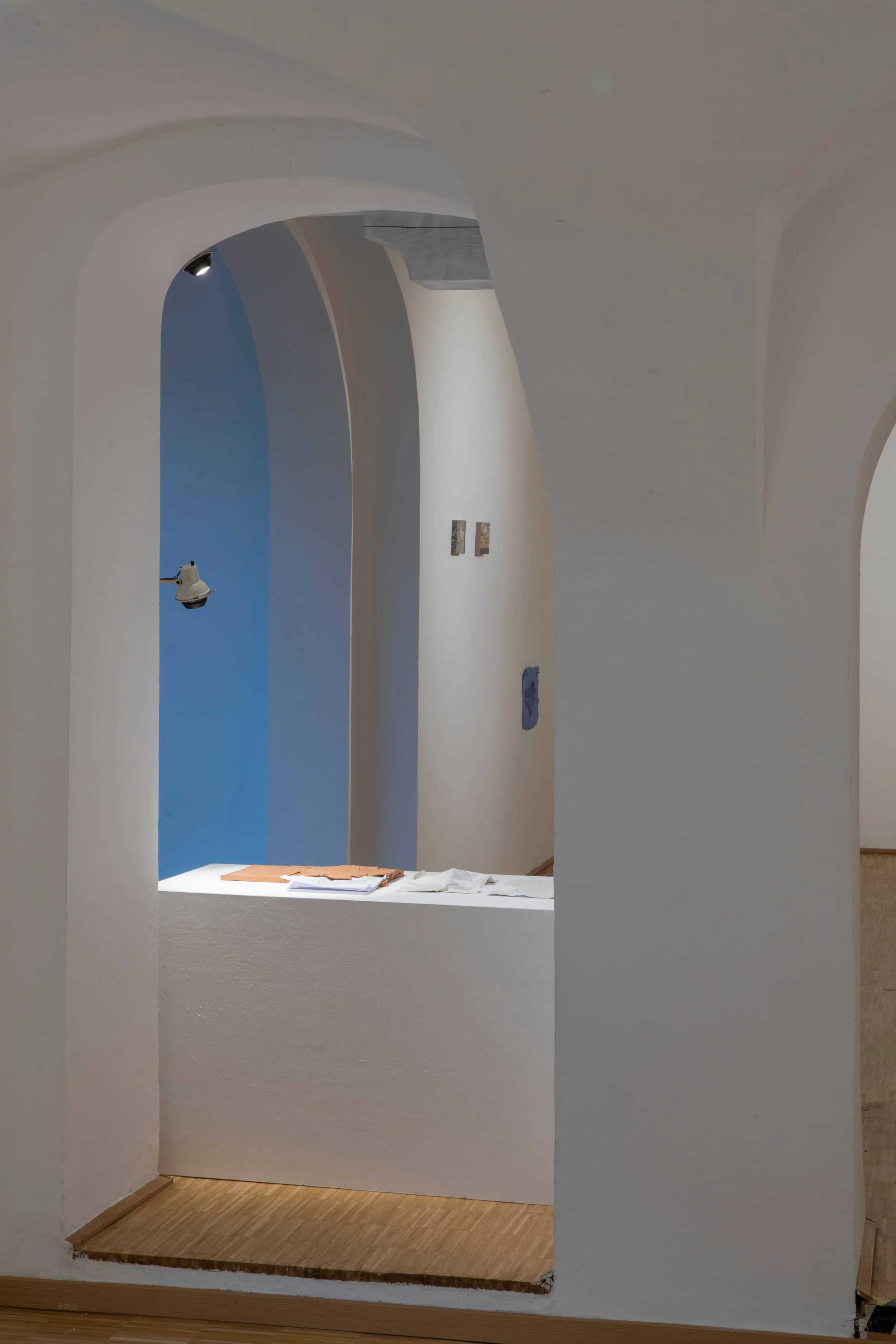
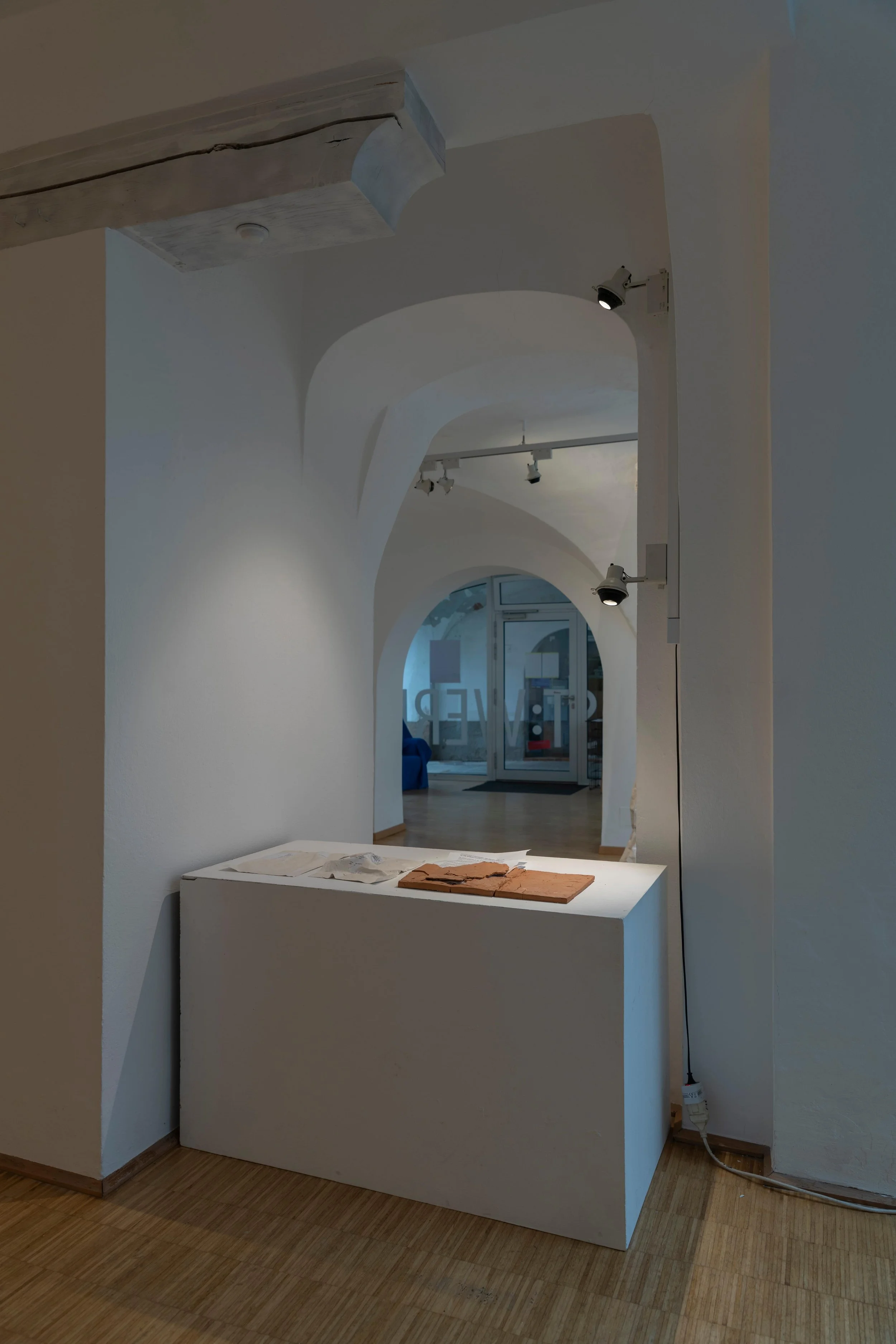
Questions of Cosmopolitanism and Boundaries of Space in the Academy of Fine Arts Vienna: The Relationship Between Art Spaces and the Policy of Inclusion and Exclusion in Them, 1994-2020, 2020.
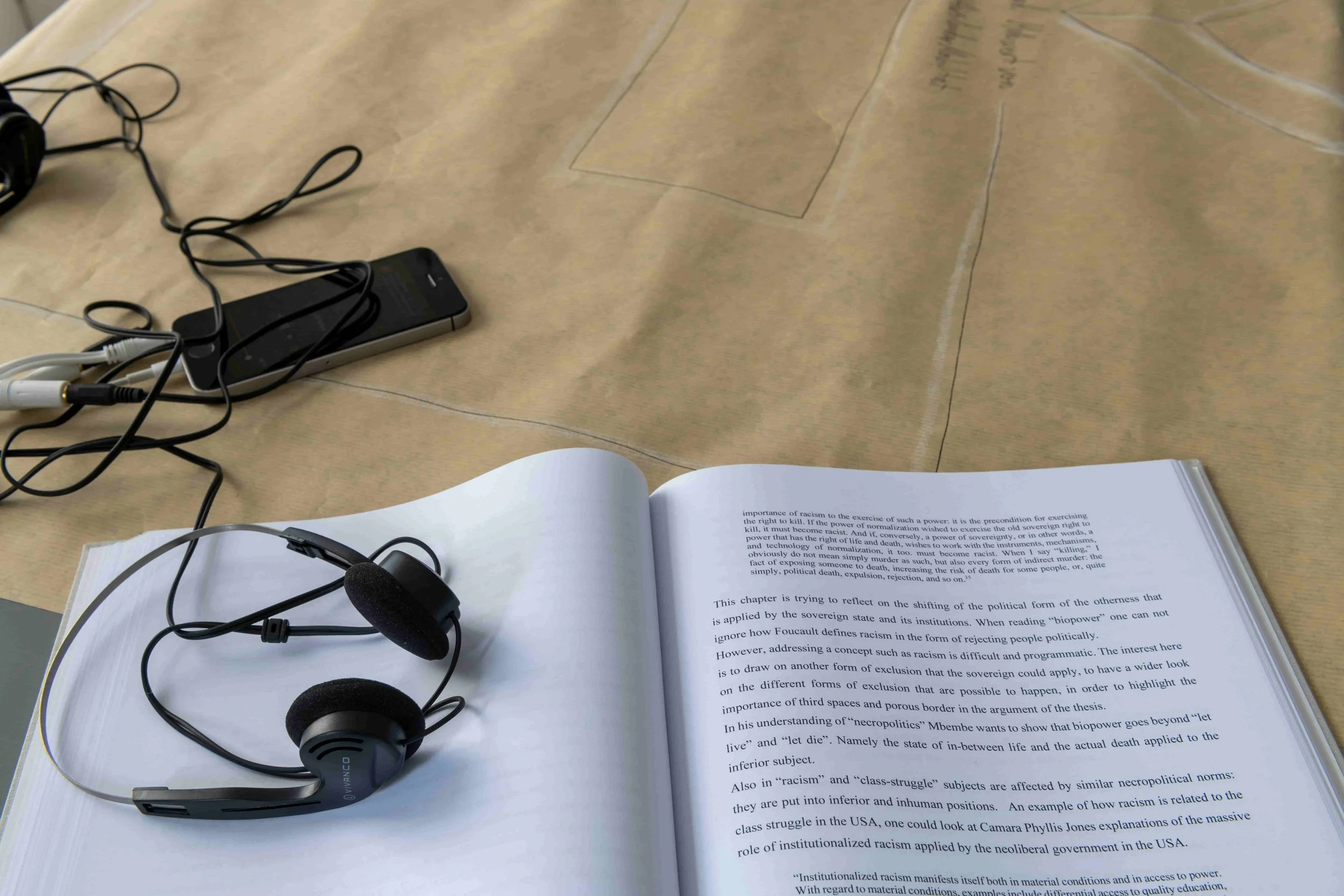
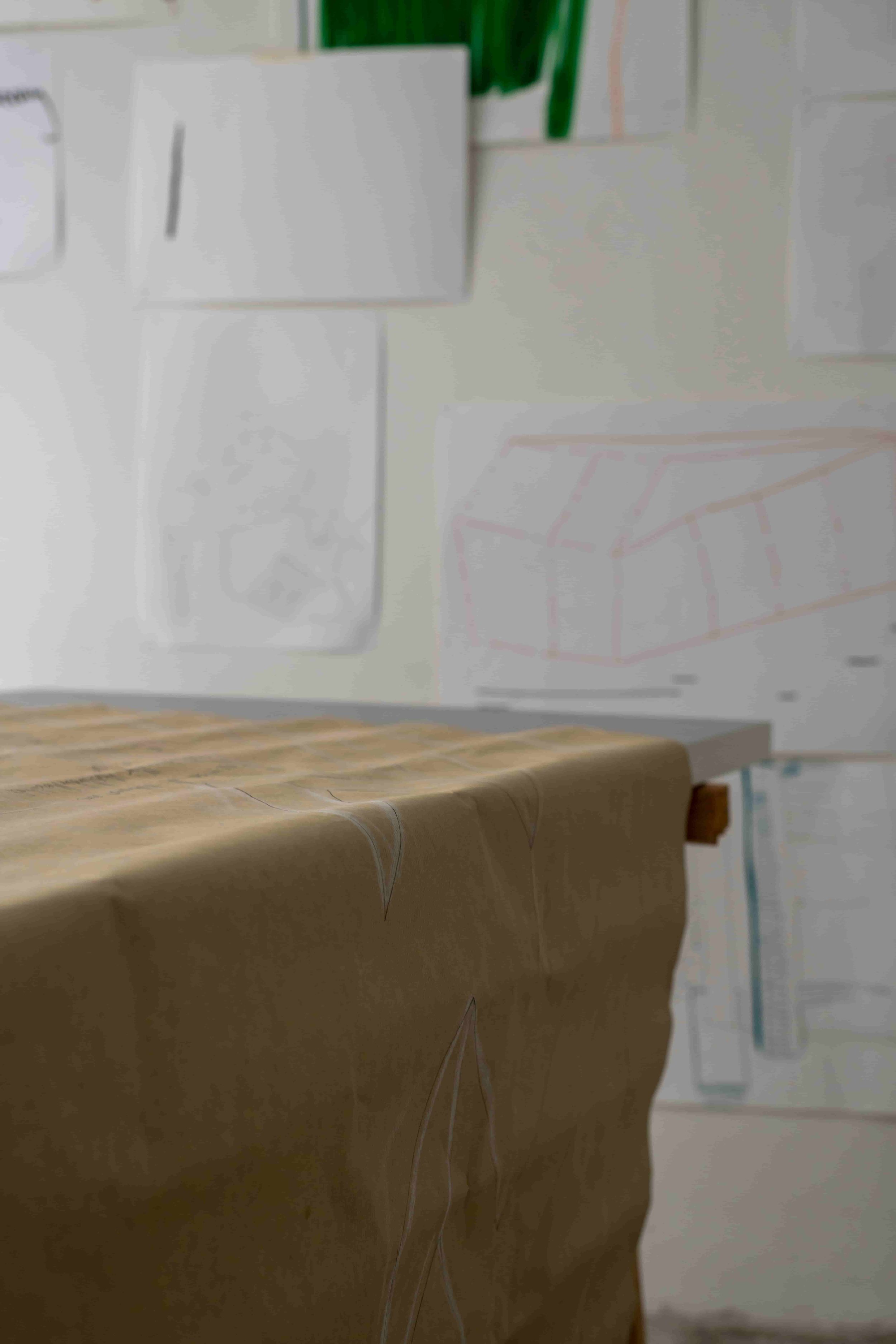
Installation, book, drawings, sketches in different materials, notes, and texts. Various dimensions and materials. Exhibition view at Viktoria Space, Vienna.
This thesis investigates how artistic contexts and educational discourses enable and produce "third spaces" at the Academy of Fine Arts Vienna. It also asks how comparable possibilities for third spaces might be pursued through the Academy's legal system. The argument develops through subjective experience and through a journey across these connected fields.
The thesis begins with dualisms whose boundaries I seek to blur: art sphere and legal system, art and theory, West and East, exclusion and inclusion, necropolitics and biopower, and drawing and writing. Drawing functions as a method for tracing third spaces that emerge between these positions rather than remaining contained by either side.
The methodological approach is an act of unfolding experiences: experiences of spaces and boundaries, of the body, and of reading, thinking, and writing. These subjective experiences produce subjective forms of knowledge - what can be understood as body knowledge. Their traces appear in forms of in-betweenness through the construction and deconstruction of architecture, language, narration, and emotional relations to these elements.
The thesis is a hybrid form of drawing and writing. Personal experience and theoretical reflection accompany one another, while drawings interrupt and reorganize the chapters. The mixed use of visual form, concepts, and languages both reveals and unsettles hierarchies between art and theory.

About the artwork
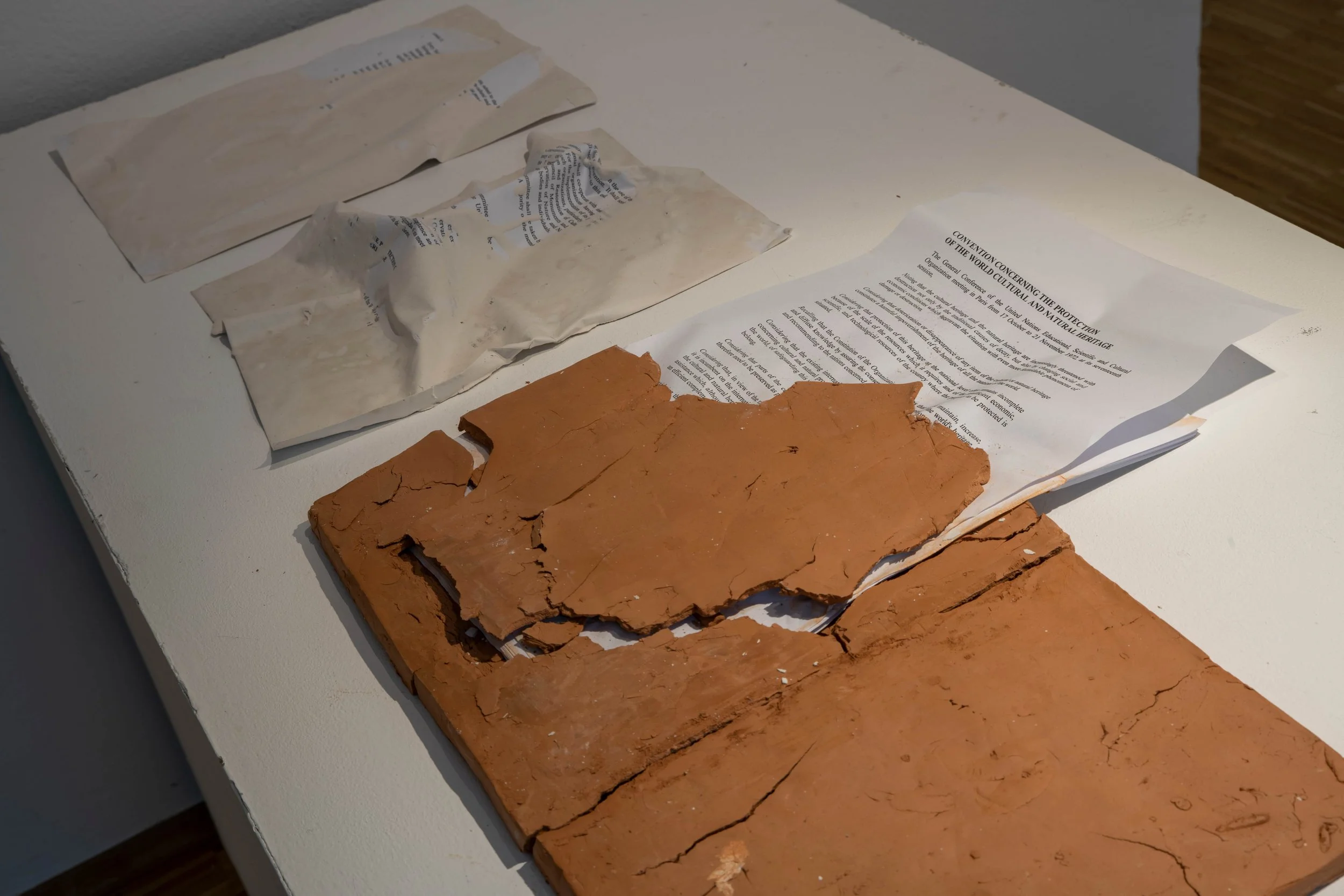
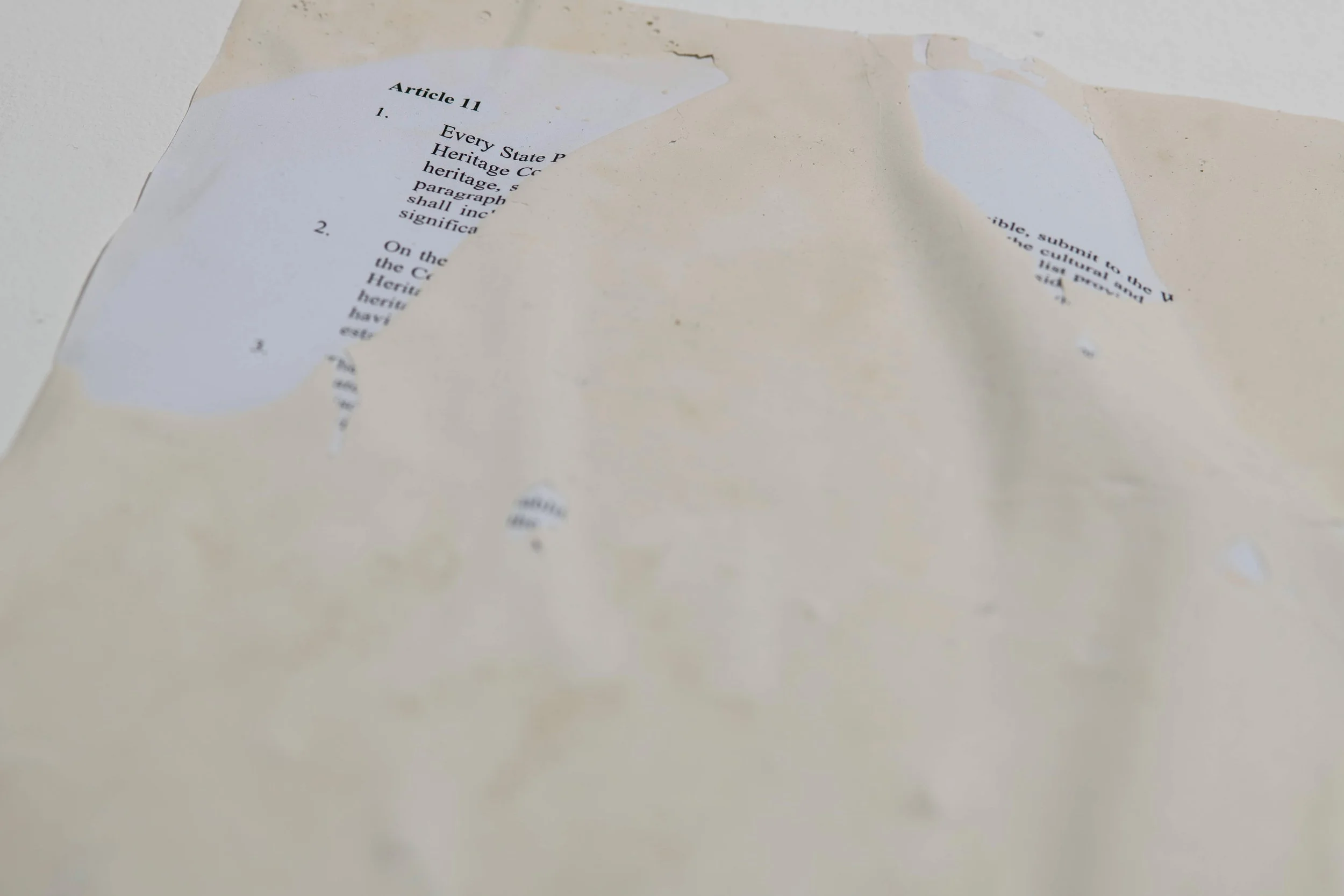
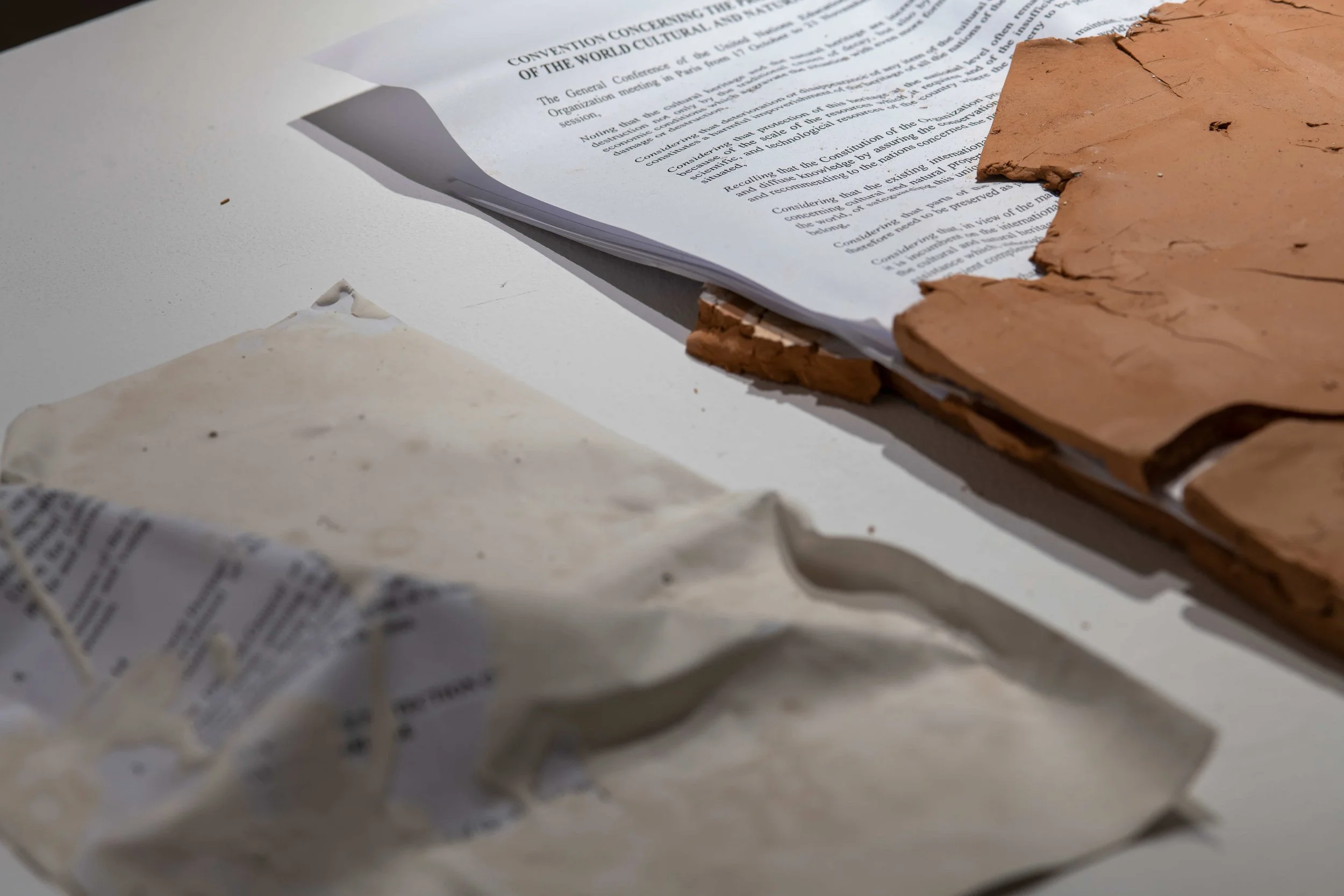
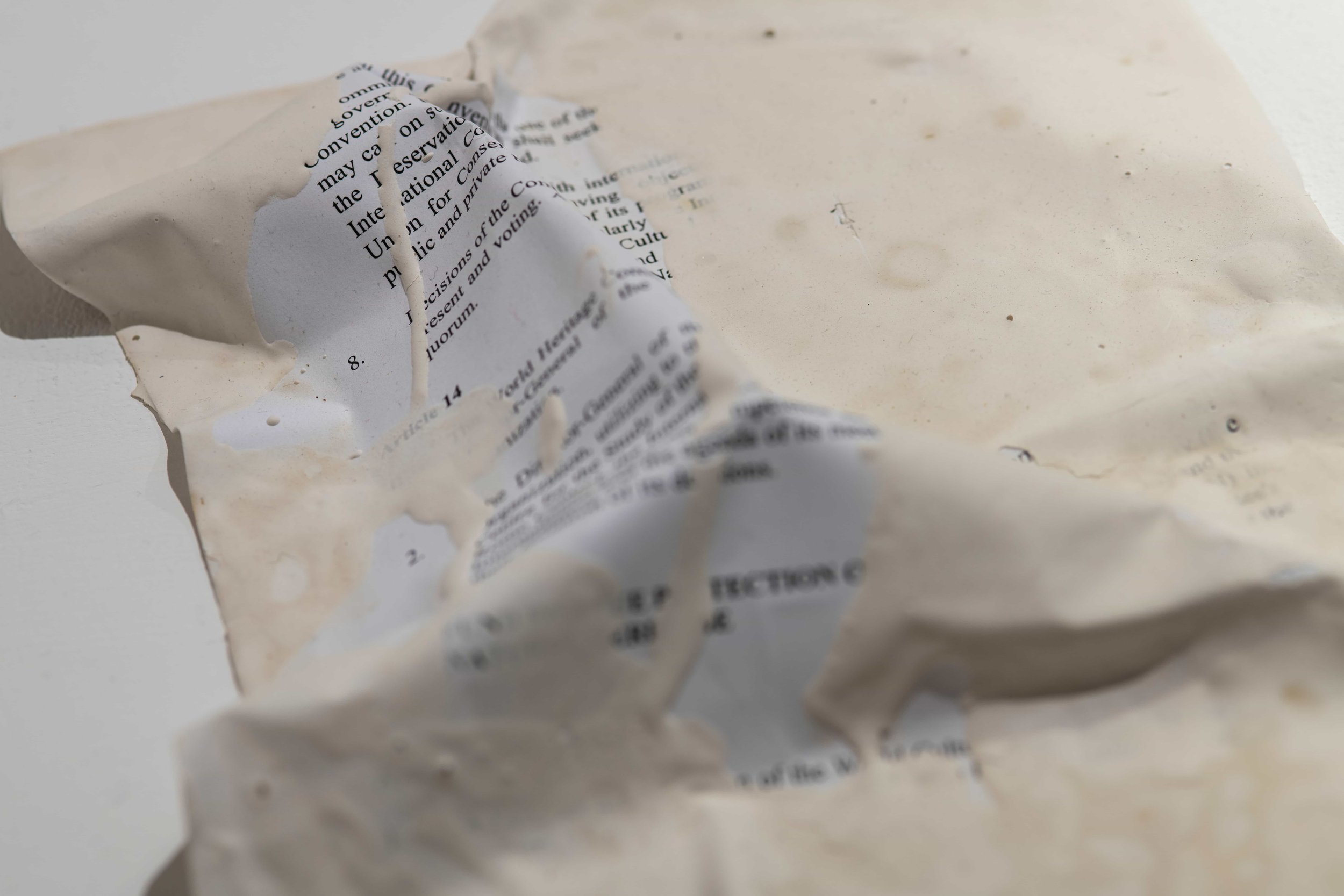
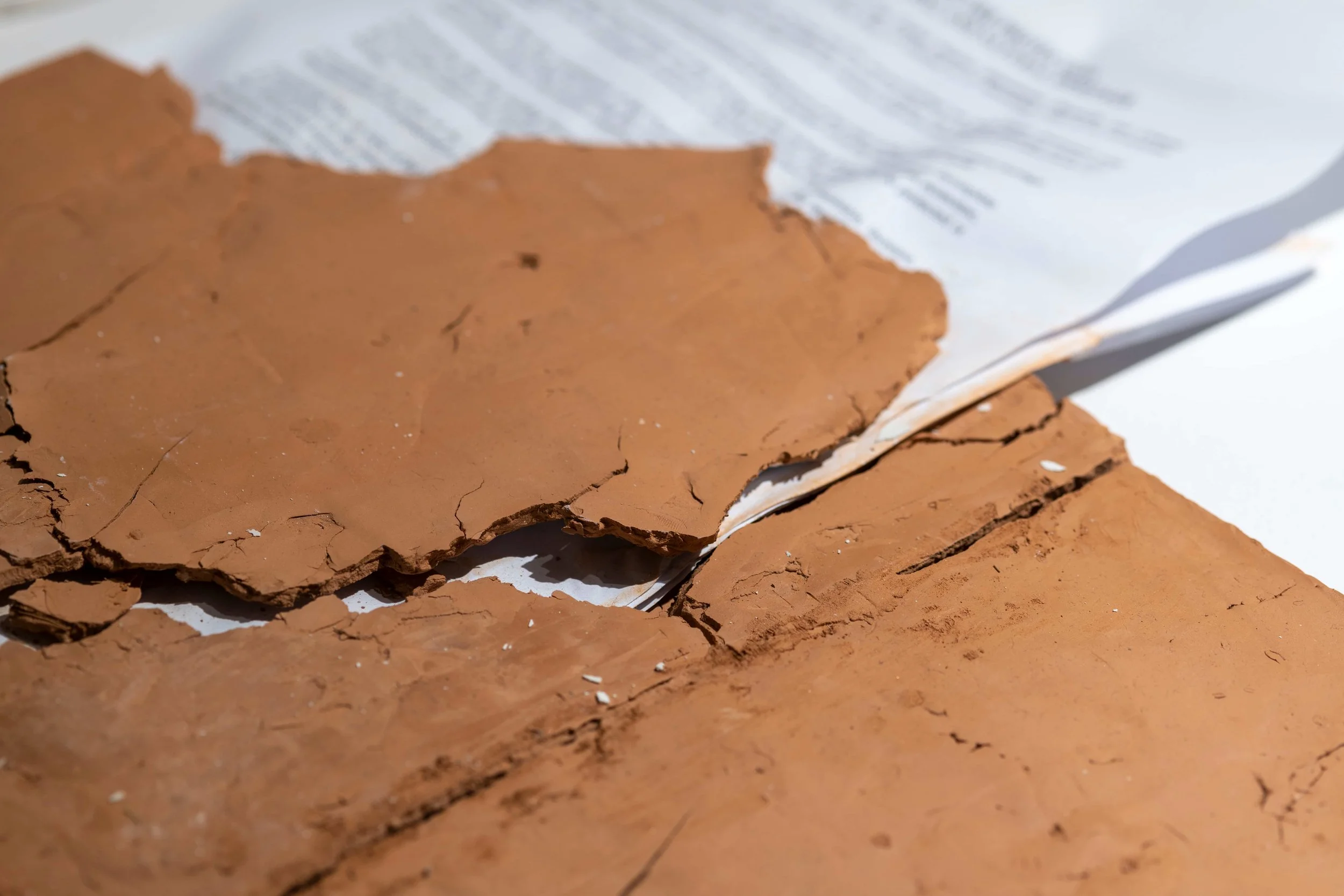
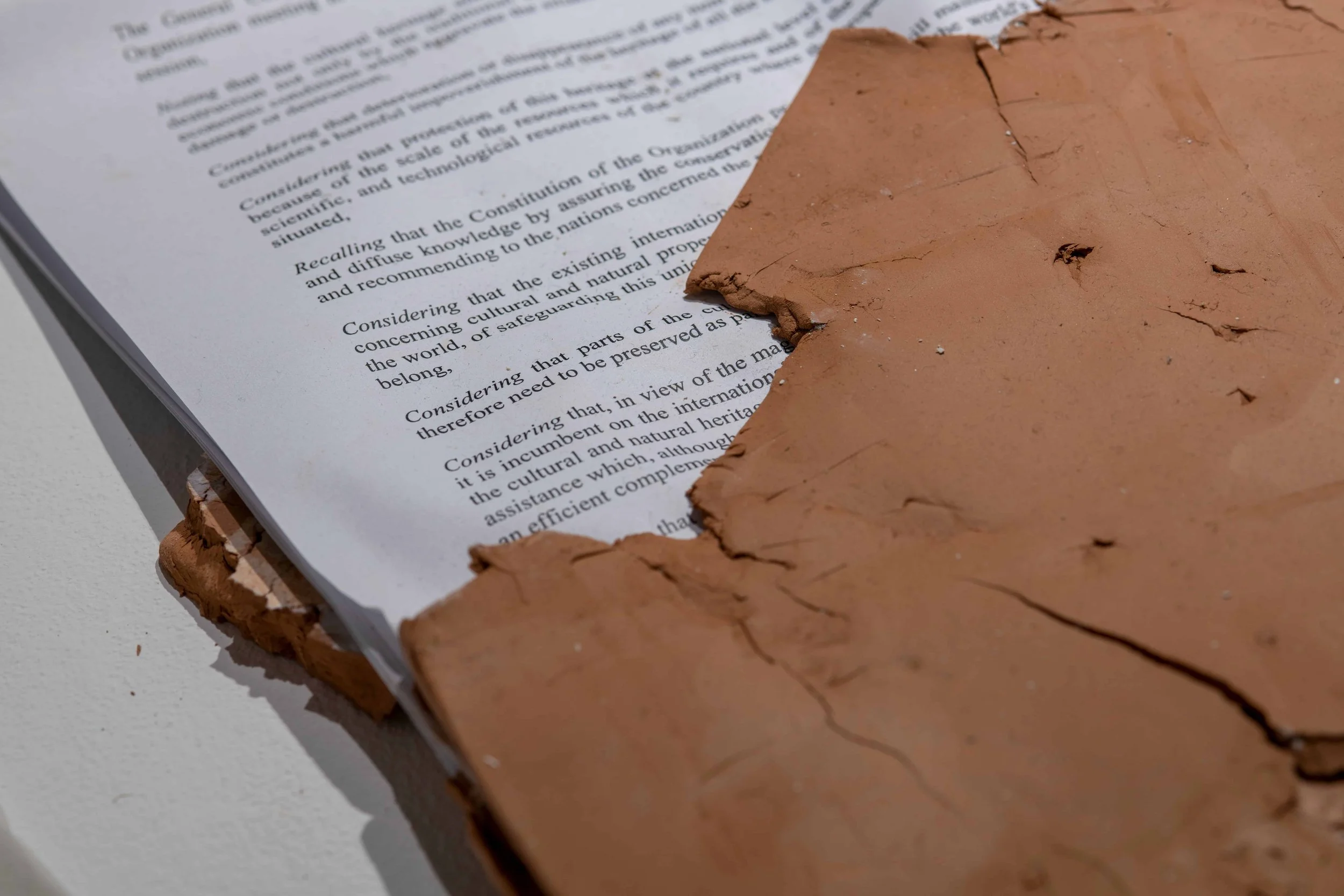
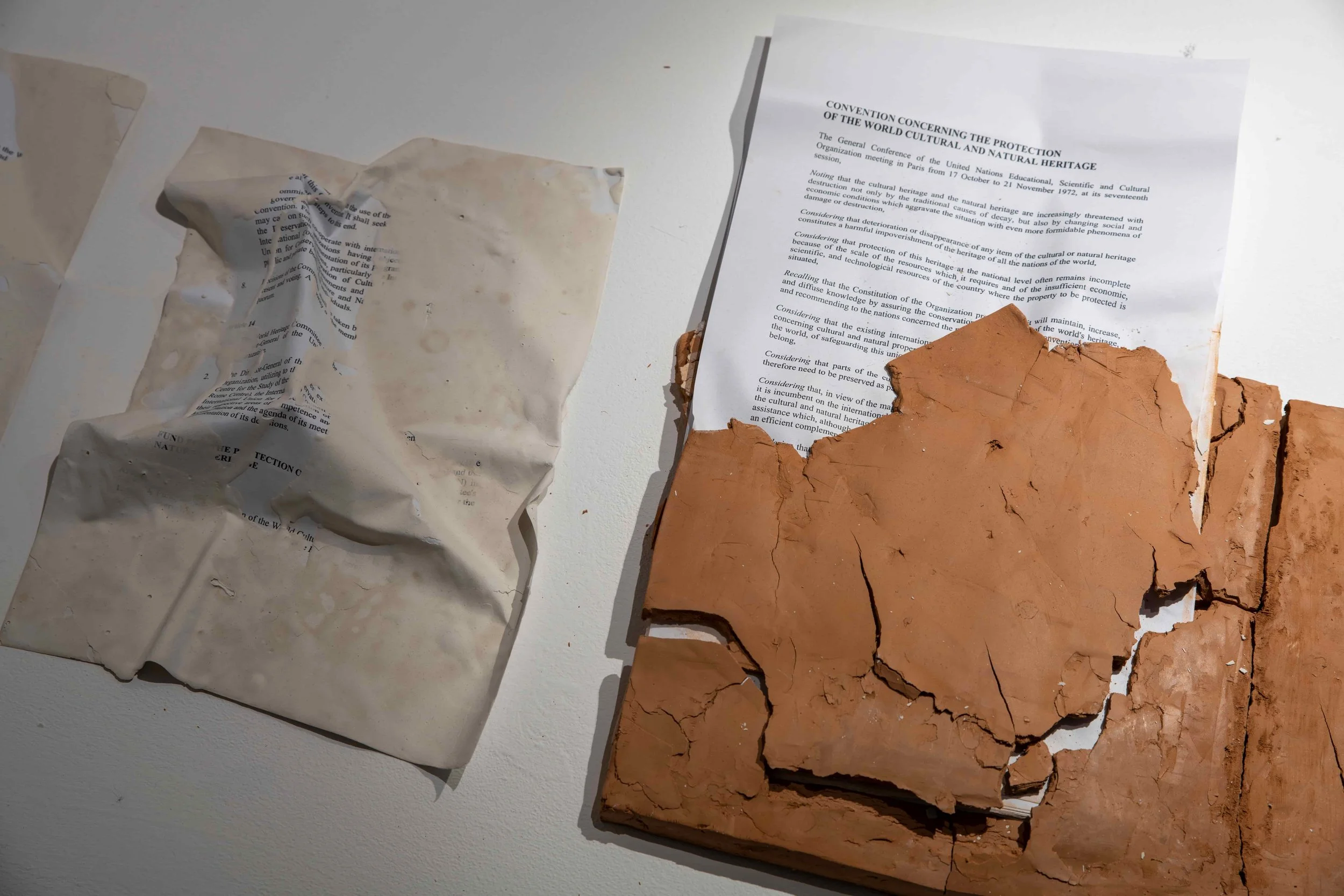
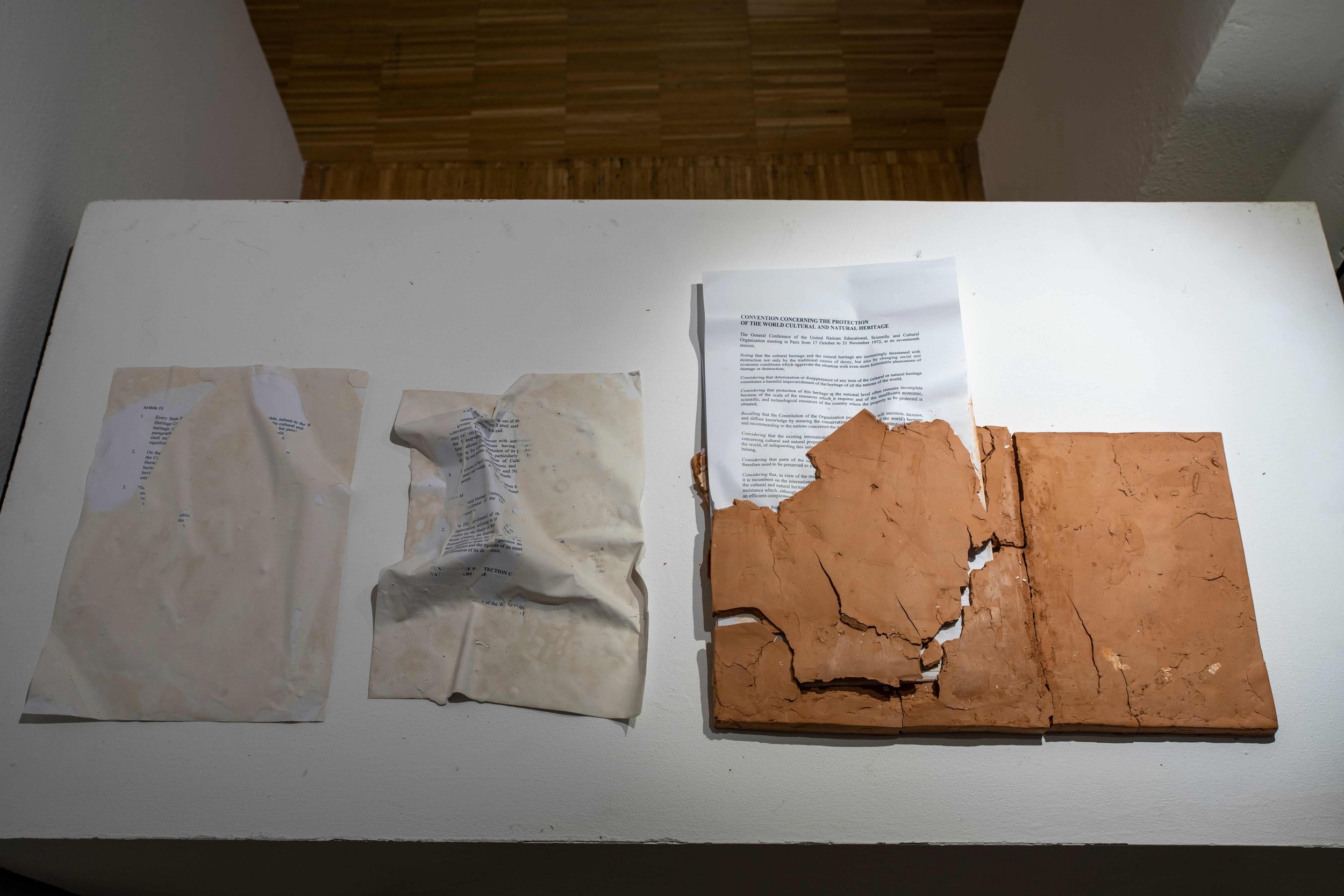
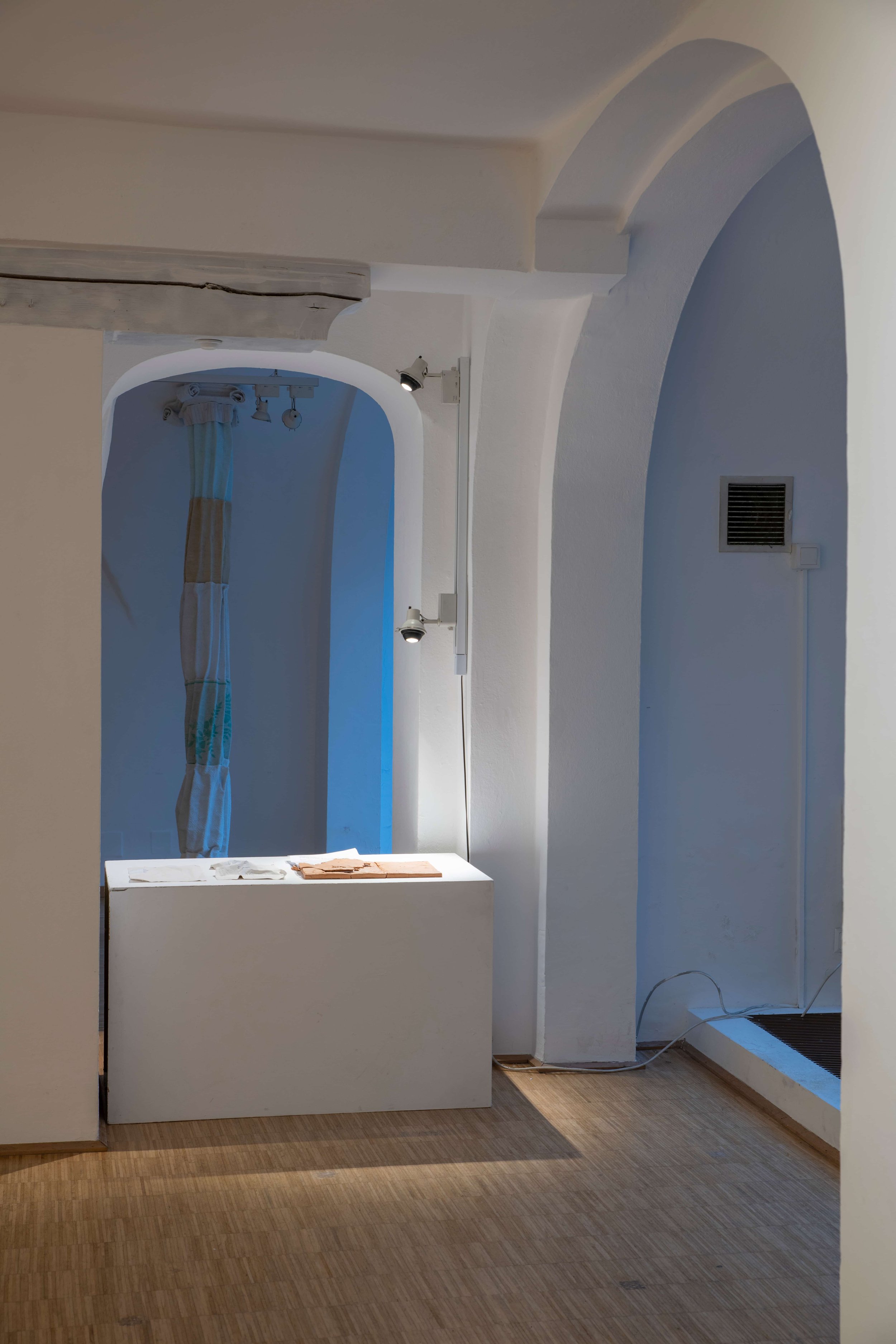
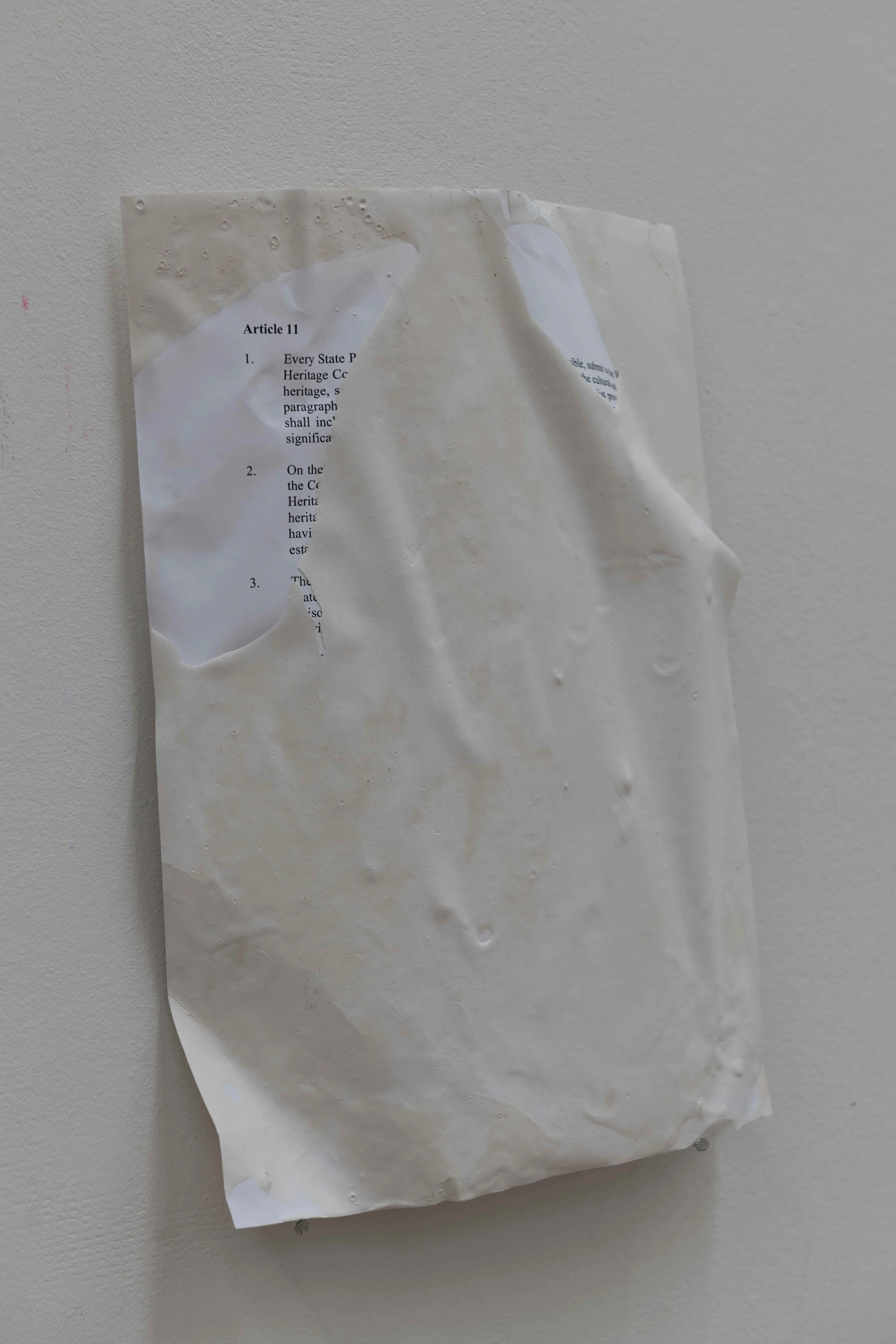
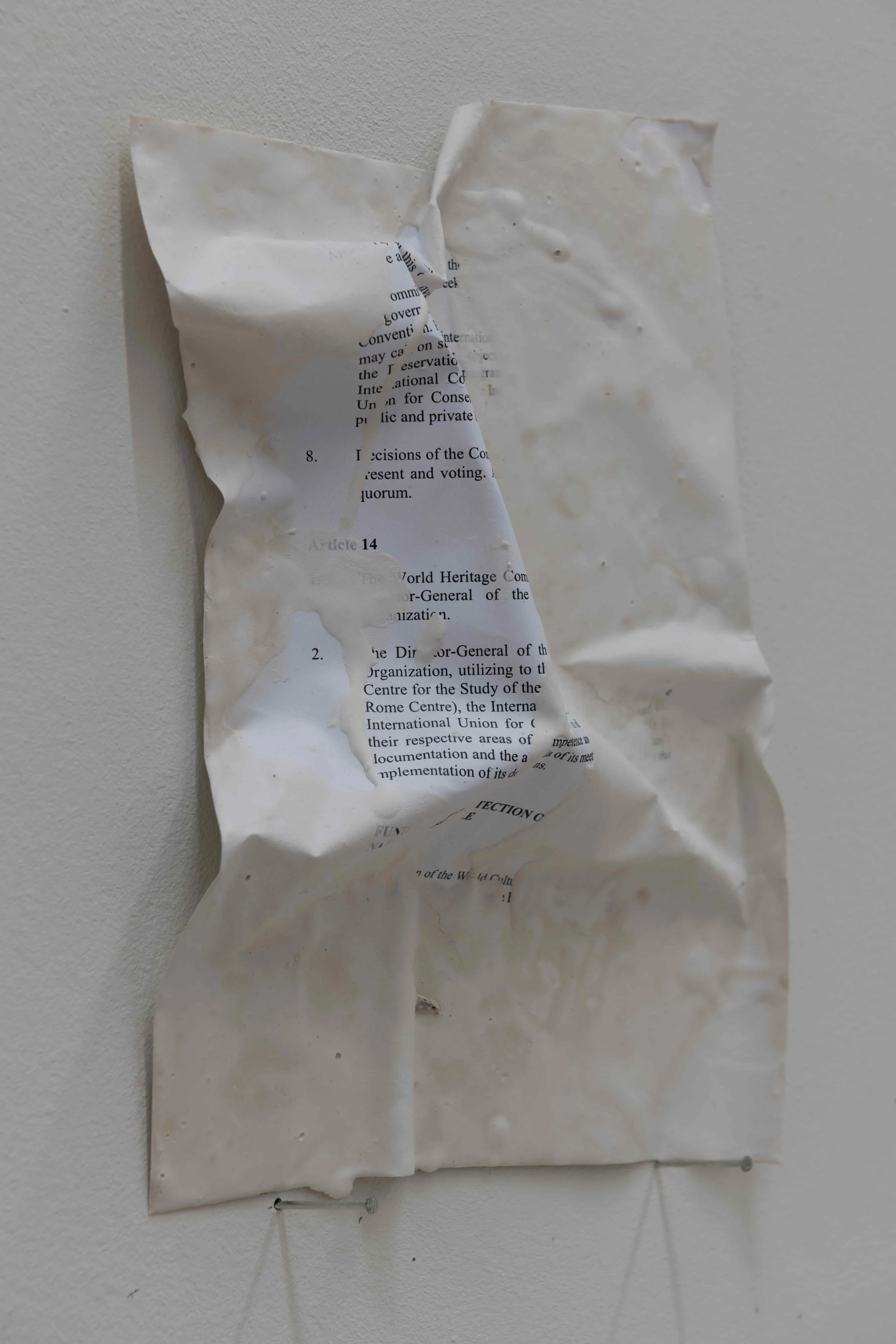
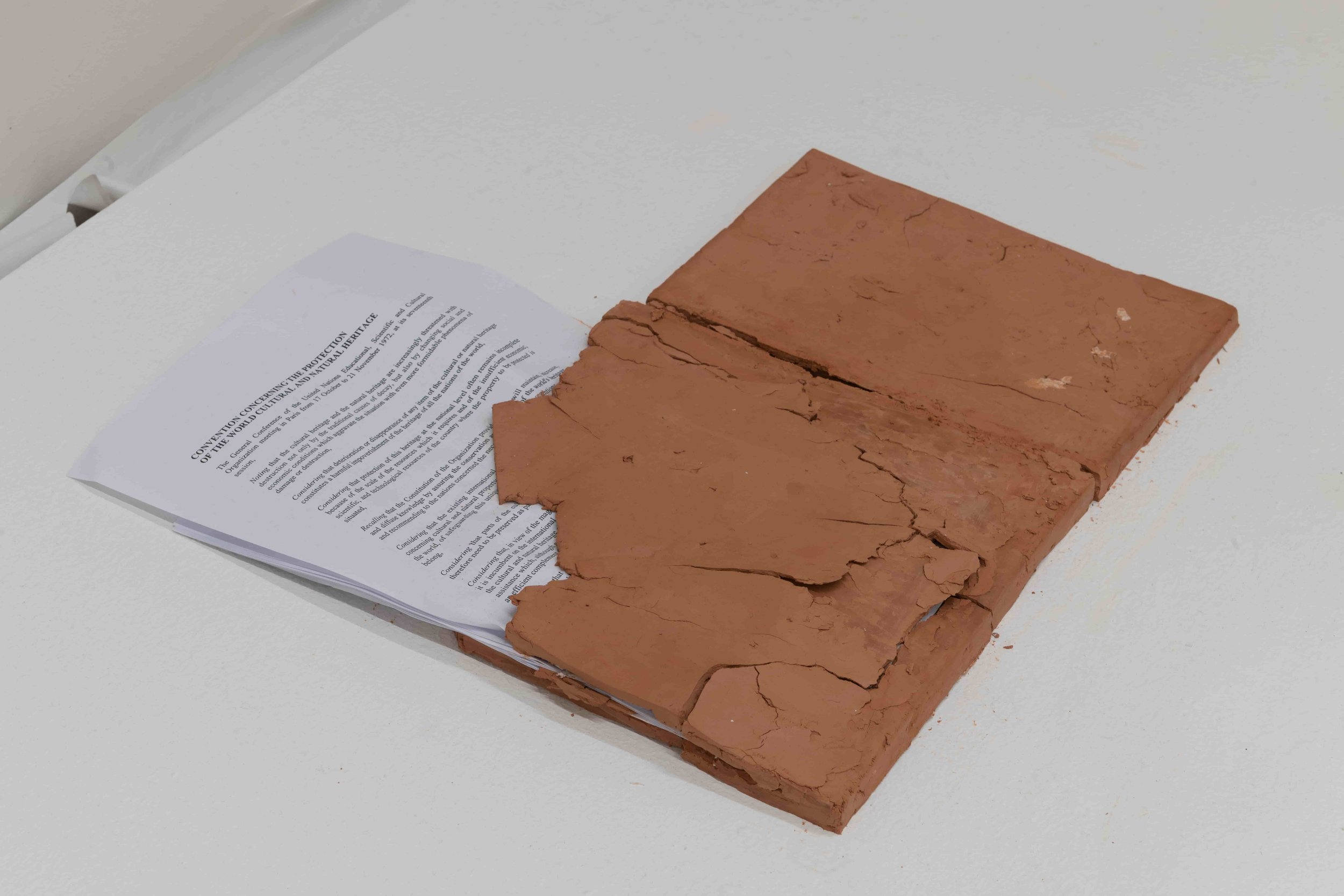
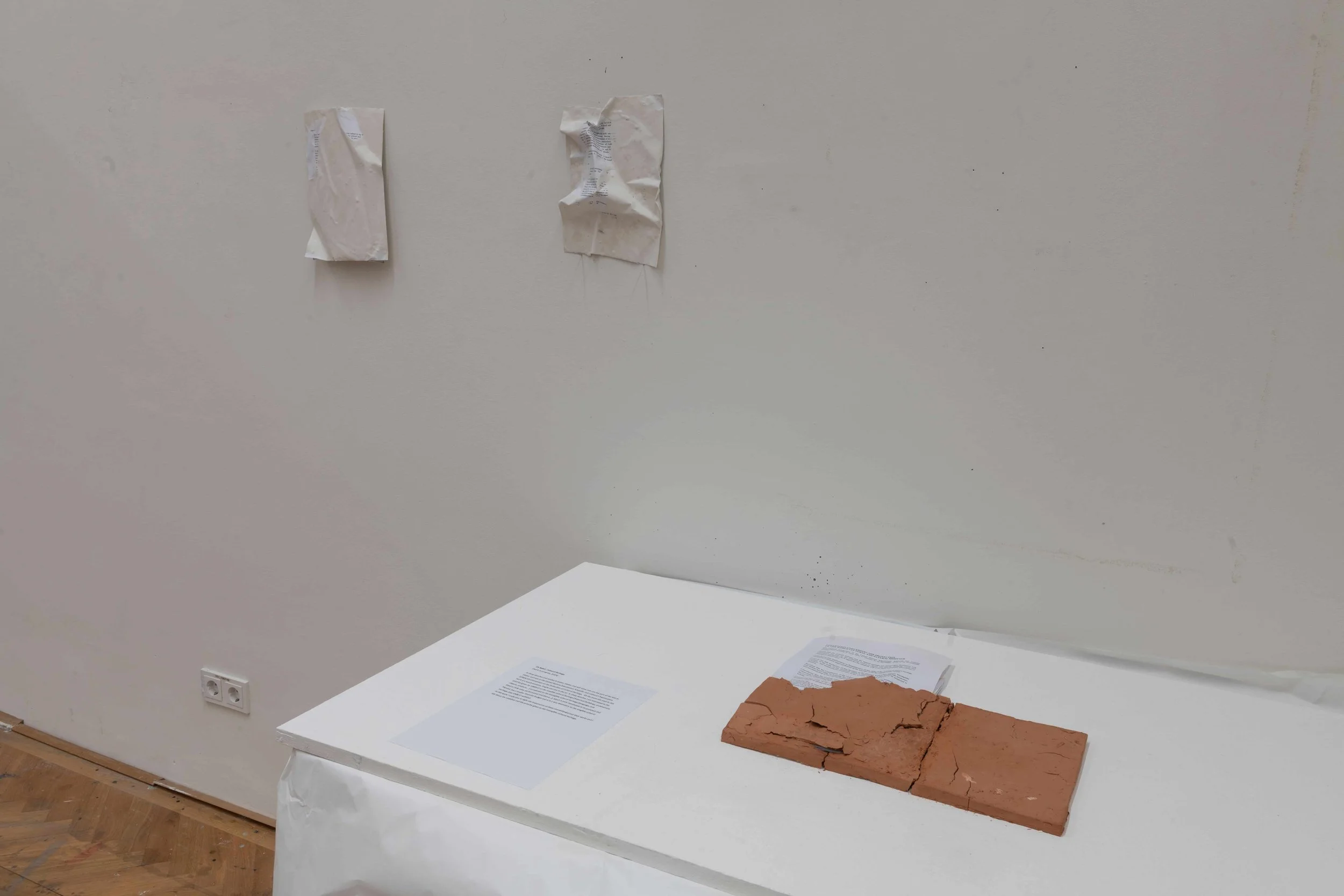
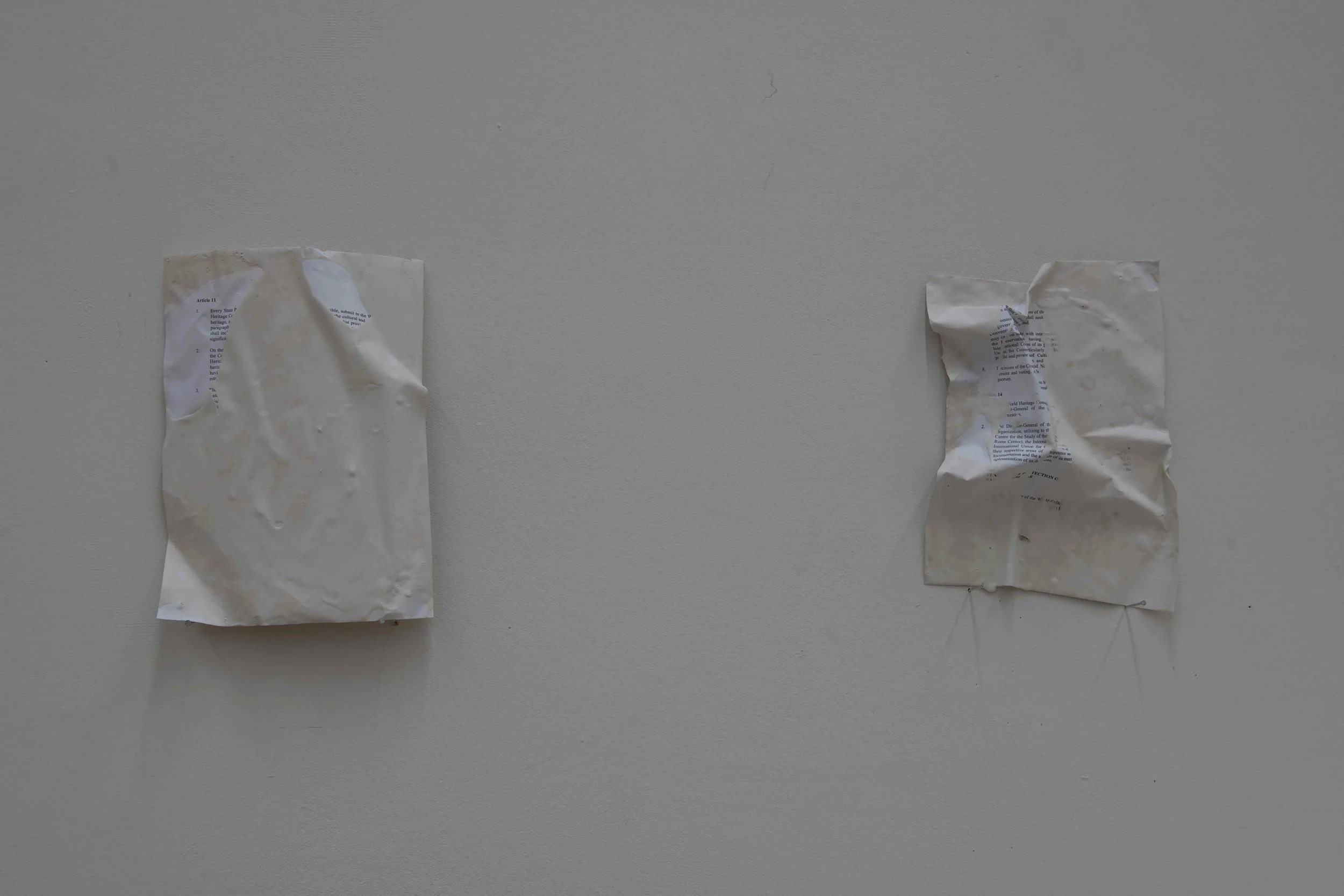
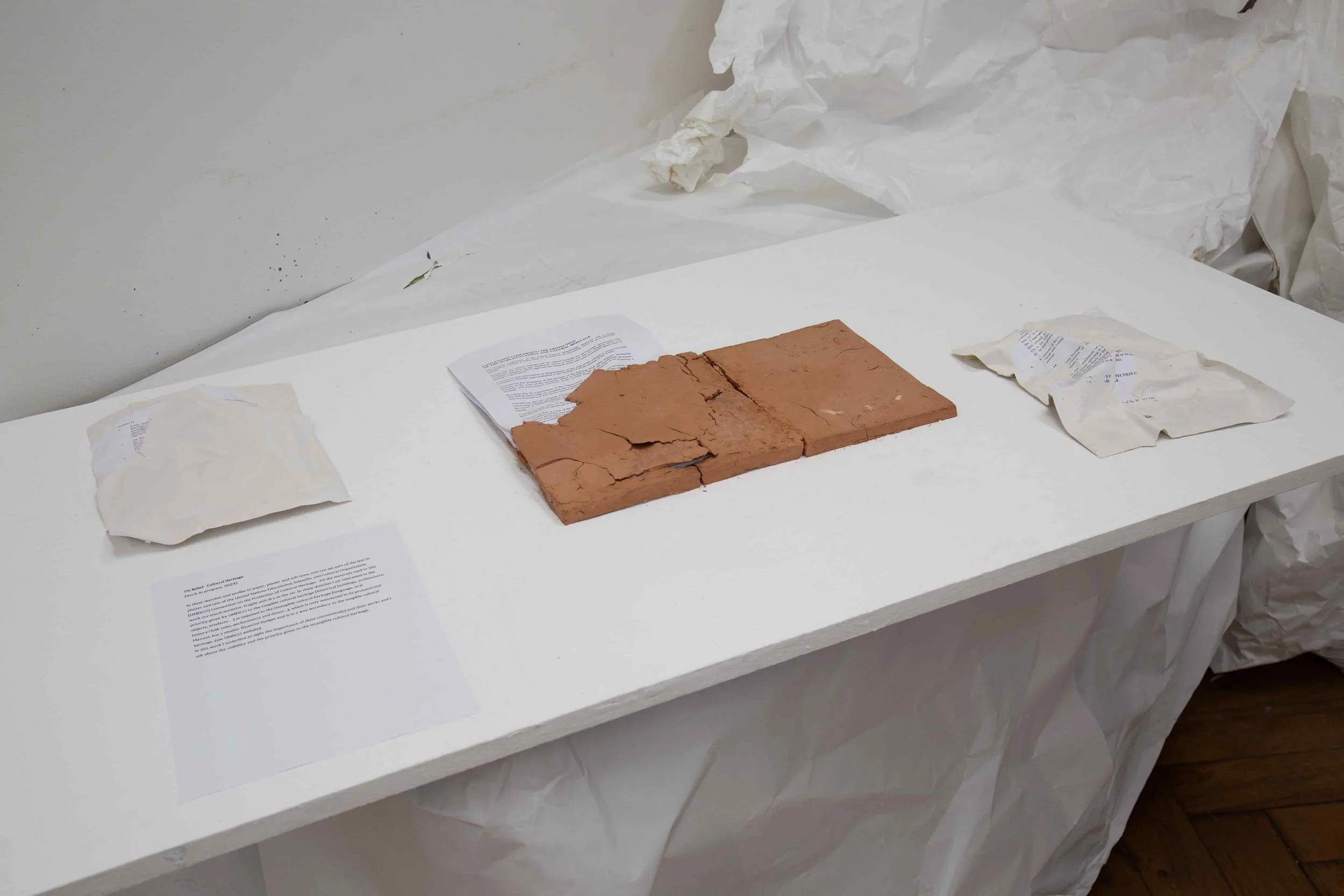
ON BELIEF: CULTURAL HERITAGE (work in progress, 2024).
The sketches and studies presented here are composed of paper, plaster, and soft tone. They incorporate part of the text of a United Nations Educational, Scientific and Cultural Organization (UNESCO) convention on the protection of cultural heritage. All the materials used in the work are touch-sensitive, fragile, and air-drying.
In these sketches, I am interested in the priority UNESCO gives to tangible cultural heritage - historical buildings, architecture, objects, and artefacts - in contrast to intangible cultural heritage such as language, oral history and folk tales, performance, and dance. Although intangible heritage is addressed in protocols and manuals, it often receives a smaller financial budget and is treated as secondary to tangible heritage.
The work brings the significance of these conventions into view and asks how intangible cultural heritage is made visible and what priority it is given.
About the artwork
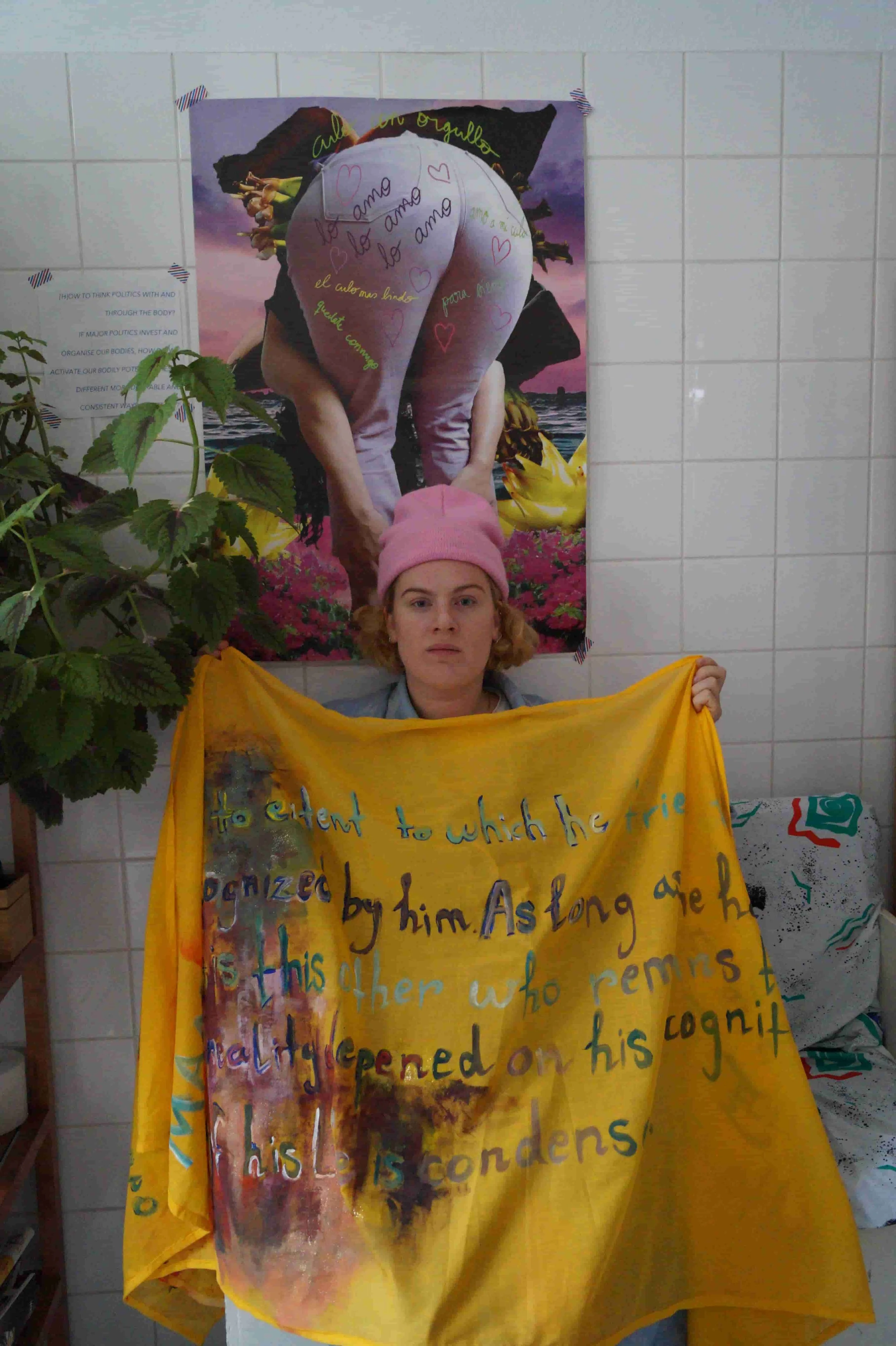
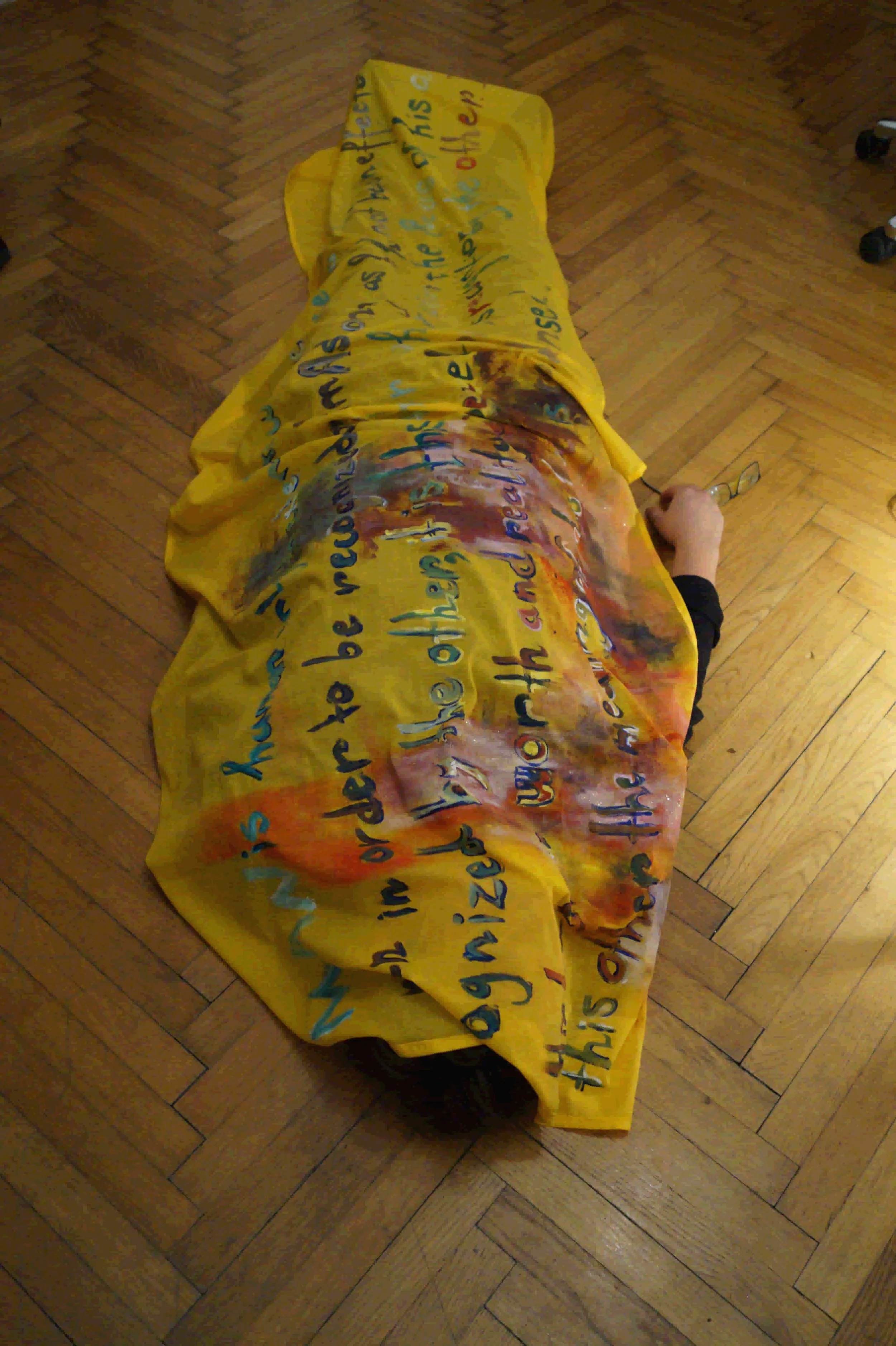
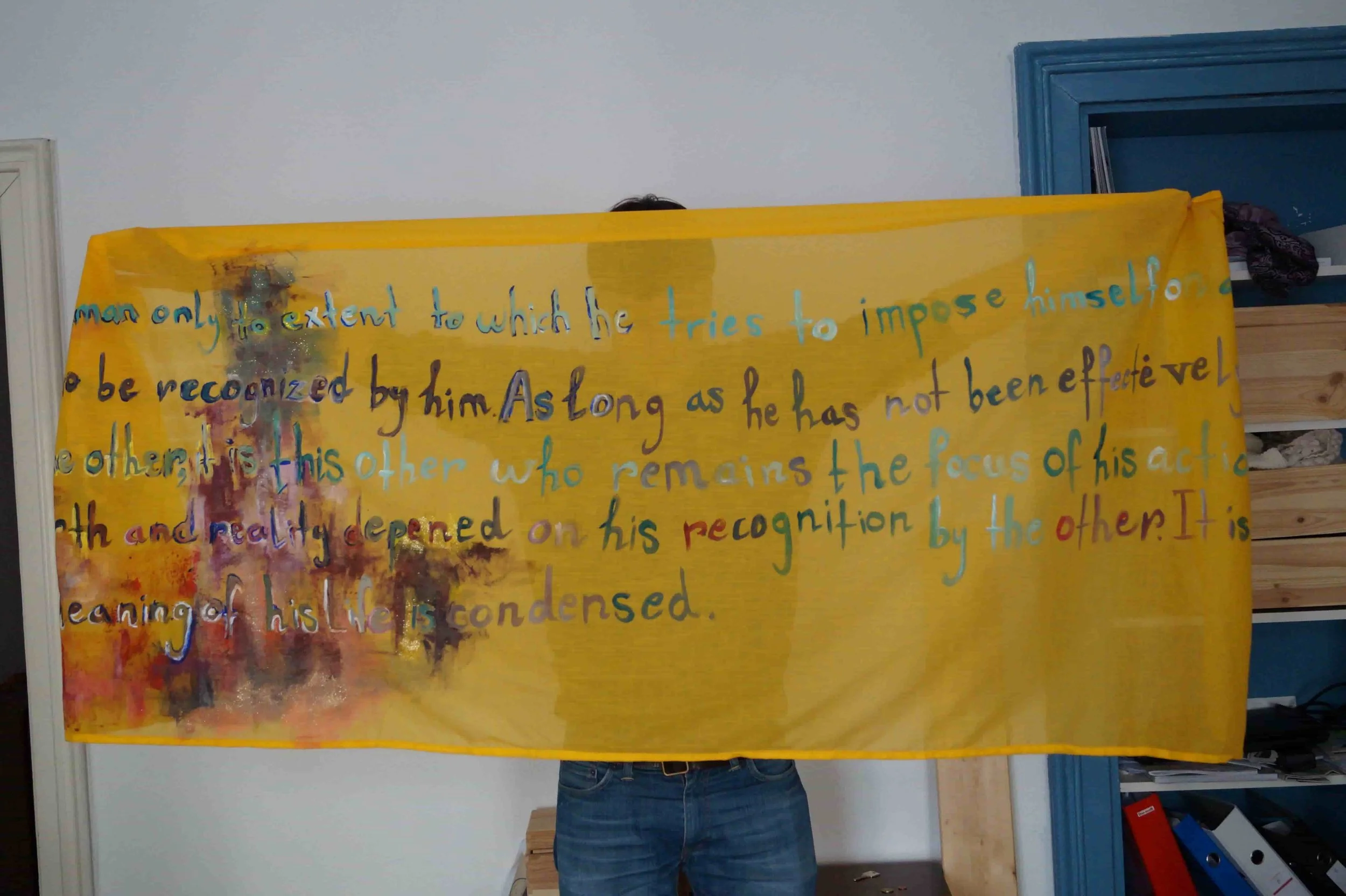
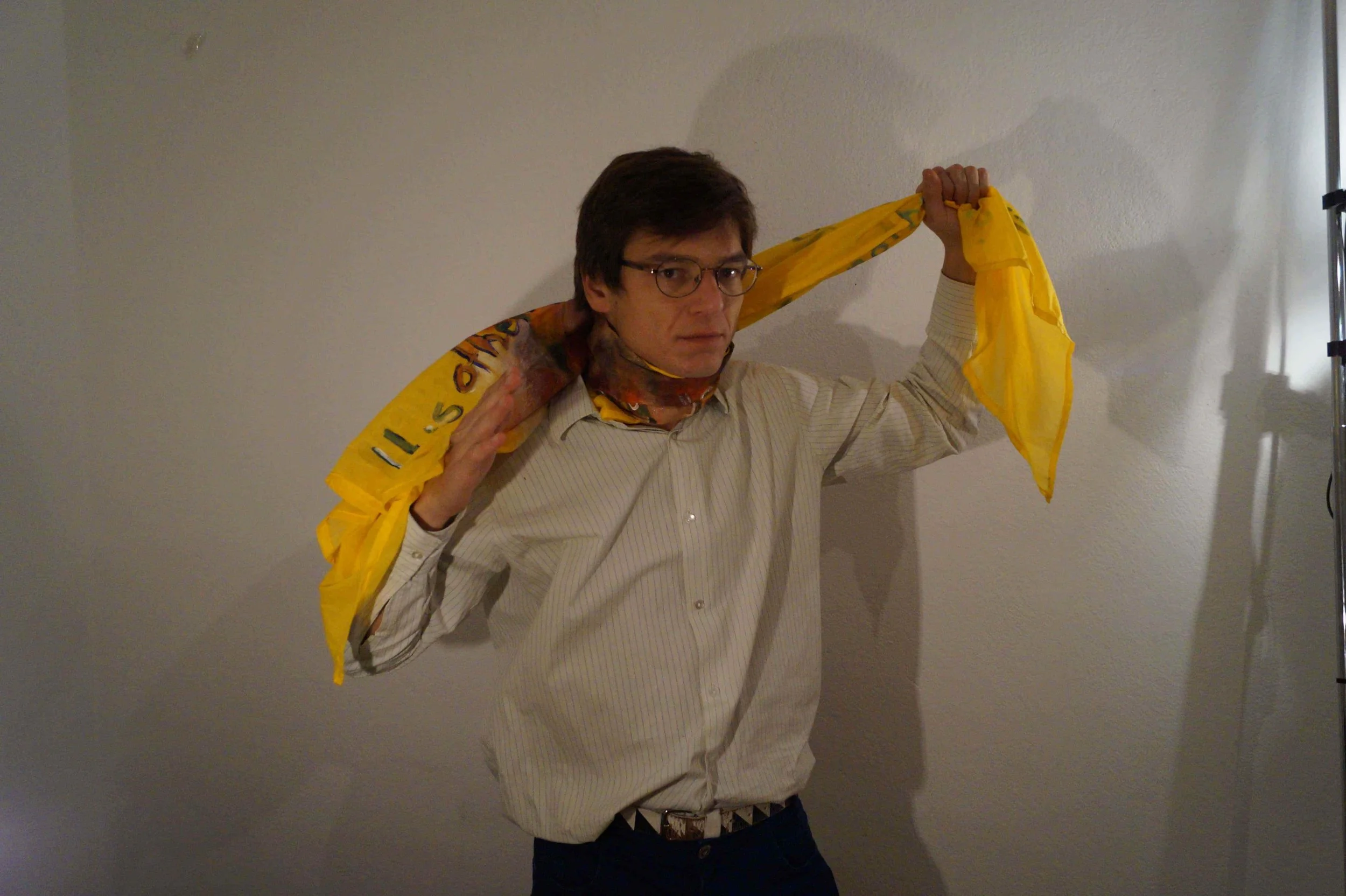
In Conversation, 2017, with Maren Blume, Peter Haselmayer, Valentin Häckl, Samuel Hbicht, Laura Nitsch, and Ben Owen-Browne.
Photographs: a selection from the series In Conversation, photographed with a Sony Alpha. © Marwa Abou Hatab, 2017.
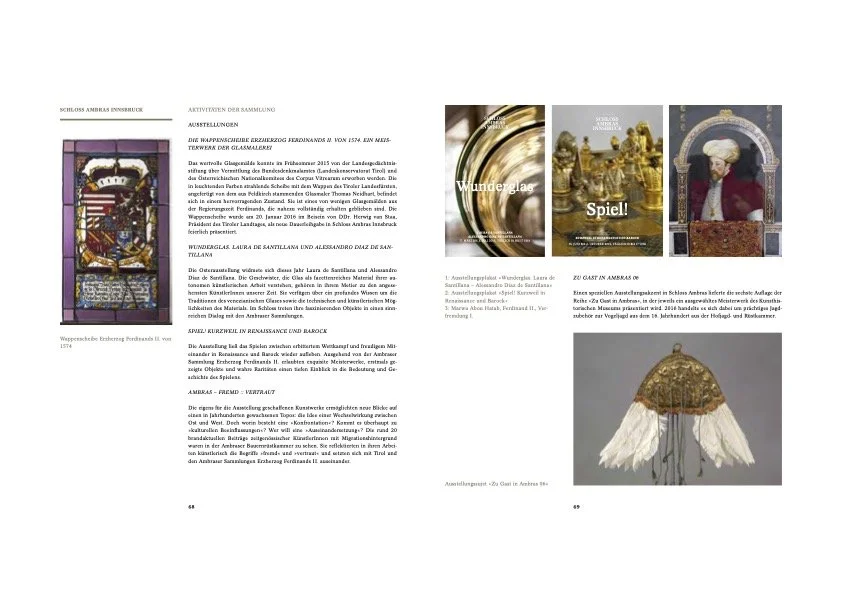
„Ein Zitat von Frantz Fanon aus Black Skin, White Masks tauchte während ihrer Auseinandersetzung mit Texten über das Buch des afro-karibischen Psychiaters und Vordenkers der Dekolonisation immer wieder auf - stets hervorgehoben und deshalb gelb unterlegt. Abou Hatab verwendete das Zitat, indem sie dessen Worte auf ein Stück gelbes Tuch malte und mehrere Personen bat, sich damit an einem Ort und in der Pose eigener Wahl fotografieren zu lassen. Ergänzt um ein Statement, das jede der Personen abgab, entstand daraus die Arbeit In Conversation (2017), in der das hervorgehobene Fanon-Zitat nicht nur verbildlicht und als Objekt in der physischen Welt materialisiert, sondern aufgrund der je individuellen ‚Verwendung' durch verschiedene Menschen zu diesen in ein Verhältnis gesetzt und im Raum verortet wurde.
Die Herangehensweise erinnert an Real Life Gaming - als würde Tetris mit Gegenständen des täglichen Lebens gespielt.
Wie auch in der Masterarbeit geht es hier aber um den ‚Habitus' (nach Pierre Bourdieu), der das soziale Spiel bestimmt.“

About the artwork
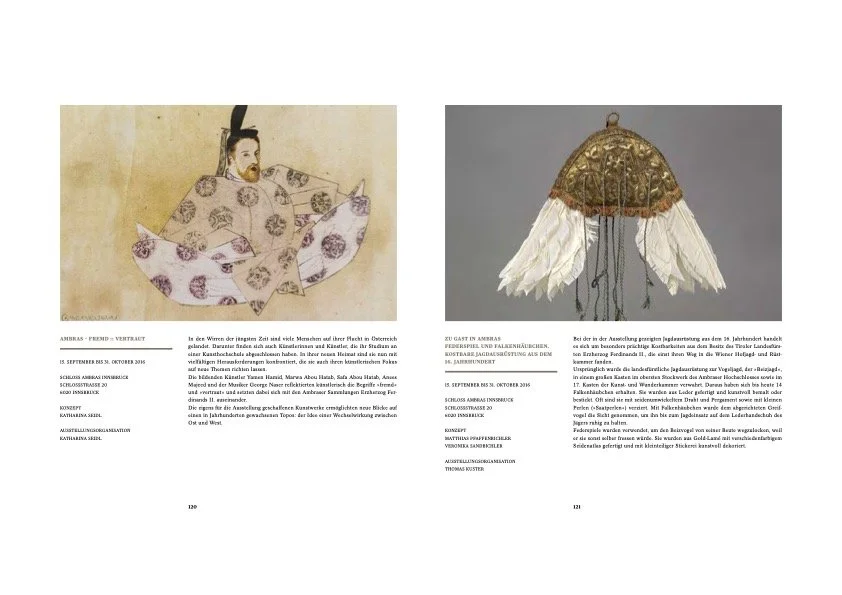
Using mixed media, photography combined with digital drawing, I engaged with the dynamic interactions between the foreign and the familiar, offering a contemporary perspective on centuries-old narratives. Through visual composition and symbolism, the works invite viewers to critically examine their own perceptions of history, identity, and cultural boundaries.
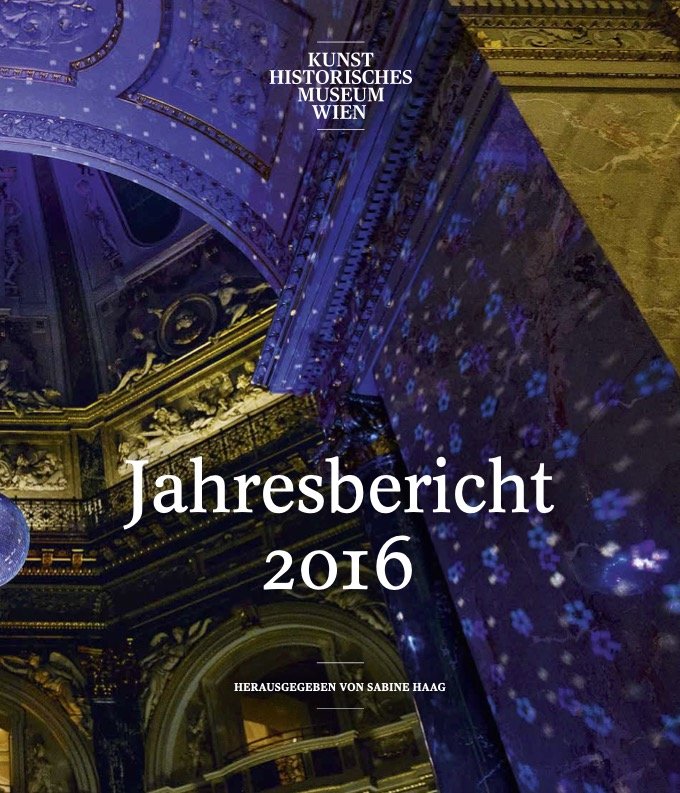
In 2016, my works Ferdinand II., Verfremdung I., and Verfremdung II. were part of a collaboration with Schloss Ambras Innsbruck and curator Katharina Seidl. Inspired by the historical Ambraser collections of Archduke Ferdinand II., these pieces explore the interplay between identity, cultural displacement, and making meaning.
Mixed media: photography combined with digital drawing.
2016, Mixed Media.







About the artwork
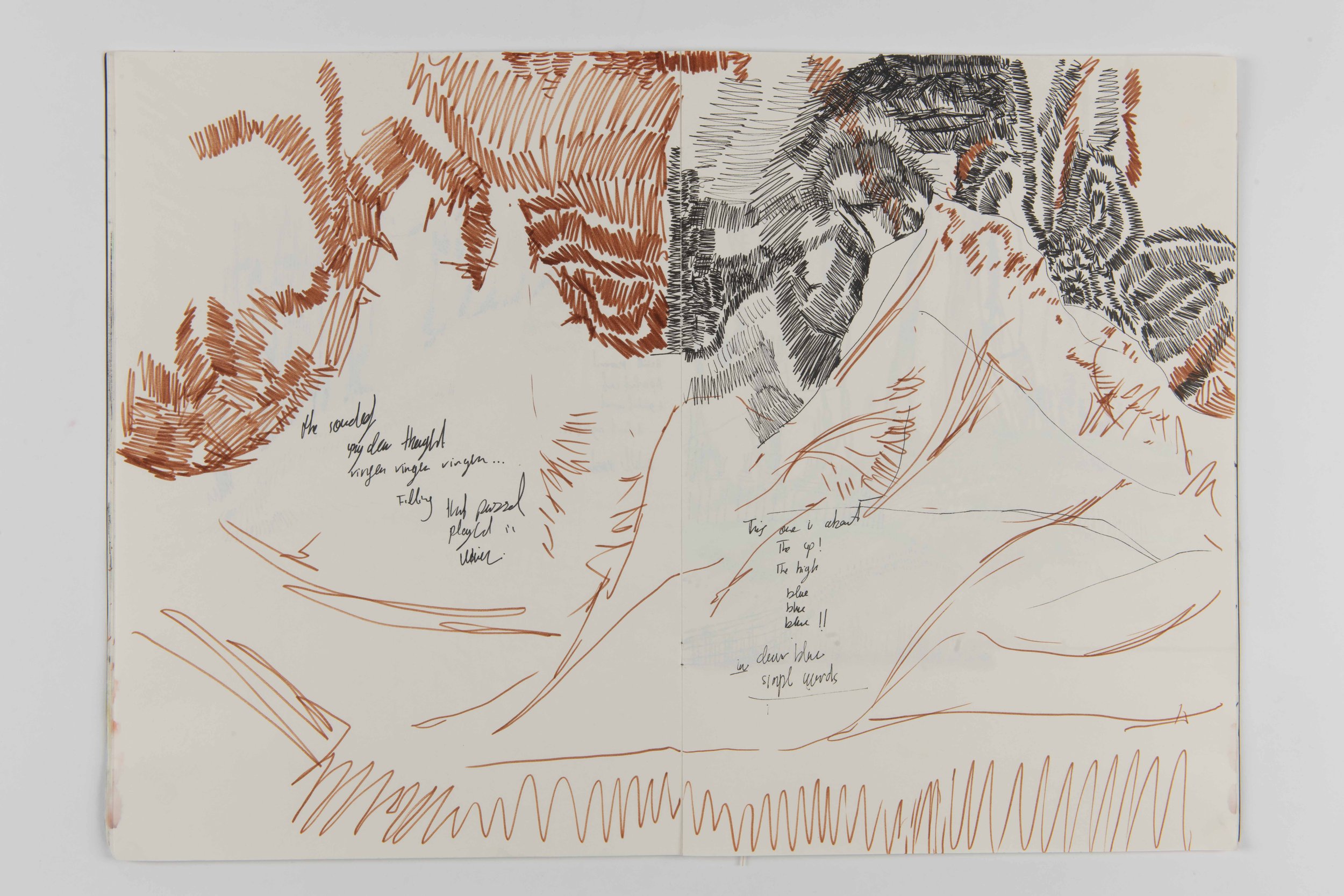
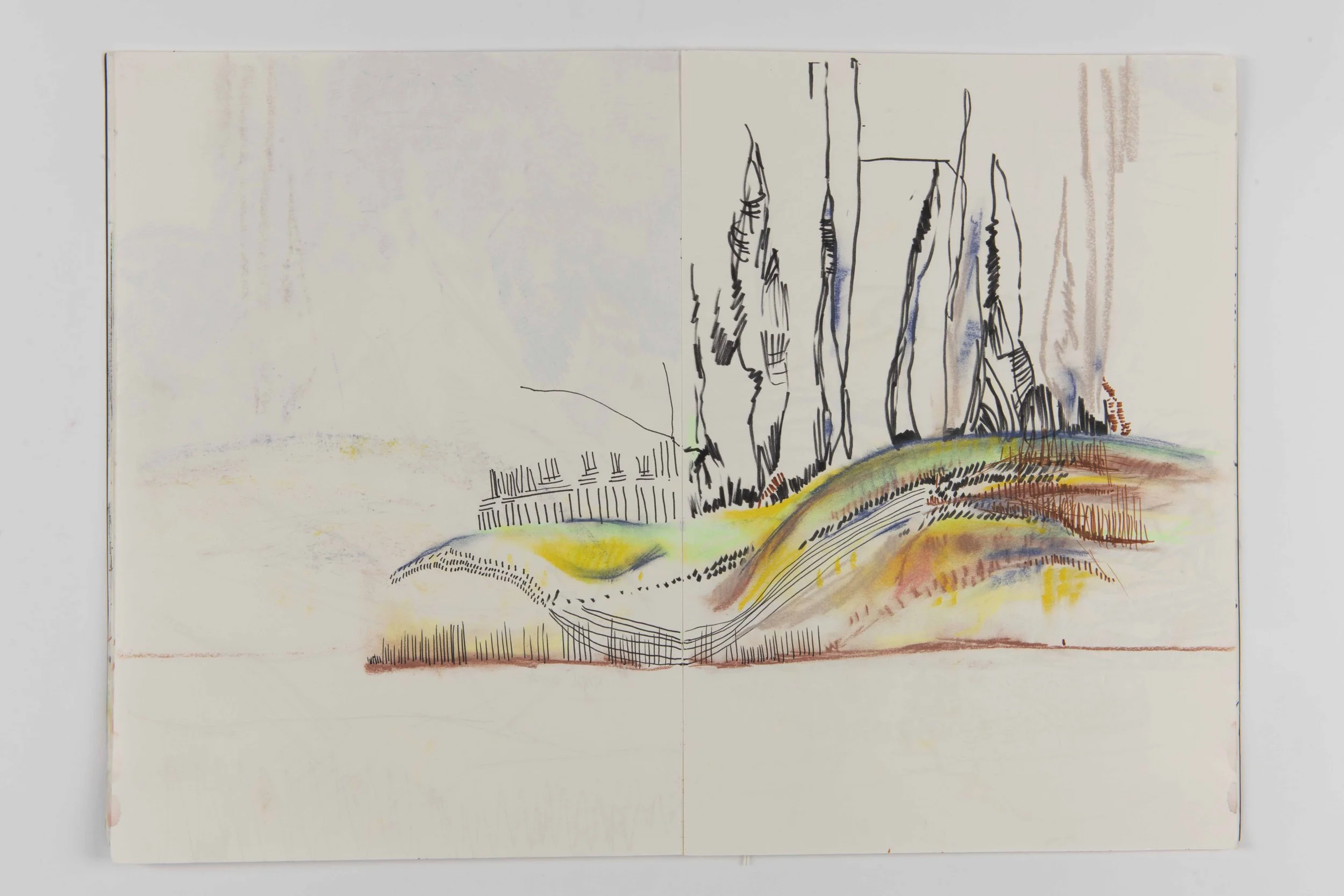
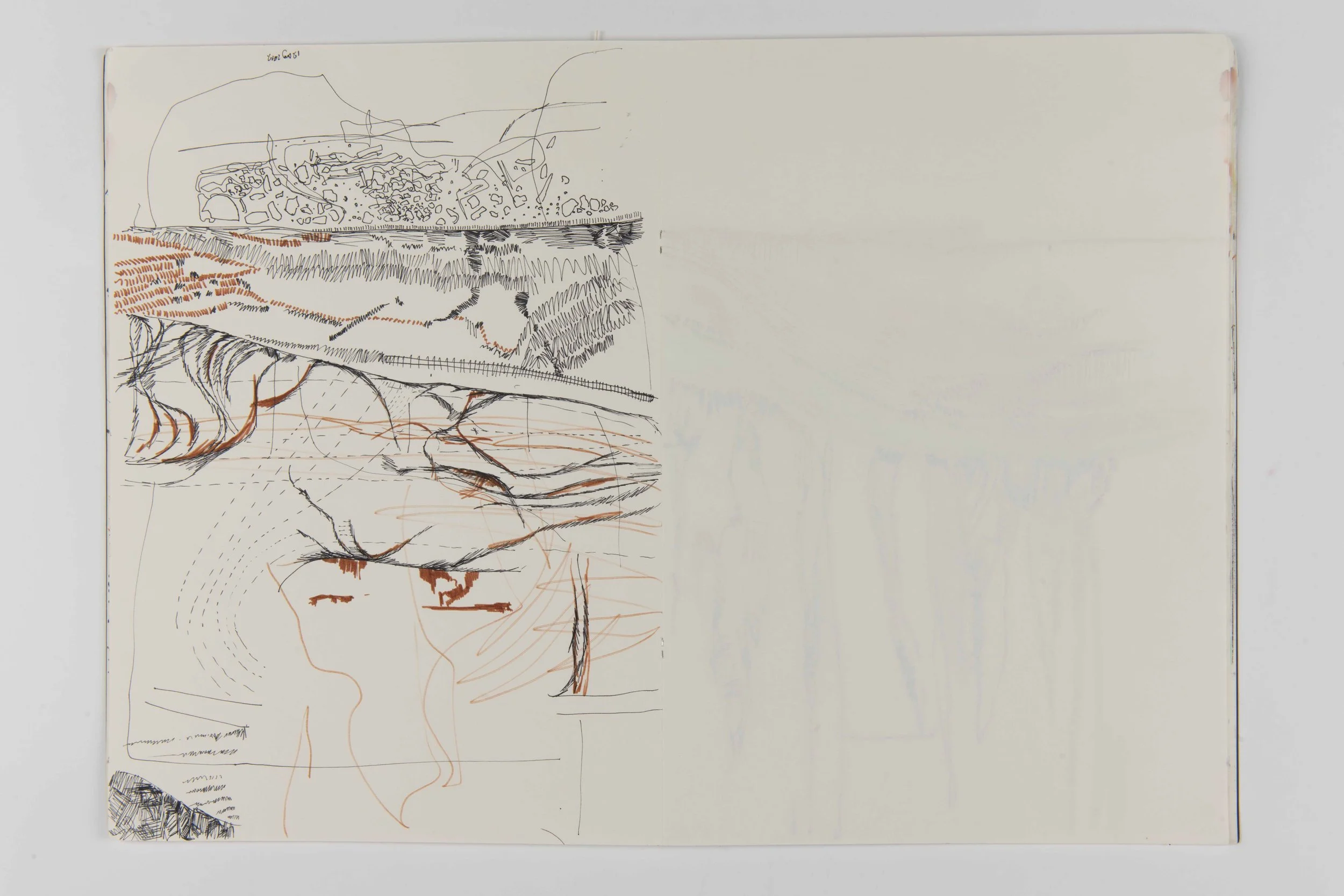
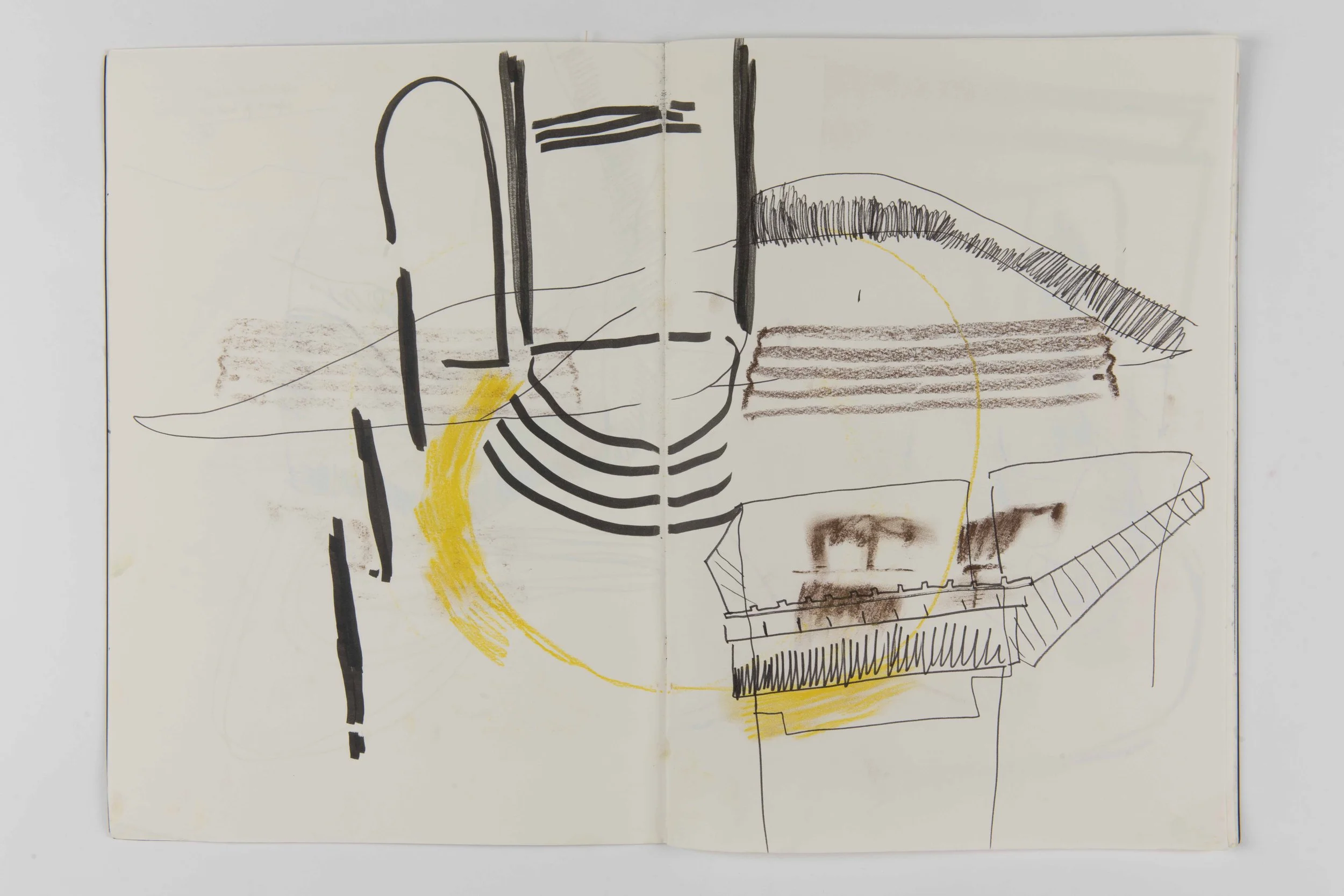
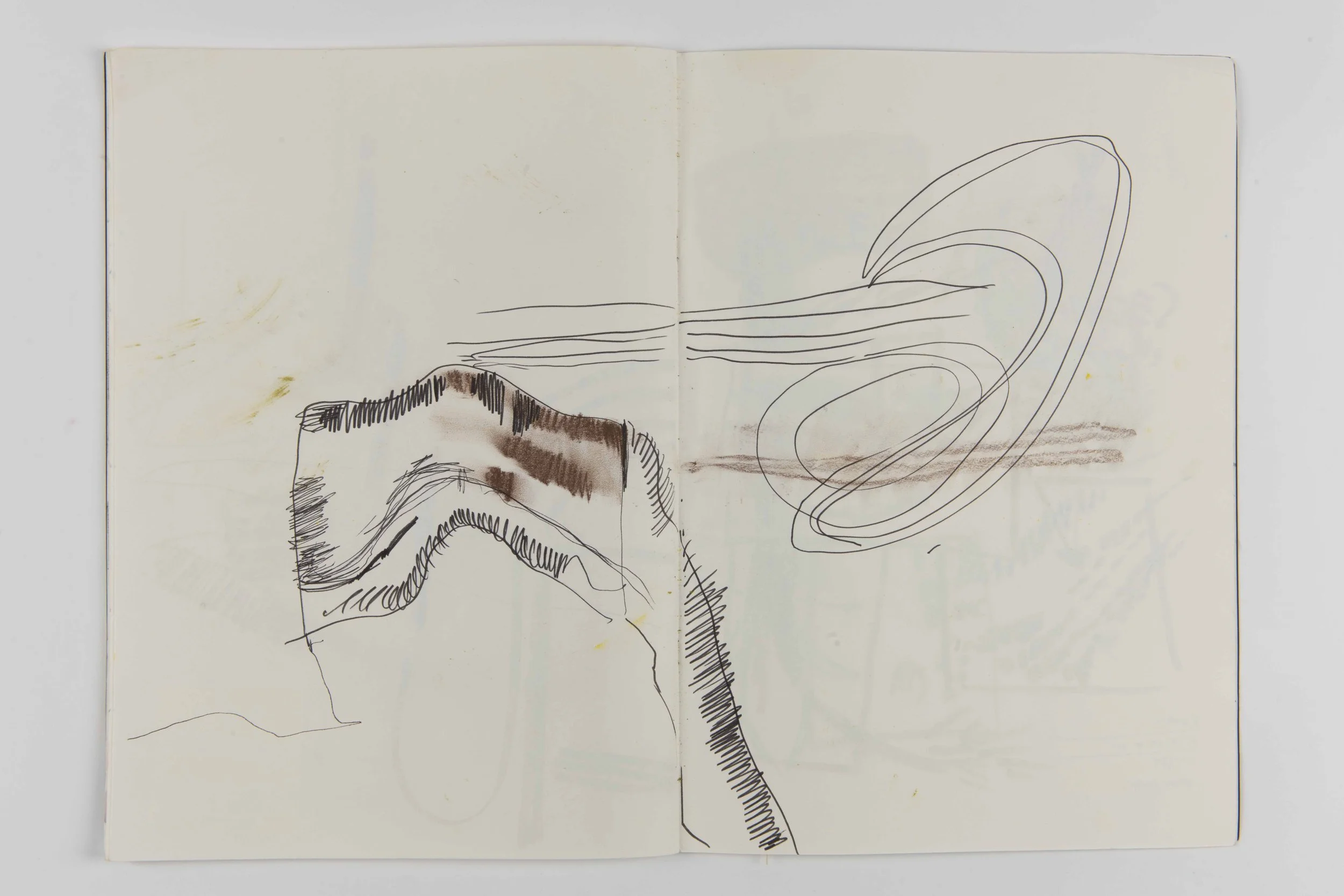
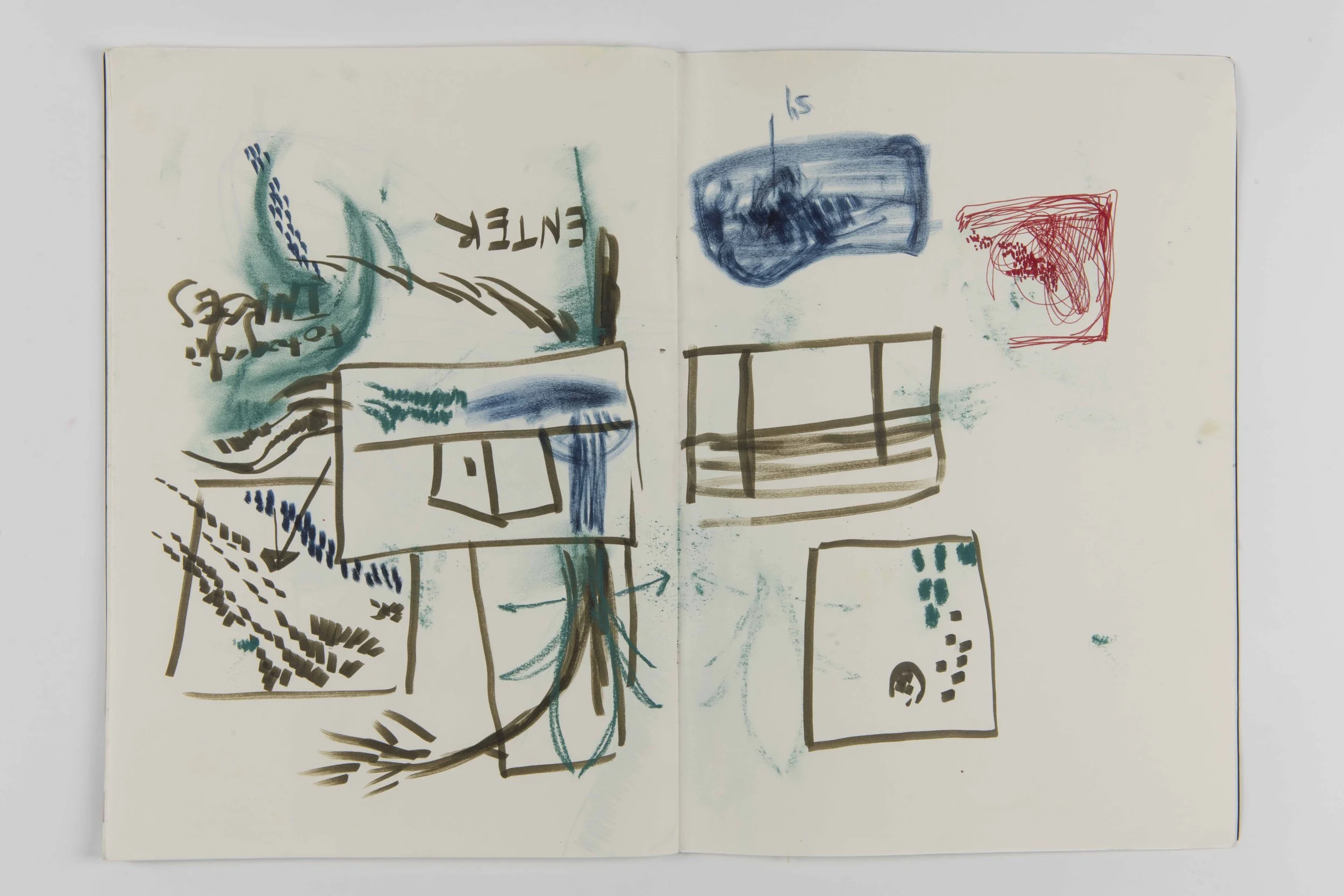
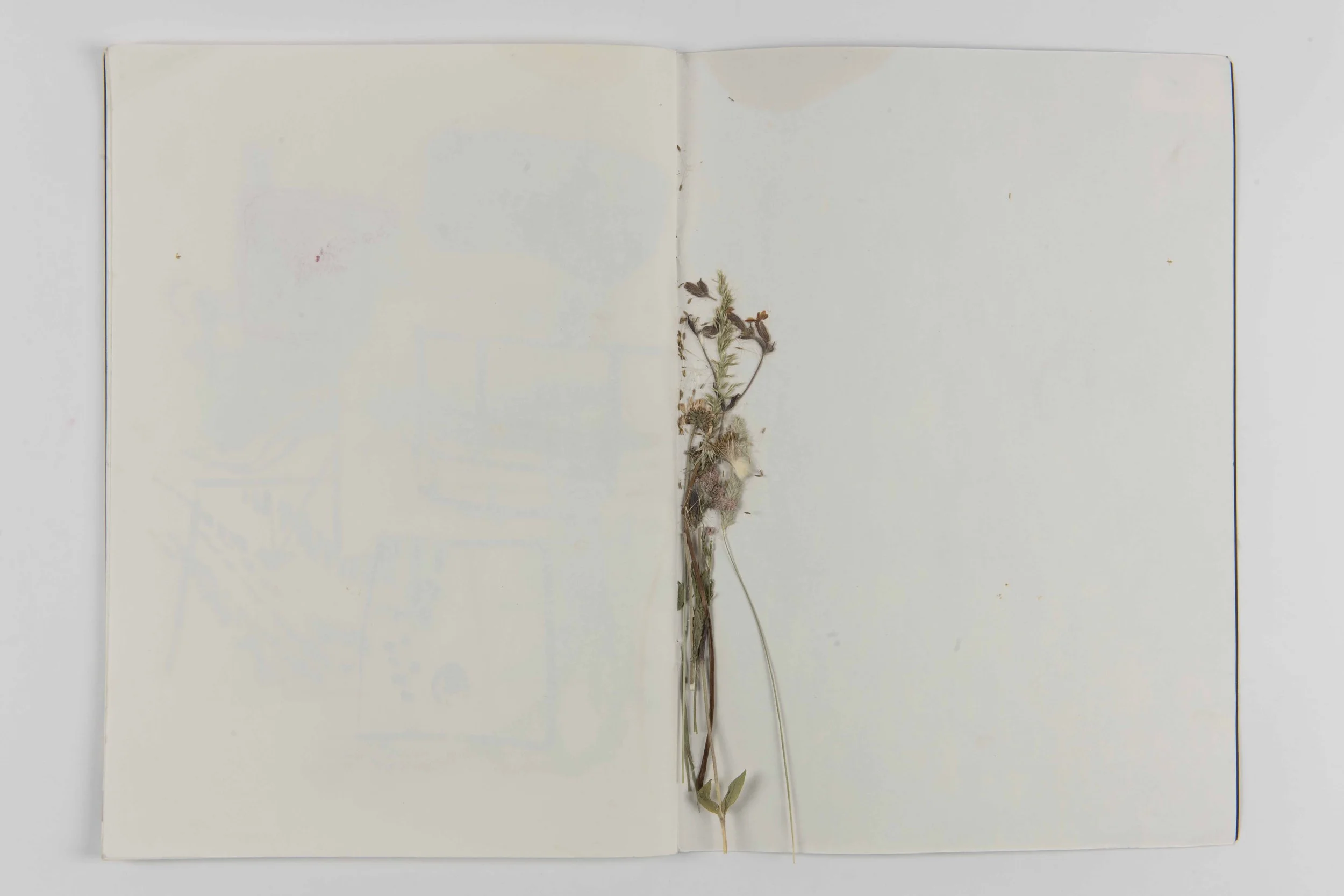
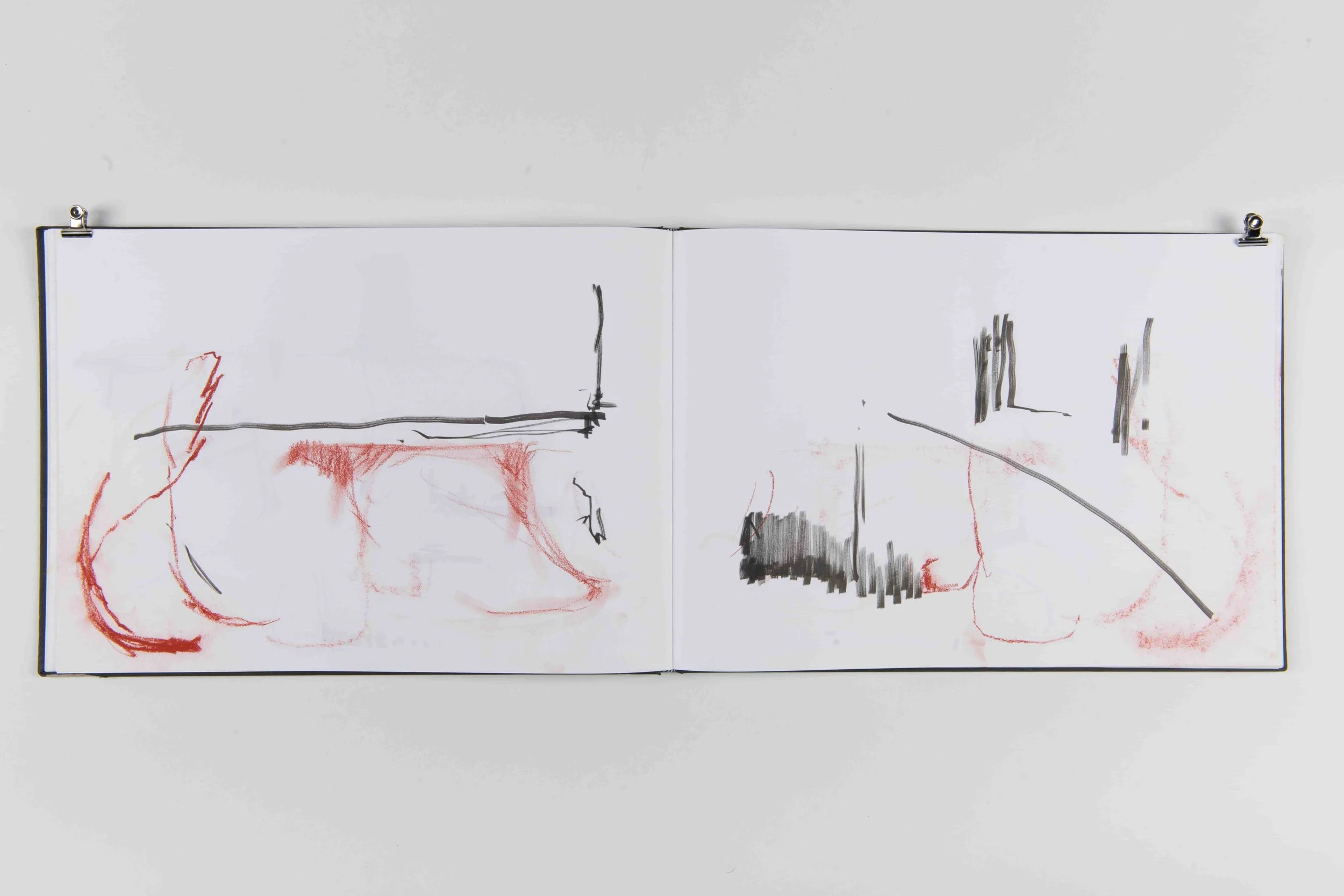
As part of my residency in Vorarlberg, Austira, in the Alps, I worked on this sketchbook while hiking and collecting impressions with colleagues from Klassezeichnen. This sketchbook is part of those experiences—drawings and notes shaped by the landscape and moments shared during our hikes.
During the residency, I wrote a poem, which I later deconstructed and performed as part of my thesis research prologue in 2020.
In the summer of 2018, during the second half of the residency, I had a sunstroke during one of the hikes. This affected my perception and shaped how I drew and wrote; traces of that experience remain in the sketchbook through fragmented lines and thoughts.
For the online presentation, I mixed natural sounds—wind, grass, and trees—drawing on open-access recordings inspired by the nature of Vorarlberg.




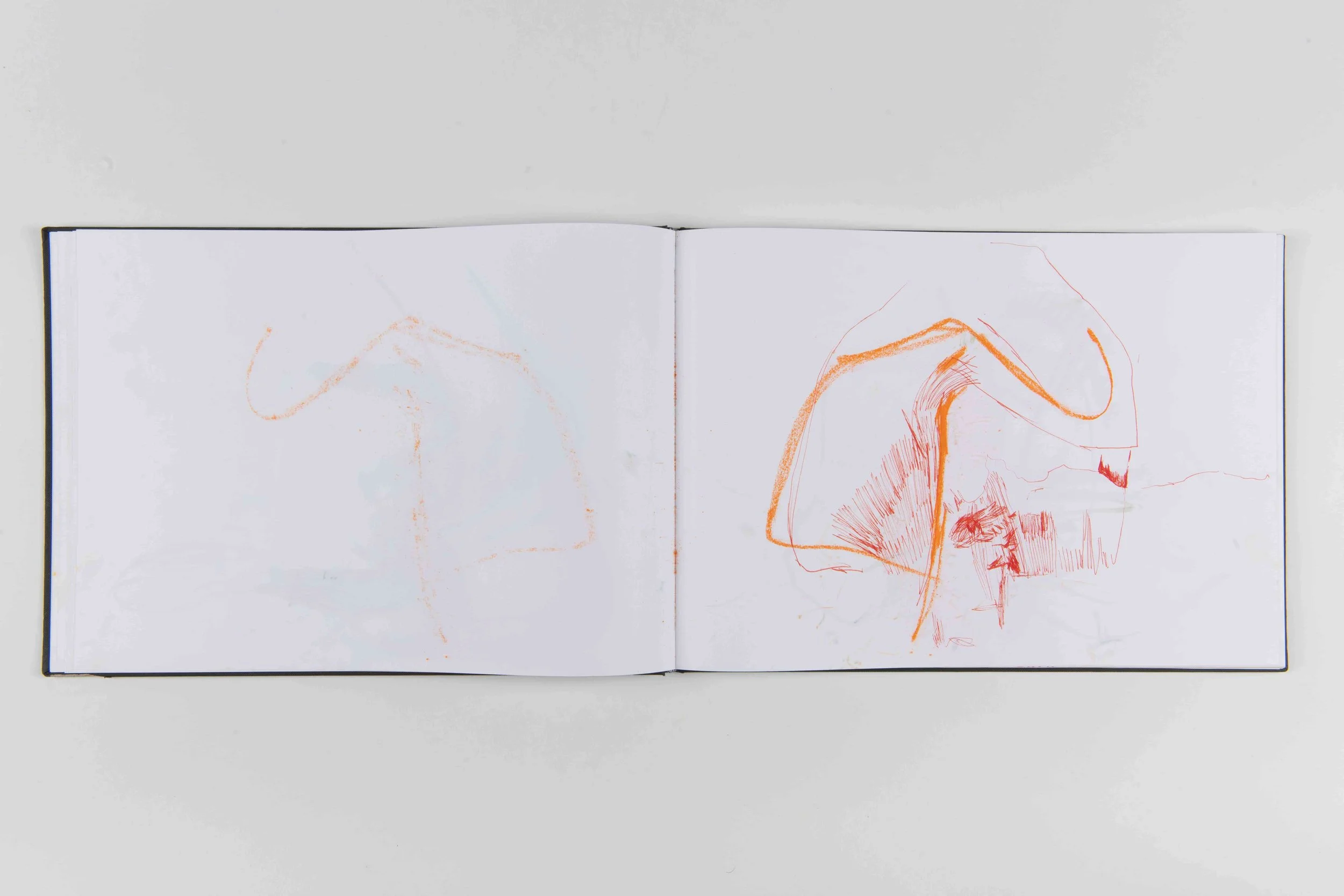
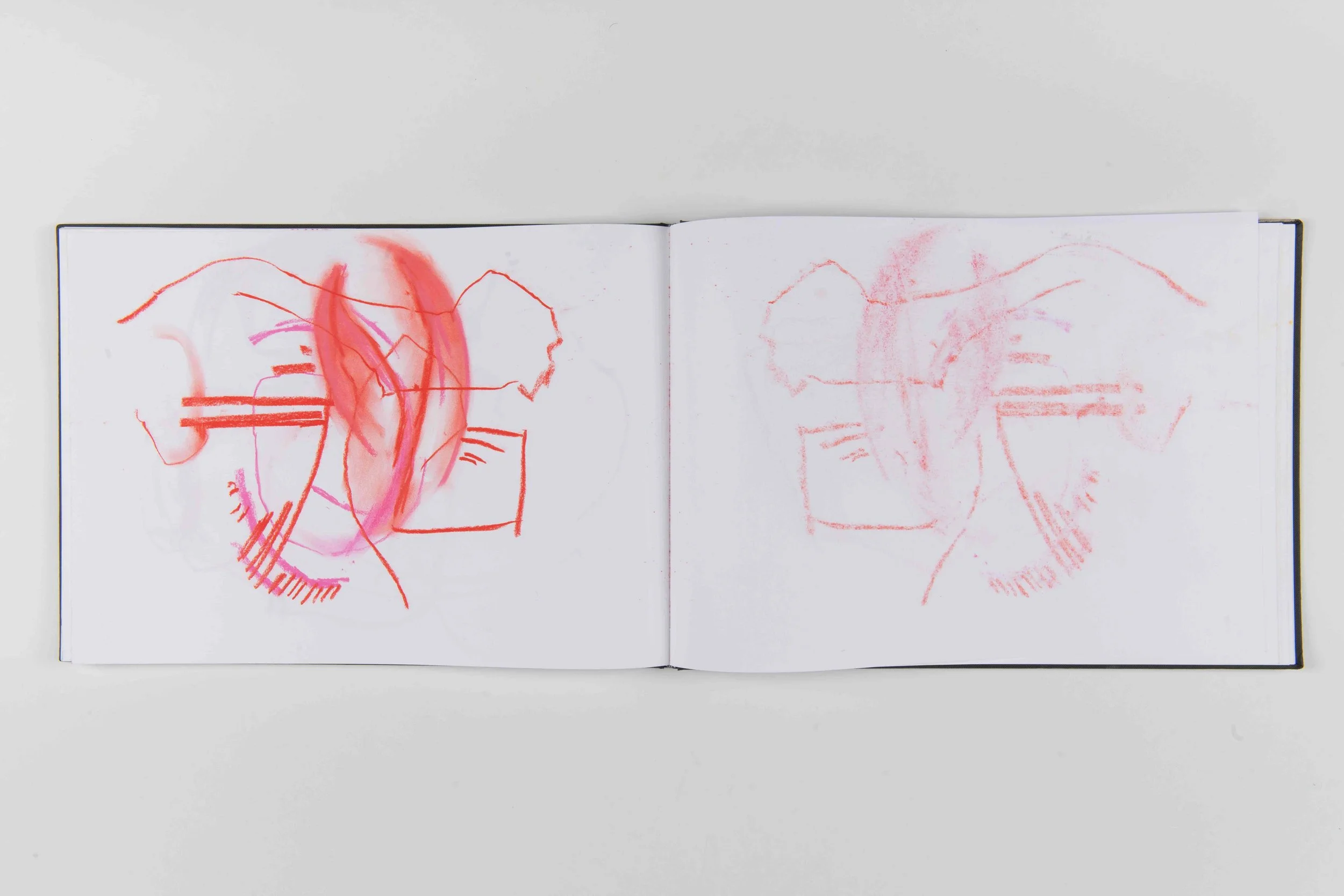
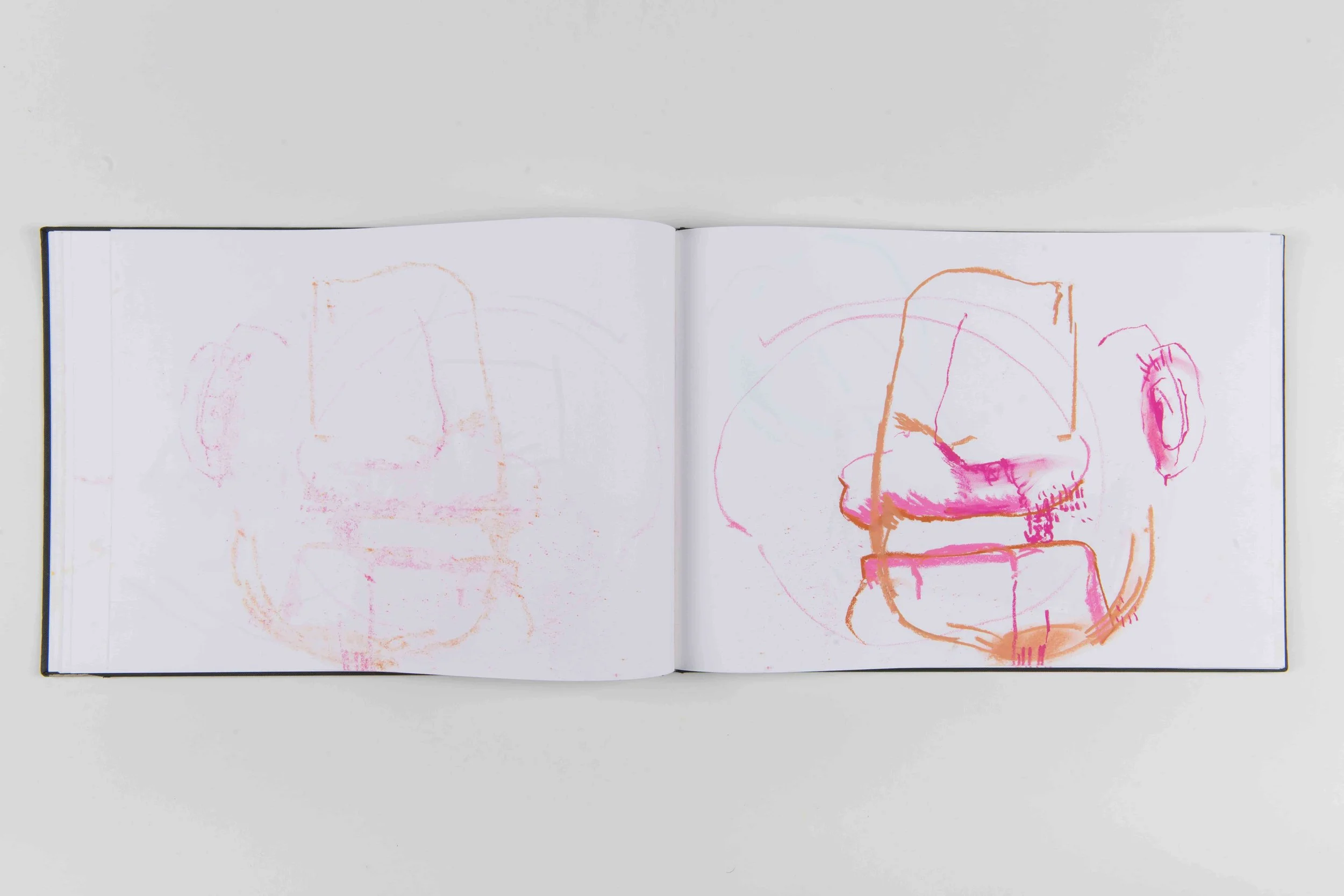


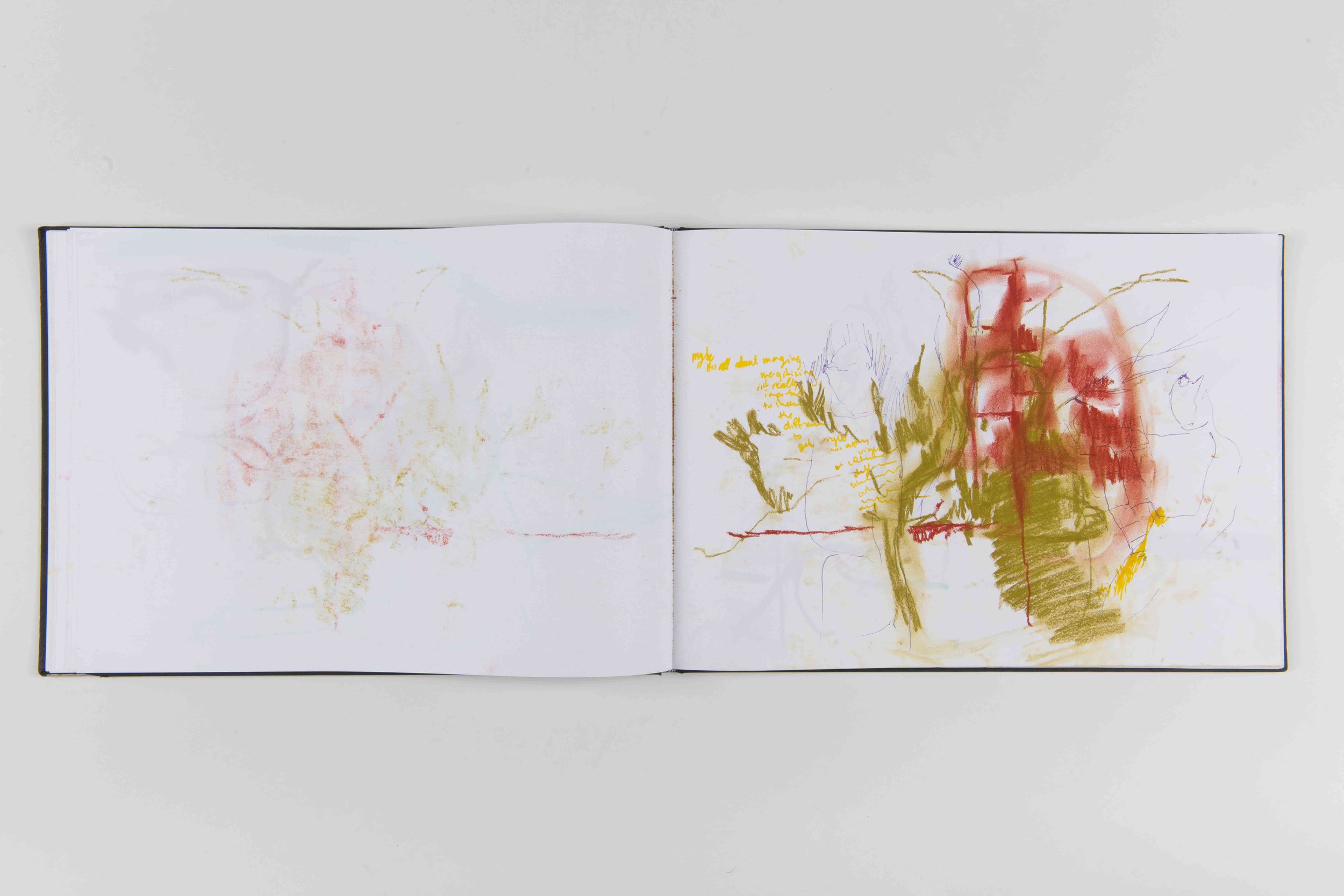
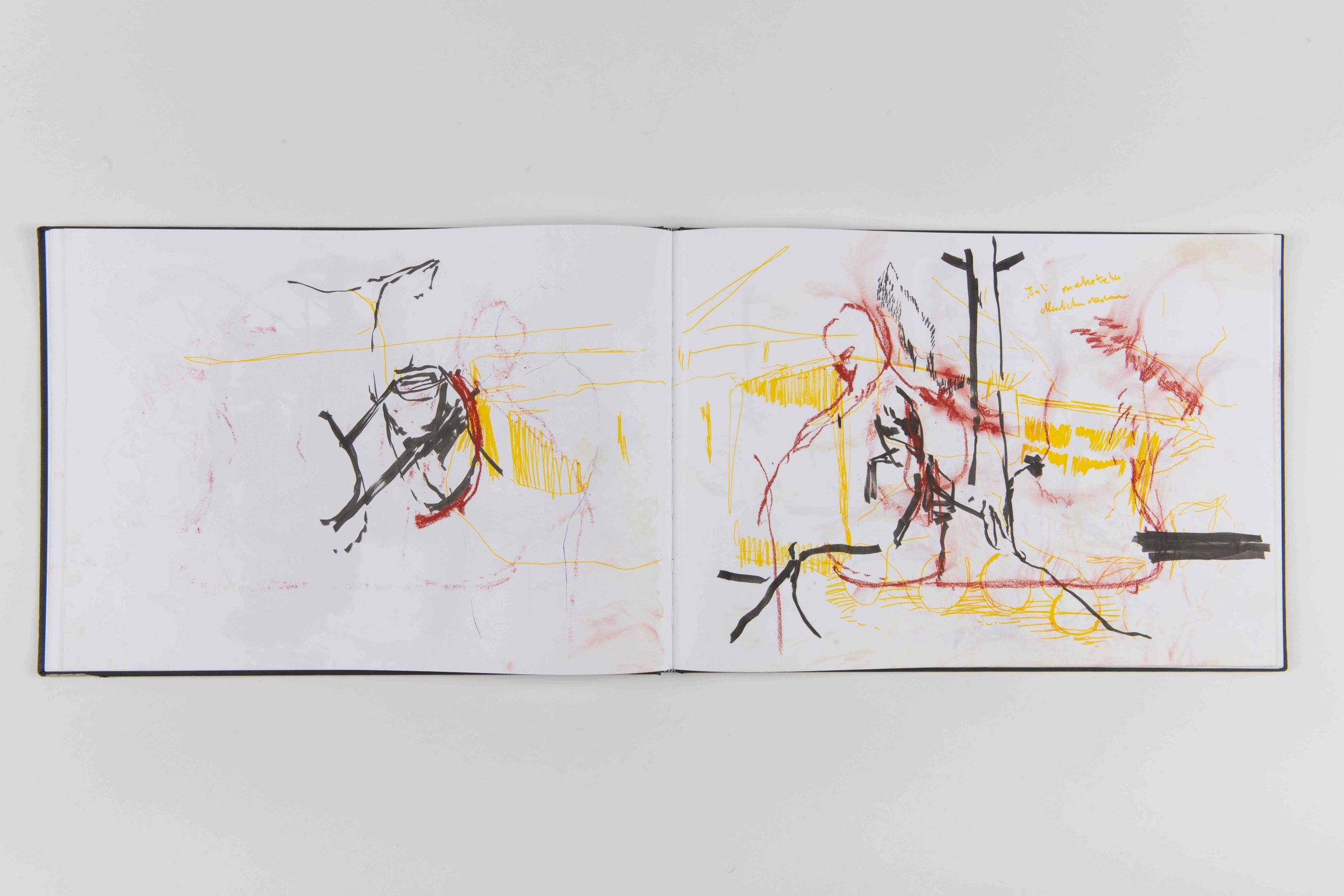




About the artwork
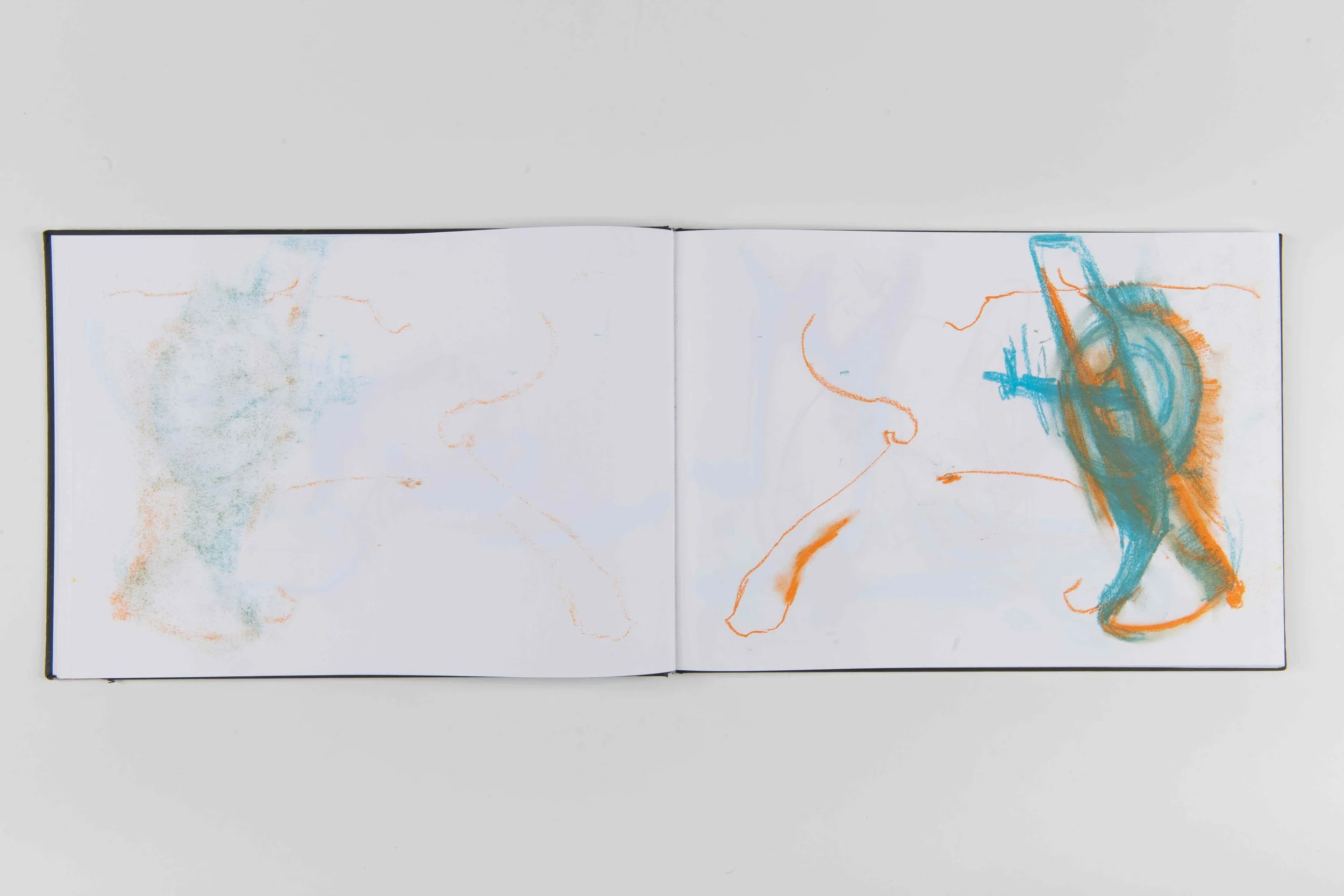
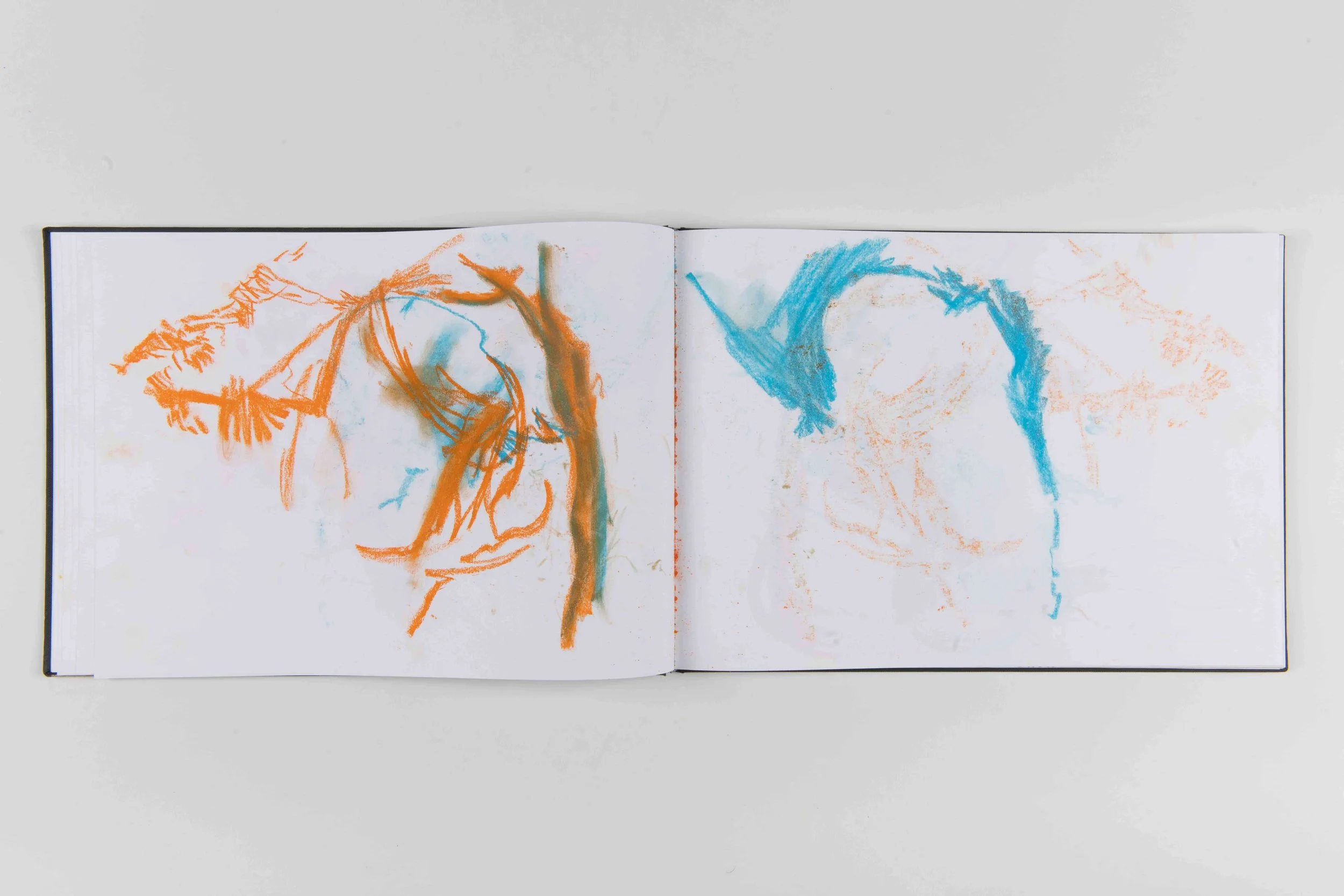
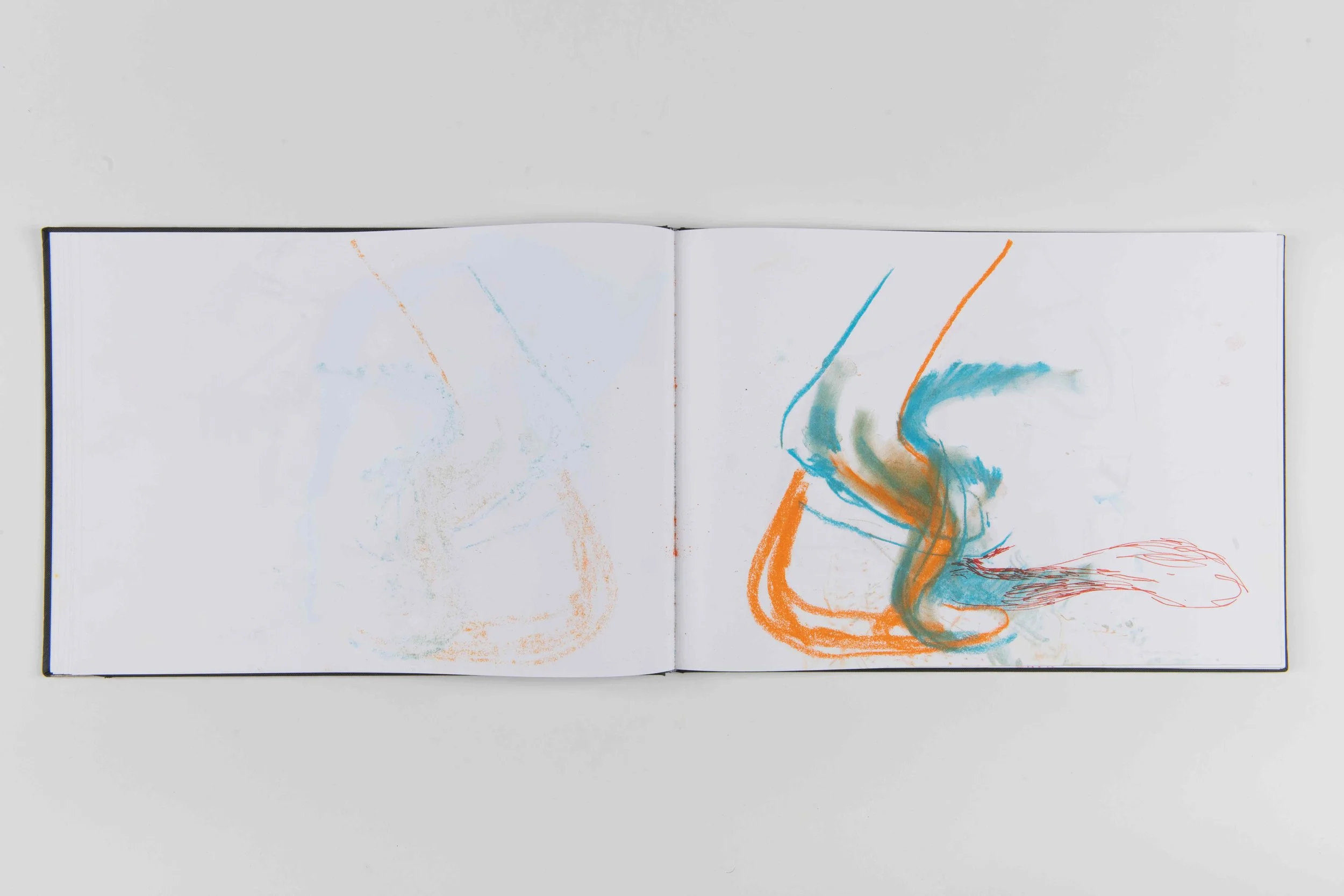
Medium: diverse media including pastel, chalk, pen, ink, and colored accents. Size: various formats, including A3 and A5.
This is a drawing exercise of bodily experience that took place in the Museum Quartier as part of the drawing seminar attended in spring 2018. No photographs of the models were taken for privacy reasons.
About the artwork
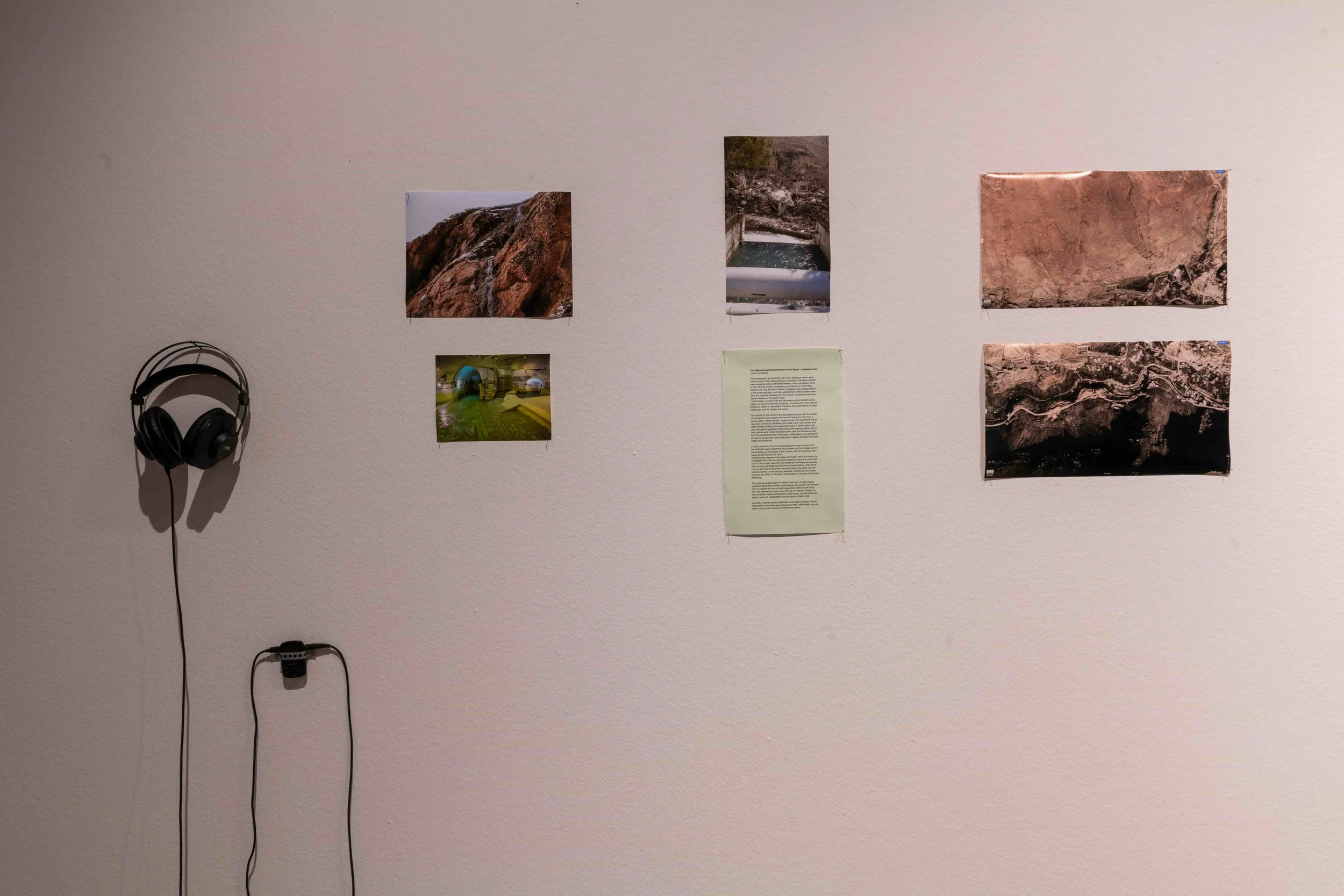
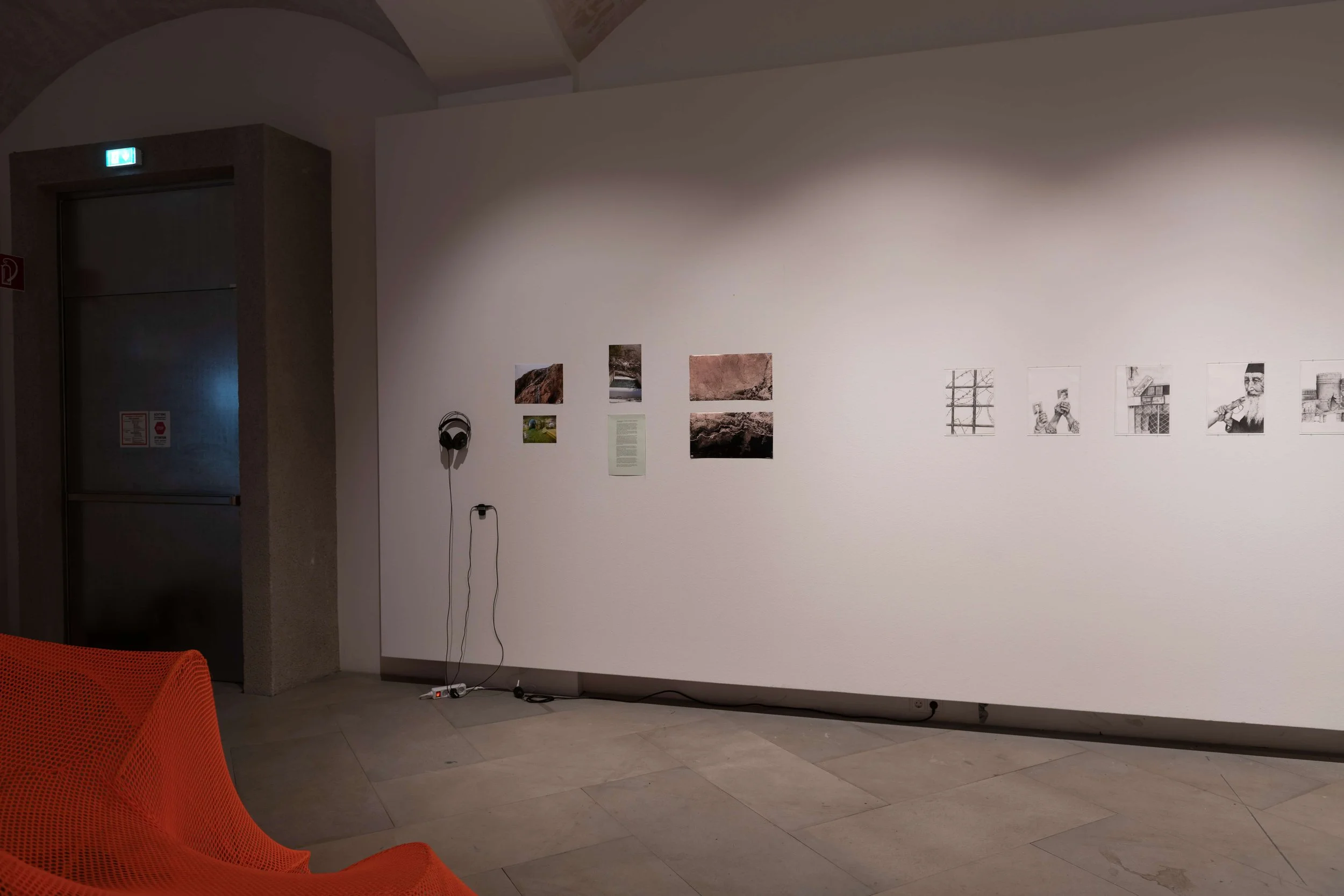
On Perception is a drawing series developed during the pandemic in 2020. It continued my ongoing artistic practice with a deeper focus on body knowledge in relation to the digital realm - specifically, on how performance and cinema are perceived through the two-dimensional screen.
During this period, I was also in conversation with the artists Emilia Lichtenwagner and Janine Muckermann. These exchanges shaped the way I explored perception and presence within digital spaces.
Selected references from film and performance: Shirin Neshat, Roja; Anne Teresa De Keersmaeker, Rosas danst Rosas; Trisha Brown, Leaning Duets (1970); Martha Rosler, Semiotics of the Kitchen; Hito Steyerl, How Not to Be Seen and Being Invisible Can Be Deadly (TateShots); Julian Rosefeldt, In the Land of Drought; Laura Horelli, Morgan Dews, Must Read After My Death; Virginia Woolf, Orlando; and Werner Herzog, Werner Herzog Eats His Shoe.
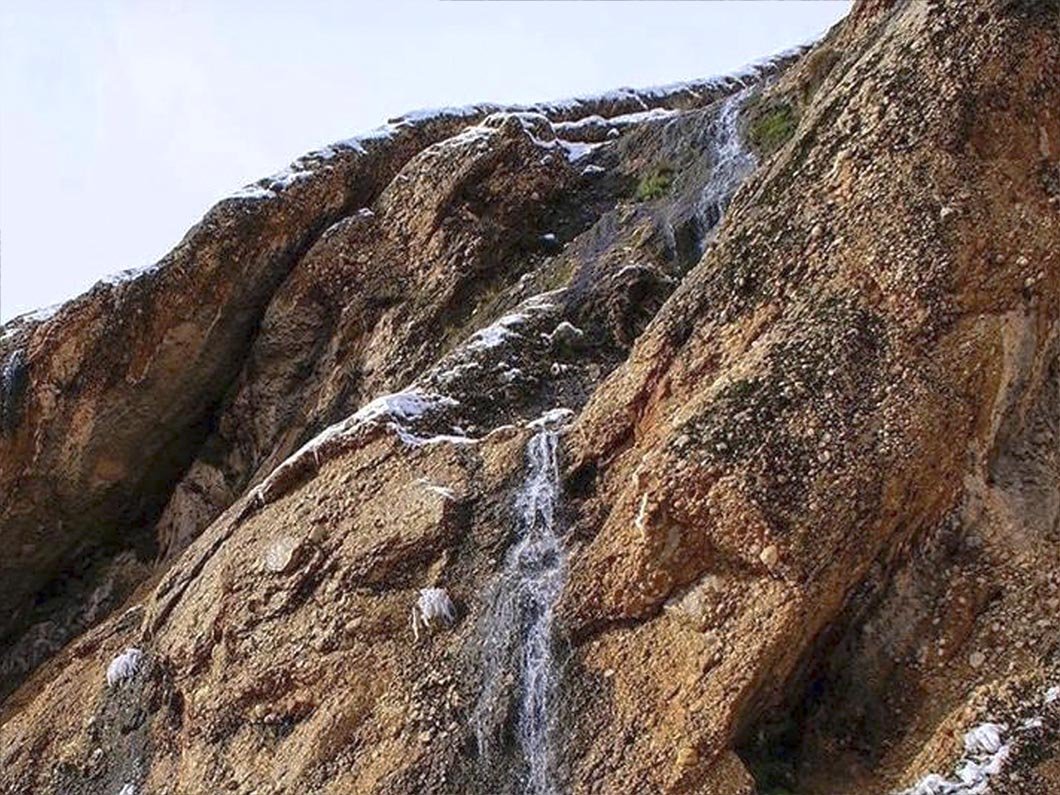
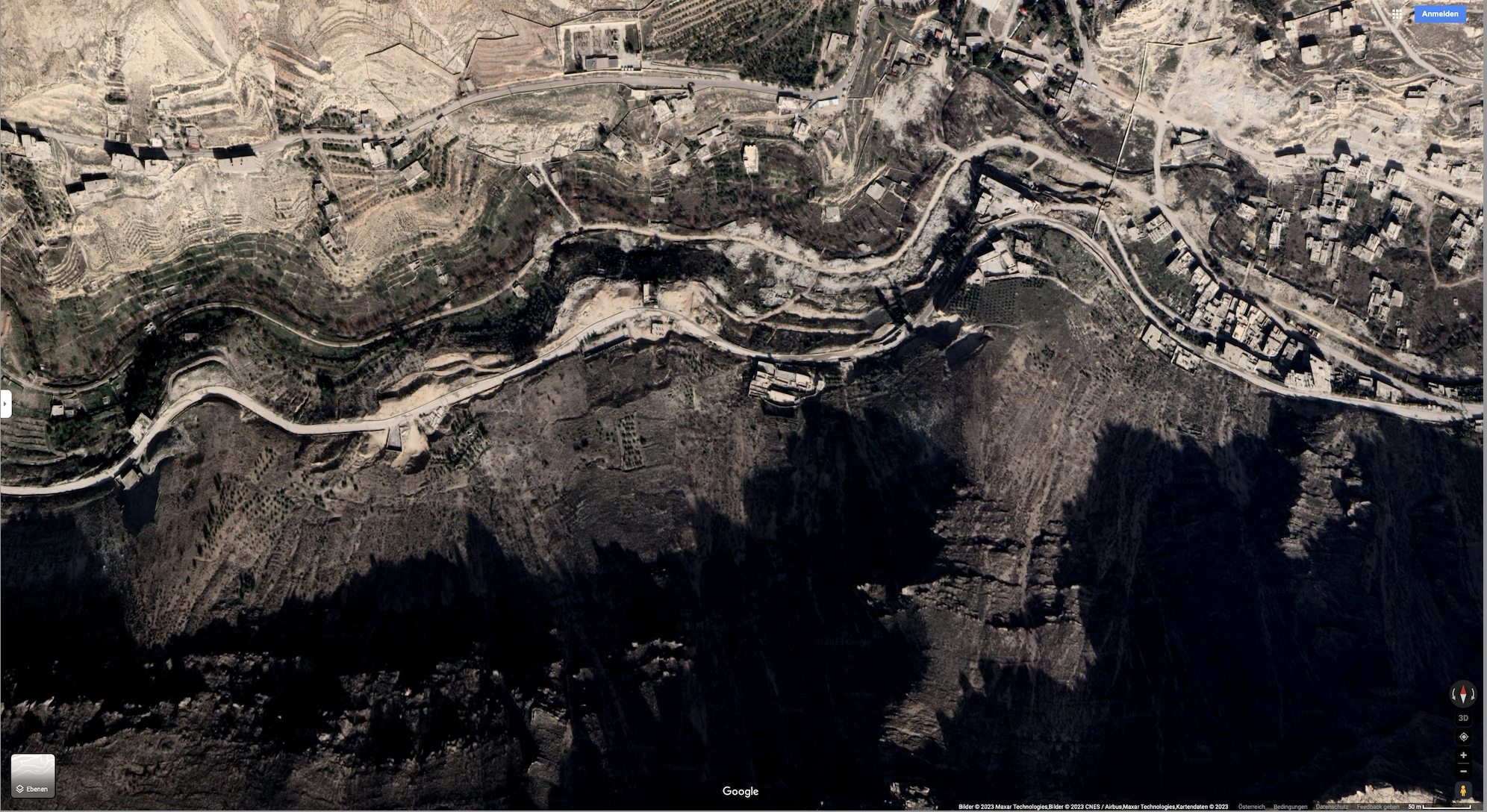
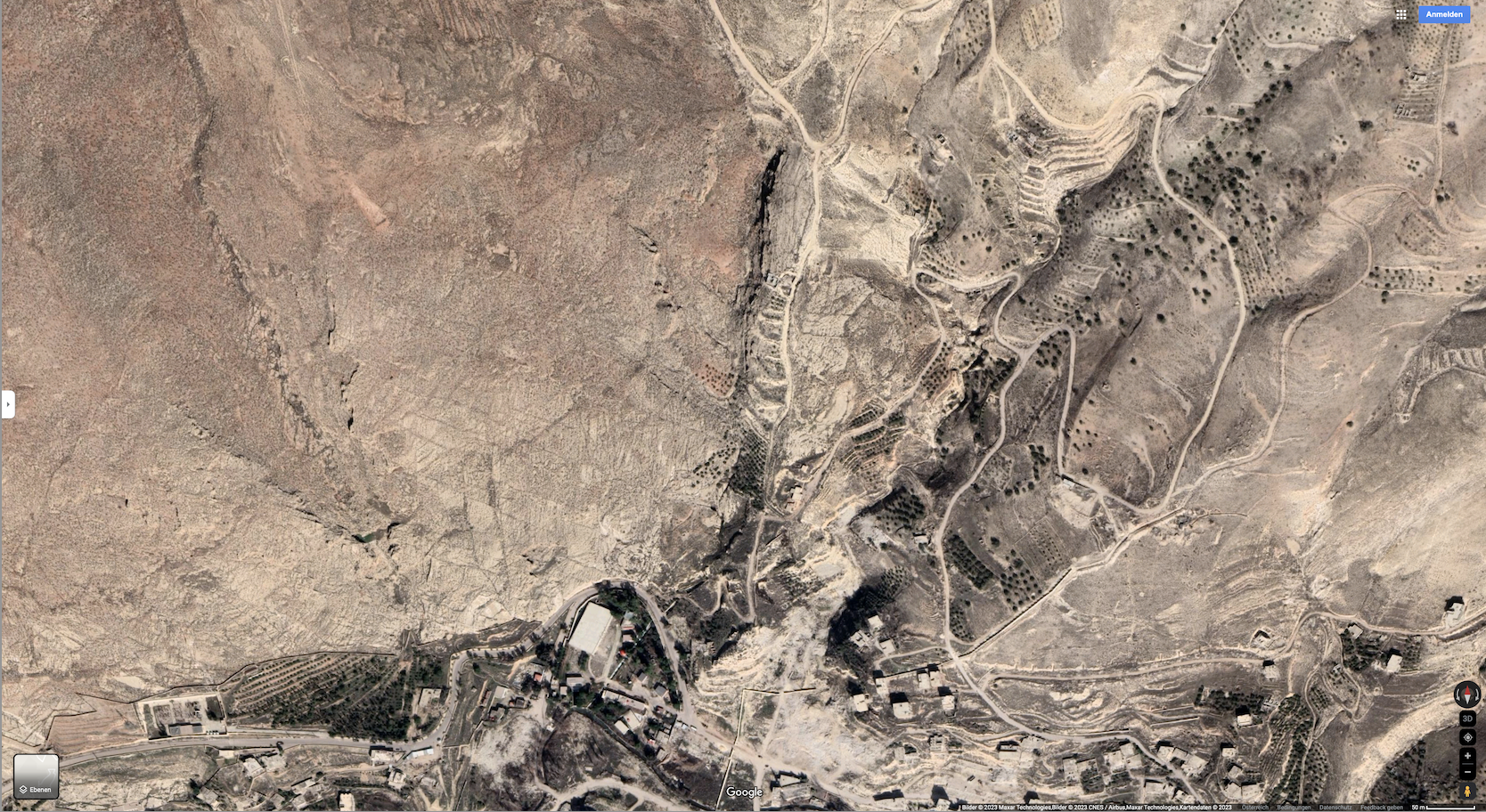
About the artwork
Participation in the group exhibition Ich kann leider auch nicht. LG.
This page now includes the full public image album currently visible on the linked project page.
CV
1990, SY
Member of IG Bildende Kunst – the advocacy association of visual artists in Austria.
Member of the Research Catalogue – international platform for artistic research.
Short Bio
Marwa Abou Hatab is an artist and researcher working across drawing, installation, photography, text, performance, and moving image. She is currently pursuing Ph.D. studies in Philosophy and Diploma studies in Fine Arts in the Drawing Class at the Academy of Fine Arts Vienna. She holds a Master in Critical Studies from the Academy of Fine Arts Vienna and a Bachelor of Arts from the University of Damascus.
Her work explores hybridity, third spaces, identity, memory, language, perception, cultural heritage, and the relationship between personal experience and public history. She has participated in exhibitions including Liminal Kondition at Kunst:werk St. Pölten, Ich sehe, ich sehe, ich sehe, and Ich kann leider auch nicht. LG at the Academy of Fine Arts Vienna, and she has received several grants and awards from the Academy, including a project grant and a recognition award for academic work.
She participated in the Art Mentoring Program of the Academy of Fine Arts Vienna as a mentee of Nela Eggenberger.
Education
Awards & Grants (Selection)
– 01 / 2024
Exhibitions & Artistic Activities (Selection)
Language Skills
Other
– 09 / 2023
1990, SY
Mitglied der IG Bildende Kunst – Interessenvertretung der bildenden Künstler:innen in Österreich.
Mitglied des Research Catalogue – internationale Plattform für künstlerische Forschung.
Kurzbio
Marwa Abou Hatab ist Künstlerin und Forscherin und arbeitet mit Zeichnung, Installation, Fotografie, Text, Performance und Bewegtbild. Derzeit absolviert sie ein Ph.D.-Studium in Philosophie sowie das Diplomstudium Bildende Kunst in der Zeichenklasse an der Akademie der bildenden Künste Wien. Sie hat einen Master in Critical Studies an der Akademie der bildenden Künste Wien und einen Bachelor of Arts der Universität Damaskus.
Ihre Arbeit befasst sich mit Hybridität, dritten Räumen, Identität, Erinnerung, Sprache, Wahrnehmung, kulturellem Erbe und dem Verhältnis zwischen persönlicher Erfahrung und öffentlicher Geschichte. Ihre Arbeiten waren unter anderem in Liminal Kondition im Kunst:werk St. Pölten sowie in Ich sehe, ich sehe, ich sehe und Ich kann leider auch nicht. LG an der Akademie der bildenden Künste Wien zu sehen. Zudem erhielt sie mehrere Förderungen, Stipendien und Auszeichnungen der Akademie, darunter eine Projektförderung und einen Würdigungspreis für wissenschaftliche Arbeiten.
Von 2023 bis 2024 nahm sie am Art Mentoring Program der Akademie der bildenden Künste Wien als Mentee von Nela Eggenberger teil.
Ausbildung
Auszeichnungen & Förderungen (Auswahl)
– 01 / 2024
Ausstellungen & künstlerische Tätigkeiten (Auswahl)
Sprachkenntnisse
Sonstiges
– 09 / 2023
Blog
In solidarity with civilians and children under armed conflict
In solidarity with civilians and children under armed conflict
A message of solidarity with civilians and children living under armed conflict in the Middle East and around the world. Every civilian life matters. Every child deserves safety, dignity, and peace.
For support: UNICEF and child protection partners for children and caregivers; UNHCR and partners for refugees and displaced adults; ICRC / Red Cross / Red Crescent for separated families; and WHO-supported mental health and psychosocial services for people affected by conflict.
Thank you, GC Arbenz, for your care and support in sharing this message.
#Solidarity #Peace #Civilians #Children #Humanity
رسالة تضامن مع المدنيين\ات والأطفال الذين يعيشون تحت وطأة النزاع المسلح في الشرق الأوسط وحول العالم. حياة كل مدني\ة مهمة، وكل طفل\ة تستحق الأمان والكرامة والسلام
للدعم: اليونيسف وشركاء حماية الطفل للأطفال ومقدّمي الرعاية؛ المفوضية السامية لشؤون اللاجئين وشركاؤها للاجئين والبالغين النازحين؛ اللجنة الدولية للصليب الأحمر / الصليب الأحمر / الهلال الأحمر للعائلات المشتتة؛ وخدمات الصحة النفسية والدعم النفسي الاجتماعي المدعومة من منظمة الصحة العالمية للمتأثرين بالنزاع.
شكراً لـ GC Arbenz على الرعاية والدعم في مشاركة هذه الرسالة.
#تضامن #سلام #أطفال #إنسانية
Vedic
Video documentation.
Statements
Artist Statement
I am an artist and researcher working across drawing, photography, text, installation, performance, and moving image. My practice is rooted in hybridity and in forms that move through and beyond fixed oppositions. I am interested in how identities, languages, images, and bodies are shaped in relation to space, memory, institutions, and historical conditions.
Drawing is central to my practice, not only as a medium but as a way of thinking. I work with drawing as a method that allows me to move between image and text, reflection and analysis, embodiment and distance. Rather than reinforcing binaries, I am drawn to in-between states, transitional forms, and third spaces in which categories become unstable and can be rethought.
My work often develops from personal, biographical, and subjective experience, while remaining connected to broader sociopolitical structures. I am interested in how art, education, and institutional frameworks shape what can be seen, said, valued, or remembered. In this sense, I approach artistic practice as a space where perception can shift and where dominant structures can be questioned rather than simply repeated.
I am especially interested in hybrid artistic forms. In my diploma work, I engage a “Zwischen-Kunst” medium, such as photography-drawing, as a method for reflecting on cultural goods, their production of value, and their reception. This interest in hybridity is not only formal; it is also conceptual. I work through spaces where meanings are not fixed, where identities remain relational, and where oppositions can be exceeded through layered, unstable, and shifting forms.
I understand art as a place for inquiry: a place to inhabit complexity, to remain with ambiguity, and to create forms that allow for reflection rather than closure.
Short Statement
I am an artist and researcher working across drawing, photography, text, installation, performance, and moving image. My practice explores hybridity, third spaces, identity, memory, language, perception, and the relationship between personal experience and public history.
Extended Bio
Marwa Abou Hatab is an artist and researcher based in Vienna. Her practice moves between drawing, installation, photography, text, performance, and moving image, and is grounded in questions of identity, memory, perception, language, migration, and historical space. She works with drawing both as a medium and as a method of inquiry, often developing works that move between visual form, critical reflection, and embodied experience.
She is currently pursuing Ph.D. studies in Philosophy at the Institute for Art and Cultural Studies and Diploma studies in Fine Arts in the Drawing Class at the Academy of Fine Arts Vienna. She completed a Master in Critical Studies at the Academy of Fine Arts Vienna and holds a Bachelor of Arts from the University of Damascus. Her education also includes graphic design training in Adobe at the New Horizon Institute in Damascus.
Her work has been shown in group exhibitions including Liminal Kondition at Kunst:werk St. Pölten and Ich kann leider auch nicht. LG at the Academy of Fine Arts Vienna. Earlier activities include the workshop series Drawing is Political at SOHO STUDIOS, Release Big Critical Energy in connection with the MA Critical Studies program, the Rundgang exhibition of the Drawing Class, and the workshop Wissen with Lisl Ponger as part of Wienwoche.
Abou Hatab has received a project grant from the Academy of Fine Arts Vienna, a recognition award for academic work, a student grant from the Vienna Scholarship Office, and the 2nd Year Scholarship of the Academy. From 2023 to 2024, she participated in the Art Mentoring Program of the Academy of Fine Arts Vienna as a mentee of Nela Eggenberger. She is also a member of IG Bildende Kunst and the Research Catalogue.
Confession
this Disposition is ideal for Digital Display.
When printing; the content on the margins bewusst/ unbewusst becomes transparent to the naked eyes.
consciously/ unconsciously
deliberately/undeliberately
willingly/unwillingly
recklessly/ carefully
daringly/ carefully
indecorously/ demurely
pretentiously/ politely
unrefinedely/ courtly
News
“DANCING WITHIN DANCING WITHOUT,” The symposium was held last month. It included a lecture performance on cosmopolitan norms and third spaces in Akbild, with lectures by Sarah Kolb on identities and performance, and Flavia Mazzanti on post-anthropocene.
The performance by Sara Lanner was followed by a keynote address by Ruth Sonderegger, which reflected on Fred Moten’s writings. The event was held at Viktoria, Vienna (Viktoriagasse 5, 1150, Wien) and was curated by Guilherme Mata and Sarah Kolb.
Datenschutz
Privacy & Artistic Rights
This website is a personal artist portfolio by Marwa Abou Hatab. It presents artworks, texts, images, video, documentation, and related artistic material. This website is hosted via Squarespace, and some technical data may be processed in order to display the site securely and correctly. Squarespace also provides privacy-policy guidance and cookie-banner options for site owners.
Controller
Marwa Abou Hatab
Email: marwa.a.hatab@gmail.com
When you visit this website, technically necessary information may be processed to make the site function properly, such as IP address, browser or device information, date and time of access, and requested pages. This processing is limited to what is necessary for the operation, security, and delivery of the website.
If you contact me by email, the data you send, such as your name, email address, and message content, will only be used to respond to your inquiry and communicate with you.
This website may contain embedded content from third parties, especially Vimeo videos. When such content is loaded, Vimeo may process technical data and may use cookies or similar technologies. Vimeo states that even when the DNT parameter is enabled, it prevents new cookies during that viewing session but does not stop your browser from sending cookies already stored from previous Vimeo visits.
This website may also contain external links, for example to Instagram, Research Catalogue, or other third-party websites. Once you leave this website, the privacy practices of those external services are governed by their own policies.
Under applicable data-protection law, you may have rights including the right to information, access, rectification, erasure, restriction of processing, data portability, objection, and the right to lodge a complaint with the competent supervisory authority. In Austria, these rights are described by the Austrian Data Protection Authority.
Copyright / Artistic Rights
All artworks, photographs, videos, texts, artistic writings, documentation, and other content published on this website are protected by copyright unless stated otherwise. Under Austrian copyright law, original literary and artistic works are protected, and works of photography are expressly included among works of art.
Unless otherwise indicated, all rights to the artistic works and texts presented on this website belong to Marwa Abou Hatab. No image, artwork, text, video, installation documentation, performance documentation, or other portfolio material may be reproduced, copied, published, distributed, modified, archived, or otherwise reused without prior written permission, except where use is permitted by mandatory law. This applies in particular to the reuse of artworks, detail images, installation views, project texts, artistic statements, and written reflections.
The presentation of work on this website does not grant any license for commercial, editorial, curatorial, academic, promotional, or digital reuse. Requests regarding publication, reproduction, citation beyond normal quotation rights, exhibition material, or image permissions should be sent by email to: marwa.a.hatab@gmail.com
This text may be updated where necessary to reflect changes in the website, embedded services, or legal requirements. Squarespace recommends updating privacy texts when site functions or data practices change.
Datenschutz & Künstlerische Rechte
Diese Website ist ein persönliches künstlerisches Portfolio von Marwa Abou Hatab. Sie dient der Präsentation von Arbeiten, Texten, Bildern, Videos, Dokumentationen und weiteren künstlerischen Materialien. Die Website wird über Squarespace gehostet. Dabei können technisch notwendige Daten verarbeitet werden, damit die Website sicher, stabil und korrekt angezeigt werden kann. Squarespace weist außerdem darauf hin, dass je nach eingesetzten Funktionen auch Cookies und ähnliche Technologien verwendet werden können.
Verantwortliche
Marwa Abou Hatab
E-Mail: marwa.a.hatab@gmail.com
Beim Besuch dieser Website können technisch notwendige Informationen verarbeitet werden, etwa IP-Adresse, Datum und Uhrzeit des Zugriffs, Browser- und Geräteinformationen sowie aufgerufene Seiten. Diese Verarbeitung erfolgt ausschließlich, soweit sie für die Bereitstellung, Sicherheit und Funktion der Website erforderlich ist. Squarespace nennt in seinen Mustertexten insbesondere Browser-, Netzwerk- und Geräteinformationen, IP-Adresse sowie Nutzungsdaten wie Klicks, besuchte Seiten und Zeitstempel als typische Website-Daten.
Wenn Sie mich per E-Mail kontaktieren, werden die von Ihnen übermittelten Daten, insbesondere Name, E-Mail-Adresse und Inhalt Ihrer Nachricht, ausschließlich zur Bearbeitung Ihrer Anfrage und zur Kommunikation mit Ihnen verwendet. Nach der DSGVO haben betroffene Personen unter anderem Rechte auf Berichtigung, Löschung und weitere Ansprüche gegenüber Verantwortlichen.
Diese Website kann eingebettete Inhalte Dritter enthalten, insbesondere Videos über Vimeo. Beim Laden solcher Inhalte kann Vimeo technische Daten verarbeiten und Cookies oder ähnliche Technologien einsetzen. Vimeo weist ausdrücklich darauf hin, dass der DNT-Parameter zwar das Setzen neuer Cookies während einer Sitzung begrenzen kann, bereits vorhandene Vimeo-Cookies jedoch weiterhin vom Browser mitgesendet werden können. Vimeo nennt außerdem mehrere Cookies, die beim eingebetteten Player verwendet werden können.
Diese Website kann externe Links enthalten, zum Beispiel zu Instagram, Research Catalogue oder anderen Plattformen. Beim Anklicken solcher Links verlassen Sie diese Website. Für Inhalte, Datenschutzpraktiken und technische Prozesse externer Websites gelten deren eigene Bestimmungen. Squarespace weist ebenfalls darauf hin, dass Drittanbieter-Tools eigene Cookies und Datenverarbeitungen mit sich bringen können.
Nach geltendem Datenschutzrecht haben Sie insbesondere das Recht auf Auskunft, Berichtigung, Löschung, Einschränkung der Verarbeitung, Datenübertragbarkeit, Widerspruch sowie auf Beschwerde bei der zuständigen Aufsichtsbehörde. In Österreich ist dies die Datenschutzbehörde. Die österreichische Datenschutzbehörde beschreibt diese Rechte ausdrücklich für betroffene Personen.
Urheberrecht / Künstlerische Rechte
Alle auf dieser Website veröffentlichten Werke, Texte, Fotografien, Zeichnungen, Videoarbeiten, Installationsansichten, Dokumentationen, künstlerischen Beschreibungen und sonstigen Inhalte sind urheberrechtlich geschützt, sofern nicht anders angegeben. Nach dem österreichischen Urheberrecht sind originale geistige Schöpfungen in Literatur, Kunst und Film geschützt; zu den Werken der Kunst zählen ausdrücklich auch fotografische Werke.
Soweit nicht anders vermerkt, liegen die Rechte an den auf dieser Website gezeigten künstlerischen Arbeiten und Texten bei Marwa Abou Hatab. Jede Vervielfältigung, Veröffentlichung, Bearbeitung, Verbreitung, Archivierung, Speicherung oder sonstige Weiterverwendung von Bildern, Werkabbildungen, Texten, Videoarbeiten, Performancedokumentationen oder künstlerischen Schreibweisen ist ohne vorherige schriftliche Zustimmung nicht gestattet, soweit dies nicht gesetzlich ausdrücklich erlaubt ist. Das gilt insbesondere für die Übernahme in Publikationen, Ausstellungen, Datenbanken, Archive, Social Media, digitale Plattformen oder KI-bezogene Nutzungen. Das österreichische Urheberrecht sieht Schutz für das Werk als Ganzes und seine Teile vor.
Die Veröffentlichung von Arbeiten auf dieser Website bedeutet keine Einräumung von Nutzungsrechten. Anfragen zu Abdruck, Reproduktion, Zitierung über das gesetzlich zulässige Maß hinaus, Bildrechten, Dokumentationen oder sonstigen Verwendungen richten Sie bitte an: marwa.a.hatab@gmail.com. Nach dem österreichischen Urheberrecht bestehen unter anderem Rechte der Vervielfältigung, Verbreitung, Ausstellung und weitere Verwertungsrechte.
Diese Hinweise können angepasst werden, wenn sich rechtliche Anforderungen, technische Funktionen der Website oder eingebettete Dienste ändern. Squarespace empfiehlt ebenfalls, Datenschutztexte zu aktualisieren, wenn sich Funktionen oder Datennutzungen einer Website ändern.
Contact
Email: marwa.a.hatab@gmail.com